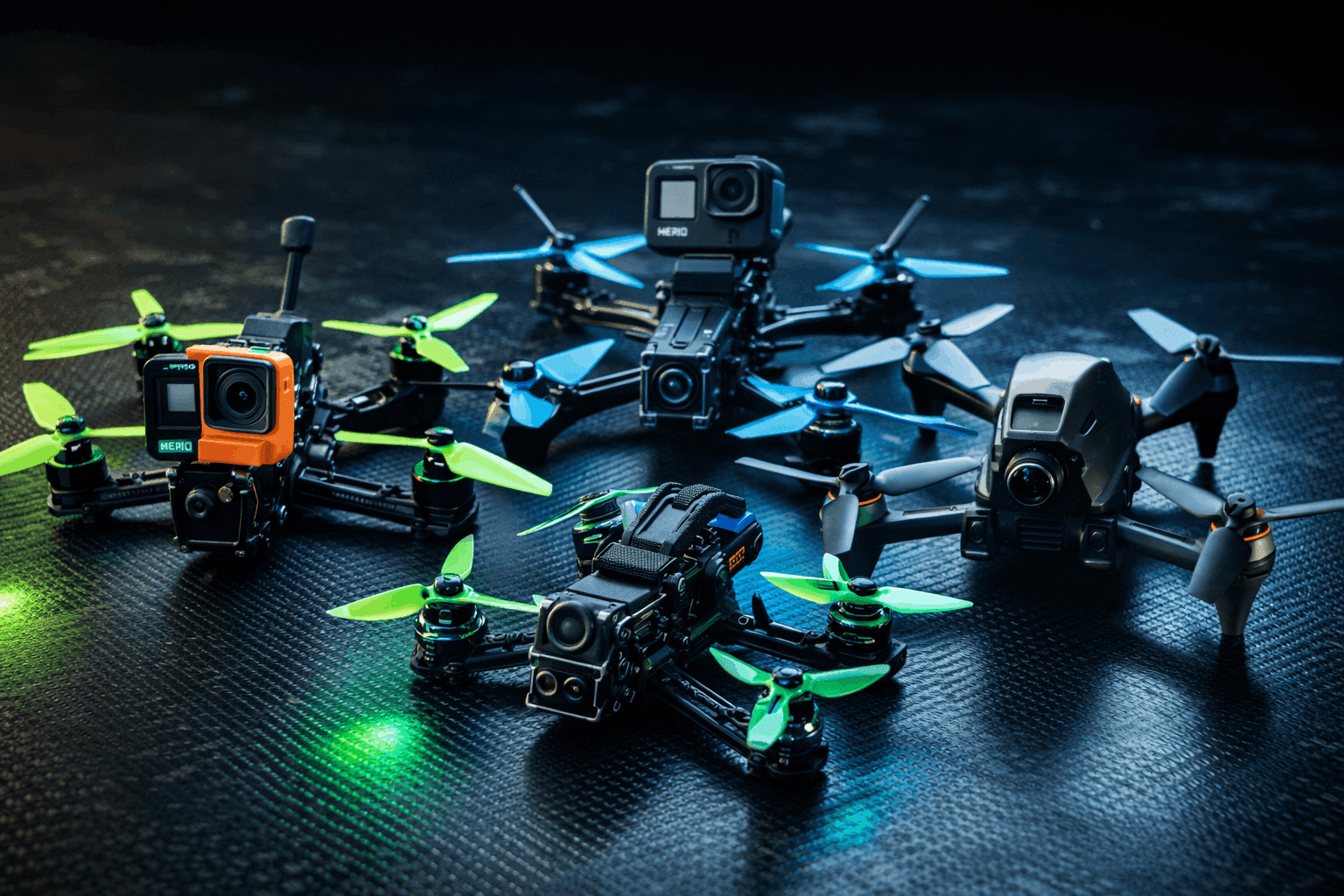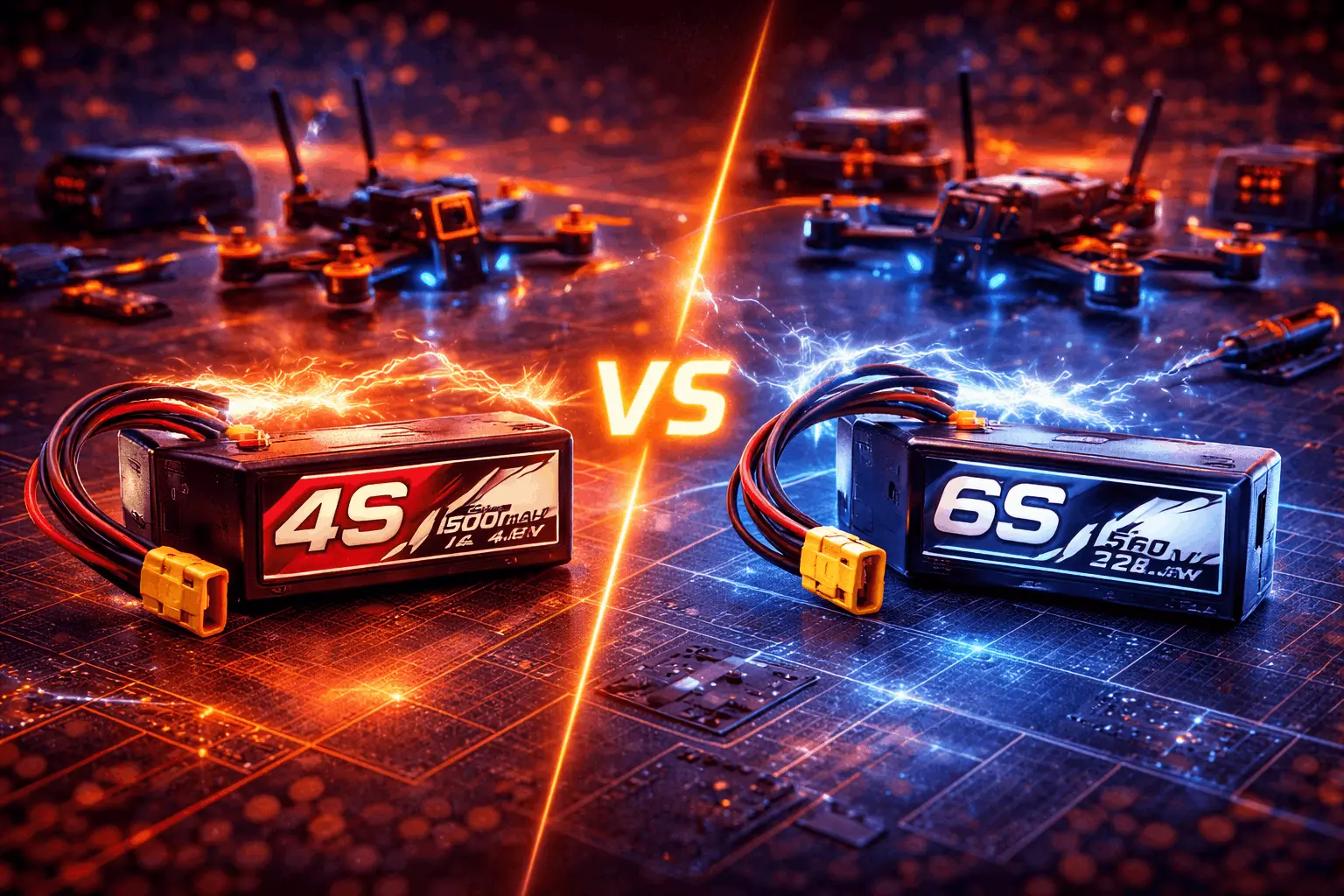
The 4S vs 6S debate has evolved from “6S is coming” to “6S is standard” — but 4S isn’t dead. Each voltage has genuine advantages depending on your flying style, budget, and goals.
Here’s the critical fact upfront: this choice locks you into a motor KV ecosystem and determines battery compatibility for years. Converting from 4S to 6S means rebuilding your power system, not just swapping batteries. Both voltages remain viable in 2026, but for different reasons and different use cases.
This guide covers voltage fundamentals, real performance differences, the efficiency debate (with honest nuance), build implications, cost analysis, and specific use case recommendations. No marketing fluff — just what you need to pick the right voltage and commit.
Note: This guide contains affiliate links. If you purchase through our links, we may earn a commission at no extra cost to you. This helps support our testing and content creation.
What 4S and 6S Actually Mean
The “S” in battery specs stands for cells in series — the number of lithium polymer cells connected end-to-end in the pack. This simple configuration choice cascades into significant differences across your entire FPV system.
A 4S battery runs four cells at 3.7V nominal each: 14.8V nominal, 16.8V fully charged. A 6S battery runs six cells: 22.2V nominal, 25.2V fully charged. That’s 50% more voltage from 6S — and that gap drives everything else.
Why Voltage Matters: The Power Equation
The physics here are straightforward: Power (Watts) = Voltage × Current. If your quad needs 1000W to hover, you can get there two ways — 4S drawing ~60A at 16.8V, or 6S drawing ~40A at 25.2V. Same power, different current path.
Why does this matter? Heat loss follows I²R — current squared times resistance. Lower current dramatically reduces waste heat in your motors, ESCs, wires, and battery. This isn’t marketing spin, it’s physics. A 6S system delivering the same power runs measurably cooler than a 4S system doing the same job.
Motor KV: The Commitment That Makes This a Big Decision
Motor KV represents theoretical RPM per volt under no load. A 2400KV motor on 4S (14.8V) spins around 35,500 RPM unloaded. That same motor on 6S (22.2V) would hit roughly 53,000 RPM — dangerously fast and likely to cook your motor in minutes.
This is why 4S and 6S builds use completely different motors:
- 4S 5” freestyle: 2300–2700KV (popular choices: 2400KV, 2550KV)
- 6S 5” freestyle: 1600–1950KV (popular choices: 1750KV, 1850KV)
A 1750KV motor on 6S reaches similar RPM to a 2550KV motor on 4S, but the flight characteristics differ. You cannot casually swap between voltages on the same motors. This KV lock-in is the primary reason converting from 4S to 6S means new motors, potentially new ESCs, and definitely new batteries. It’s not a battery-only change — it’s a powertrain rebuild.
Performance Comparison: What You Actually Feel in Flight
This is where perception and reality sometimes diverge. Let’s separate the real differences from the placebo.
Power and Thrust
6S delivers more voltage headroom, enabling higher absolute power potential with properly matched low-KV motors. For competitive racing, cinematic heavy lifting, or aggressive freestyle where you’re hammering full throttle out of dives, 6S has a genuine edge.
But here’s the nuance: 4S can match 6S power output through higher KV motors drawing more current. The difference is cost — your ESCs and motors work harder electrically and run hotter to achieve equivalent performance. For typical freestyle at moderate aggression, the power difference is modest. You won’t crash more on 4S or find yourself unable to execute tricks. Your components just work harder to get there.
Throttle Resolution and Voltage Sag
6S runs from 25.2V (full charge) down to roughly 19.8V (3.3V per cell, time to land). That’s a 5.4V operating window. 4S runs from 16.8V down to about 13.2V — a 3.6V window. The wider 6S range translates to finer throttle resolution and more granular control between stick positions.
More importantly, voltage sag behavior differs significantly under hard acceleration. When you punch the throttle, battery voltage drops momentarily. 6S maintains higher voltage even during peak draws, keeping motors responsive. 4S sags further proportionally, creating a brief lag before full RPM. Many pilots describe this as 6S maintaining “punch” through the entire flight while 4S punch degrades as the pack depletes. For racing and competitive freestyle where millisecond responses matter, this is real. For weekend park flying, it’s a quality-of-life improvement.
The Efficiency Debate: Let’s Be Honest
This is where expert opinion diverges, and this article won’t pretend otherwise.
The common claim: 6S is more efficient because lower current means lower I²R losses. Mathematically sound. But here’s where it gets interesting — as relayed by Joshua Bardwell, motor expert Ryan Harrel argues that 6S is actually less efficient in practice. Harrel’s reasoning: most real-world comparisons aren’t apples-to-apples. Pilots typically pair a 6S 1300mAh pack against a 4S 1500mAh — different energy storage, different weight. Many also run slightly higher KV on 6S than the true mathematical equivalent, extracting more performance and burning more energy. Bardwell himself notes that Harrel’s credentials on motor/ESC testing are impeccable, and he tends to agree.
So why do pilots feel like they get longer flights on 6S? Bardwell’s own experience: on 4S, he’d feel voltage sag, decide to land, and the pack still had juice. On 6S, sag was less noticeable — he’d fly deeper into the pack, sometimes killing batteries because he didn’t feel the fade. The quad felt stronger longer, so he flew longer. Perception improving experience, not raw energy advantage.
Practical takeaway: For equivalent capacity, equivalent flying style, and truly matched motor setups, the efficiency difference is marginal — maybe 5% either way depending on how you measure. Don’t buy 6S expecting dramatically longer flights. Buy it for cooler operation, more consistent feel through the pack, and modern ecosystem alignment. Those are the real, honest benefits. For a deeper dive on battery fundamentals, C-ratings, and storage, check our complete FPV drone battery guide.
Build Considerations: What You’re Committing To
Choosing 4S or 6S commits you to a specific ecosystem. Understanding the full picture prevents expensive surprises.
Motor Selection
This is the hard commitment. You cannot use a 4S motor (2400KV+) on 6S without the Betaflight motor output limit workaround — and even then, it’s a compromise. Oscar Liang and others have documented the process: Betaflight auto-detects battery voltage and scales motor output to ~66% on 6S, effectively capping RPM. It works for transitional use, but motors run hotter than ideal, and you’re throwing away the voltage advantage. It’s a bridge, not a destination.
Going the other direction — 6S motors on 4S — gives you an underpowered, sluggish quad. You can’t scale up motor output in Betaflight.
This lock-in is why many pilots maintain separate 4S and 6S quads rather than converting. Building a new 6S quad from scratch is often cleaner and cheaper than retrofitting an existing 4S build. If you’re planning your first serious 5” build, check our best FPV motors guide for current recommendations across both voltages.
ESC and Flight Controller Compatibility
Most modern ESCs handle 3–6S input, so voltage compatibility isn’t usually the bottleneck. The real difference: on 4S with high-KV motors pulling heavy current, your ESC works hard. The same ESC on 6S with low-KV motors sees lower current demand and operates more comfortably. Effectively, 6S gives your ESC more thermal headroom.
Flight controllers are almost universally 3–6S compatible. One thing worth noting for 6S: add a low-ESR capacitor (1000µF, or two 470µF in parallel) across your battery lead. The higher voltage spikes from 6S packs are harder on electronics, and a cap smooths them out. Most 6S builders consider this mandatory.
Battery Weight and Availability
For 5” freestyle, typical battery pairings are 4S 1500mAh vs 6S 1300mAh. The 4S pack is slightly lighter — fewer cells means less material. For sub-3” builds, this weight difference becomes significant enough to favor 4S or lower.
Both voltages have strong availability from quality brands — Tattu R-Line, CNHL, and GNB all offer solid options in both formats. Pricing still slightly favors 4S, but the gap has narrowed.
Charger Requirements
If your charger only supports 4S (check for “6S” or “25.2V max” in specs), switching requires an upgrade. Most modern hobby chargers support 1–6S out of the box. One non-negotiable: always select the correct cell count when charging. Charging a 6S battery on 4S settings will damage it and creates a genuine fire risk. Parallel charging requires same-voltage batteries — you cannot mix 4S and 6S on the same board. For LiPo safety fundamentals, see our LiPo battery safety guide.
Cost Analysis: Real Numbers
Let’s get specific. Costs reflect typical 2026 pricing from major retailers.
Initial Build Comparison
Motors: Roughly equivalent pricing between 4S and 6S KV options — $50–80 for a set of four quality motors either way.
ESCs: Same hardware works for both (3–6S rated). $40–60 for a 4-in-1 stack. No cost difference.
Batteries (4-pack): This is where it adds up. A 4S 1500mAh quality pack (CNHL MiniStar, Tattu R-Line) runs $20–35 each. A 6S 1300mAh equivalent runs $25–40 each. Over four batteries: $20–40 premium for 6S.
Charger: If buying new, a 6S-capable charger costs $30–50 more than a 4S-only model. If you already own a multi-voltage charger, no difference.
Total initial premium for 6S over 4S: roughly $80–120. Not trivial for a beginner, but not enormous either.
Long-Term Economics
6S batteries always cost more per unit. Over a year of flying with 5–6 batteries rotating through your collection, you’ll spend $30–60 more on 6S replacements. The counterargument: if 6S motors and ESCs run cooler and last marginally longer, there’s a small offset. In practice, batteries are the dominant consumable cost, and the 6S premium persists.
The hidden cost is conversion. If you build 4S now and switch to 6S in six months, you’re buying new motors and new batteries. That $80–120 you “saved” evaporates, plus you’ve got orphaned 4S gear. Building 6S from the start avoids this conversion tax entirely.
Budget Recommendation
Tight budget / learning phase: Build 4S. Crashes happen constantly while learning, and cheaper batteries soften the blow. Skills transfer completely to 6S later. Pair it with a budget setup under $500 and focus on stick time.
Moderate budget: Build 6S directly. The $80–120 premium is justified by future-proofing and avoiding conversion costs. The modern FPV ecosystem optimizes for 6S.
Multiple quads: Run both. 4S for sub-3” builds, whoops, and beaters. 6S for your primary 5” freestyle rig. Separate battery collections, clearly labeled. One quality multi-voltage charger handles everything.
Use Case Recommendations: Matching Voltage to Your Flying
Rather than abstract analysis, here’s when each voltage makes practical sense.
Choose 4S When:
Building micro or sub-3” quads. Weight budgets are tight at this scale, and 6S doesn’t meaningfully improve performance on small props. A 4S 650mAh weighs noticeably less than a 6S equivalent, and that weight delta is significant on a 200g drone. Most sub-3” builds standardize on 4S or lower. For indoor options, check our best Tiny Whoop guide.
Learning on a budget. If you’re still crashing regularly (we all were), cheaper batteries reduce the sting. Flying 4S while developing skills is smart economics. Your stick control, spatial awareness, and muscle memory transfer perfectly to 6S later.
Racing in 4S-mandated classes. Some racing leagues and MultiGP classes specify 4S limits. Check your local rules before building. Don’t build 6S if your racing class doesn’t allow it.
Leveraging an existing 4S ecosystem. If you already own 4S batteries, charger, and spare motors, keeping things consistent avoids new purchases. Valid reasoning for casual hobbyists who aren’t chasing performance edges.
Choose 6S When:
Building a 5” freestyle quad (the modern standard). For traditional 5-inch freestyle, 6S is the default in 2026. It’s what most content creators fly, what manufacturers optimize for, and what the parts ecosystem centers around. If you’re building your first serious 5” quad, build 6S. See our best FPV drones guide for current top picks.
Prioritizing performance consistency. When you want maintained punch through the whole pack, smoother throttle, and competitive responsiveness, 6S delivers. Lower current means less thermal throttling during extended aggressive sessions. Professional racers have largely migrated to 6S.
Carrying payload. Hauling a GoPro or other camera gear favors 6S. Low-KV motors deliver more torque efficiently, handling payload without cooking your electronics. For cinematic work, check our cinematic FPV filming guide.
Flying in hot climates or pushing hard. Cooler-running motors and ESCs are more reliable under thermal stress. If you’re flying in summer heat or hammering aggressive freestyle sessions back-to-back, 6S gives your components more margin. Component lifespan extends when you’re not constantly riding thermal limits.
Investing long-term. Building once to fly for years? 6S future-proofs your setup. The industry trajectory is clear — motors, ESCs, and frames continue optimizing for 6S. You won’t need a powertrain replacement when 6S becomes even more universal.
When Either Voltage Works
Casual freestyle without competitive pressure. Weekend flying at moderate speeds. Learning and exploration at any budget level. Both teach fundamentals identically, and the performance gap at moderate aggression is genuinely small.
Running Both 4S and 6S
Many serious pilots own quads in both ecosystems. This is practical and common.
Separate battery collections, clearly labeled — color-coded straps work well. Same charger handles both if it’s multi-voltage. Always verify cell count before charging. Converting an existing 4S quad to 6S rarely makes financial sense — by the time you buy new motors and batteries, you’re most of the way to a complete new build. Build fresh for 6S and keep the 4S as a backup or beater.
Starting fresh in 2026: Build 6S for your primary 5” rig. If you want a secondary micro, build 4S. This split gives you the practical benefits of each voltage without fighting the ecosystem.
Frequently Asked Questions
Is 6S really that much better than 4S for freestyle?
“Better” depends on priorities. 6S advantages: cooler operation, more consistent performance through the pack, smoother throttle, sustained punch. 4S advantages: lower cost, adequate performance for most flying, lighter batteries, simpler if you have existing gear.
For competitive performance, 6S is preferred. For casual fun, both work equally well. The upgrade is quality-of-life, not a performance cliff. You won’t suddenly become a better pilot on 6S — your skills are the bottleneck, not your voltage.
Can I use 4S batteries on a 6S build, or vice versa?
4S on a 6S build: underpowered and weird-handling because the motors have wrong KV for that voltage. 6S on a 4S build: dangerous — motors spin way too fast, likely burning out motors and ESCs.
Betaflight’s motor output limit feature (set to ~66%) allows running 4S motors on 6S batteries as a transitional workaround. Motors run hotter than ideal, and you lose the voltage advantage. It’s a bridge for pilots migrating to 6S who haven’t replaced motors yet — not a permanent solution. Always use the voltage your build was designed for.
Does 6S actually run cooler?
Yes, and this is pure physics. Same power output, higher voltage, lower current. Heat generation is proportional to current squared (I²R). Lower current means significantly less heat in motors, ESCs, and wiring. In practice, motors on 6S are noticeably cooler after a session compared to 4S at similar flying intensity. This translates to longer component life and more consistent performance — thermal throttling is less likely when your electronics aren’t constantly fighting heat buildup.
Is 4S becoming obsolete?
Not obsolete, but increasingly niche for 5” builds. 4S remains standard for micros, specific racing classes, and budget entries. Battery and motor options still exist — the community hasn’t abandoned 4S. It’s just less prominent as the mainstream default shifts to 6S. If you have a working 4S setup you enjoy, there’s no urgency to switch. New builders get steered toward 6S because that’s where ecosystem optimization and innovation focus.
What motors should I use for 4S vs 6S on a 5” quad?
4S: 2300–2700KV. Common picks: 2400KV for balanced freestyle, 2550KV for more aggressive flying.
6S: 1600–1950KV. Common picks: 1750KV for efficient all-round use, 1850KV–1950KV for more aggressive setups.
The product of voltage × KV determines RPM and feel. Always match motor KV to your intended battery voltage — motor listings specify this. Using wrong KV causes poor performance at best, damaged equipment at worst. Browse our best FPV motors guide for specific recommendations.
How much more expensive is 6S vs 4S total?
Per battery: $5–10 more for 6S. For a 4–6 battery collection: $20–60 premium. Charger upgrade (if needed): $30–50. Total initial build premium: roughly $80–120. The cost difference persists long-term since 6S batteries always cost more to replace. The counterargument is future-proofing — you avoid the conversion tax if you’d eventually switch anyway.
What’s the real flight time difference?
This is genuinely complicated, and anyone giving you a clean number is oversimplifying. For truly matched comparisons (same mAh, same flying style, mathematically equivalent motor KV), the efficiency difference is marginal — 5% or less either way. The perceived difference is larger because 6S maintains voltage better through the pack, so pilots fly deeper into their batteries before noticing sag and landing. You feel like you flew longer because the quad felt stronger longer. That’s real value — just not raw energy efficiency.
Can I use the same charger for both?
If your charger supports 6S (check specs for “25.2V max” or “6S”), yes. Most modern hobby chargers handle 1–6S. Always select the correct cell count — wrong settings damage batteries and create fire hazards. Parallel charging requires identical voltage packs on the same board. If buying a new charger, get one supporting 1–8S for maximum flexibility.
Where to Buy
4S LiPo Batteries:
4S 1500mAh FPV Batteries on GetFPV
4S 1500mAh FPV Batteries on Amazon
6S LiPo Batteries:
6S 1300mAh FPV Batteries on GetFPV
6S 1300mAh FPV Batteries on Amazon
6S-Compatible Chargers:
The Decision: 4S or 6S for Your Build?
Choose 4S if: you’re budget-constrained, building micro or sub-3” quads, flying casually, or leveraging an existing 4S ecosystem. 4S is perfectly adequate and represents the proven foundation of FPV.
Choose 6S if: you’re building a primary 5” freestyle quad, prioritize performance consistency and component longevity, want to future-proof your investment, or plan to fly aggressively over years. The upfront premium pays for itself in avoided conversion costs.
For new builders in 2026, the default recommendation is 6S for 5” builds. The industry has shifted there for legitimate reasons: cooler operation, better performance consistency, ecosystem maturity, and parts optimization. But if 4S fits your situation better, you’re not choosing wrong — you’re choosing differently based on valid circumstances.
Whatever you pick, commit to it. Build the entire powertrain around your voltage choice. If you eventually want to switch, build a new quad rather than Frankensteining a conversion. Either path leads to excellent FPV flying — the pilot matters more than the cell count.