Introduction
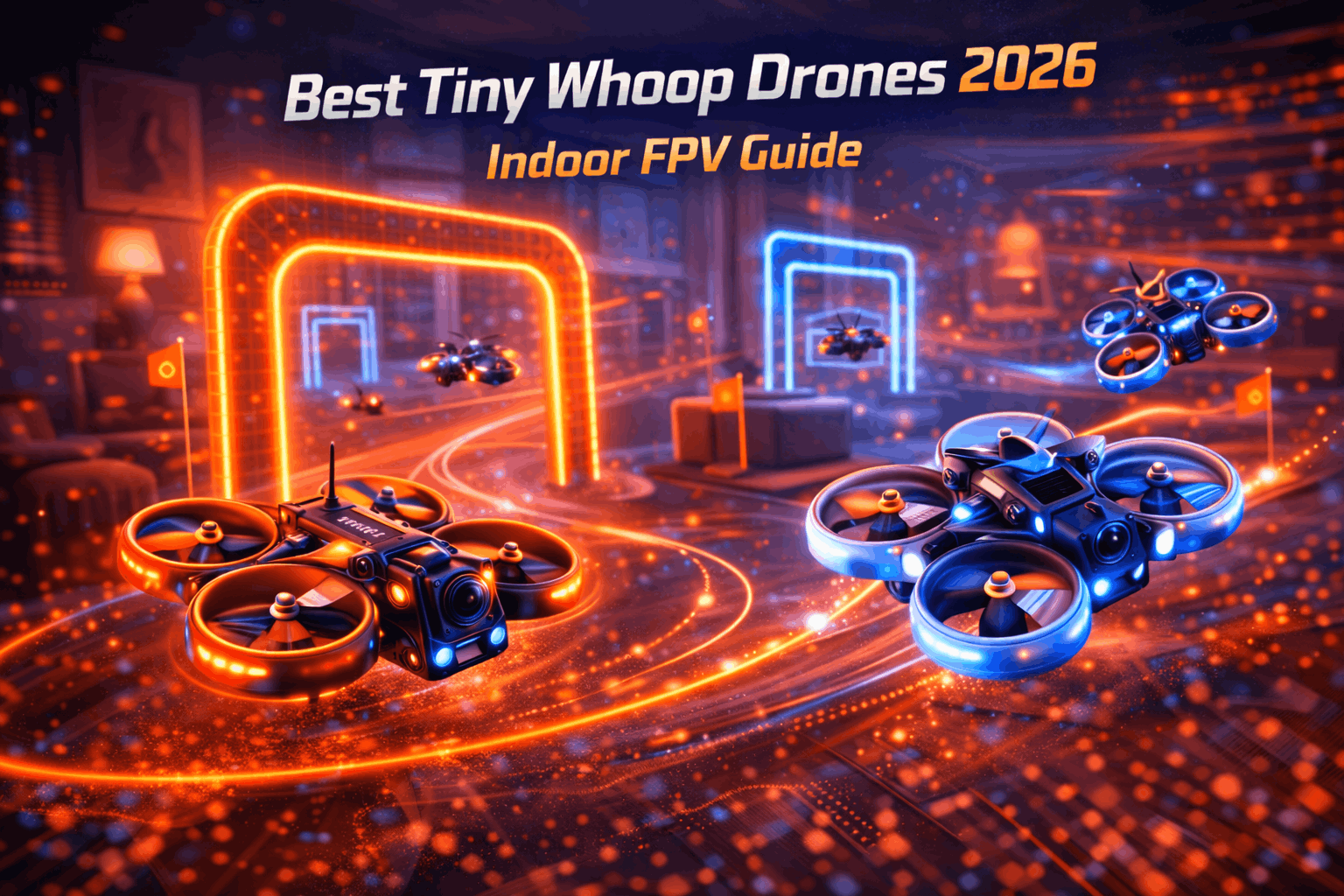
Tiny whoops pack genuine FPV thrills into packages small and safe enough to fly in your living room. They're not scaled-down "real" drones—they're a distinct category with their own culture, racing scene, and dedicated pilots who wouldn't trade them for anything.
This guide celebrates what makes tiny whoops special while providing practical selection guidance. You'll understand what defines the category, key technology choices, top recommendations across categories, and how to pick the right whoop for your flying style.
If you’re still deciding whether a tiny whoop is right for you compared to larger indoor-capable drones, our complete FPV drone buyer’s guide for 2026 breaks down all major FPV categories and use cases.
Note: This guide contains affiliate links. If you purchase through our links, we may earn a commission at no extra cost to you. This helps support our testing and content creation.
What Defines a Tiny Whoop
Tiny whoops are a specific FPV category with distinct characteristics that set them apart from both larger quads and toy drones.
Physical Characteristics
Size: Typically 65-75mm motor-to-motor distance (wheelbase). The standard is 65mm—small enough for tight indoor spaces but large enough for real flying.
Weight: Under 50 grams typically, often around 17-25g. This light weight is critical—it's why they're safe indoors.
Ducted propellers: This is the defining feature. Props are surrounded by protective ducts (guards). You can crash these into walls, ceilings, and people without damage. The ducts aren't optional—they define the category.
Power: Mostly 1S LiPo batteries (3.7V), occasionally 2S. 1S is standard for weight and cost reasons.
Motors: Either brushed (older) or brushless (modern standard). This is a critical choice in modern tiny whoops.
Why Tiny Whoops Exist
Tiny whoops solve a problem: How do you fly FPV without weather limitations, without risk, without needing open space? You shrink it down, add ducted props for safety, and fly indoors year-round.
But they're not beginner training tools—they're a serious flying category. Expert pilots fly tiny whoops competitively, for skill development, for fun in winter, and because tiny whoops offer a pure flying experience that larger quads can't match.
The Tiny Whoop Culture
There's a dedicated community. MultiGP runs a Tiny Whoop racing class with competitive tournaments. Indoor tracks exist specifically for whoop racing. Pilots trick-progress on whoops—learning maneuvers and building skills. This isn't beginner territory; it's a destination.
Many experienced pilots who can afford any drone still fly tiny whoops regularly. Why? Because they're pure fun without logistics. No driving to fields, no weather worries, no retrieval hassles. Just living room flying, battery swapping, and pure FPV joy.
Brushed vs Brushless: The Critical Choice
This decision fundamentally affects your flying experience.
Brushed Tiny Whoops
Characteristics: Lower power, quieter, lighter, simpler electronics.
Advantages:
- Better precision in tight indoor spaces—lower momentum allows turning on a dime
- Quieter operation—important if flying in shared housing
- Longer flight time per battery—around 30 seconds more than brushless
- Linear throttle response—easier smooth, controlled flying
- Better for tight racing—many prefer brushed for technical tracks
- More forgiving for beginners—smoother power delivery
Disadvantages:
- Lower power—less aggressive flying capability
- Motor wear—brushes wear out faster, requiring replacement
- No turtle mode—can't auto-flip from inverted
Brushless Tiny Whoops
Characteristics: More power, motor longevity, advanced features.
Advantages:
- Raw power—dramatically more aggressive flying capability
- Motor longevity—brushless motors last far longer
- Turtle mode support—automatically flips from upside down (saves retrieval)
- 48KHz/RPM filter support—cleaner, smoother flying
- Better elevation changes—quicker ascent and descent
- Professional features—all modern whoops are brushless
Disadvantages:
- More intimidating—beginners need throttle limiting
- Harder crashes—higher speed = higher impact force
- Cost—slightly higher initial price
Which Should You Buy?
Brushless all the way in 2026. Modern brushless whoops have matured to the point where they're the clear choice. The turtle mode, 48KHz support, and motor longevity justify the small cost premium. Brushless is the modern standard for good reason.
That said, brushed whoops still have devoted pilots who prefer their tight-space characteristics. If you specifically want maximum precision in confined spaces, brushed remains viable.
Analog vs Digital Tiny Whoops
A secondary but important choice.
Analog Tiny Whoops (Standard)
Most tiny whoops use analog FPV—your camera transmits uncompressed video to analog goggles.
Advantages:
- Lower weight—no digital processing adds weight
- Cost-effective—less expensive than digital
- Compatibility—works with existing analog goggle ecosystem
- Established ecosystem—proven, stable systems
Use when: You already have analog goggles or prefer the mature ecosystem.
If you’re curious how digital FPV systems compare beyond tiny whoops, our
digital FPV systems comparison for 2026 explains the real-world differences between DJI O4, Walksnail, and HDZero.
Digital Tiny Whoops (Premium)
A small number of models integrate DJI O4 digital video—HD quality, much cleaner image.
Advantages:
- HD video quality—significantly cleaner image
- Better low-light performance—digital excels when analog struggles
- Future-oriented—where technology is heading
Disadvantages:
- Weight penalty—adds 5-10 grams (significant for tiny whoops)
- Cost premium—roughly double the price
- Complexity—more setup involved
- Goggle requirement—must have DJI O4 goggles
Use when: You have DJI O4 goggles or HD image quality is priority.
For most pilots in 2026, analog tiny whoops are the right choice. Digital is premium, specialized option.
Top Tiny Whoop Recommendations
Best Overall: BetaFPV Air65
The standard-bearer. The Air65 is the most popular 65mm tiny whoop in 2024-2025 for excellent reasons.
Specifications:
- 65mm wheelbase, 17.1g weight (incredibly light)
- Brushless motors, multiple KV options available (23000KV standard, 27000KV/30000KV aggressive)
- ExpressLRS receiver (excellent range and latency)
- 400mW VTX (plenty of power for small spaces)
- Flight time: 2-4 minutes depending on KV (aggressive flying ~2.5 min, gentle ~3.5 min)
Why it wins:
Light, responsive, proven performance. The frame is durable despite being tiny. The all-in-one board is reliable. Camera produces good quality. Multiple KV options let you tune aggression.
Flight feel: Snappy and responsive. Punch the throttle and it jumps. Quick rolls and tight turns feel natural. The ducts protect from inevitable wall impacts.
Price: $90-120 for bind-and-fly
Best for: Most pilots, all flying styles
You can check current configurations and availability for the BetaFPV Air65 Tiny Whoop.
Best 75mm Whoop: BetaFPV Air75
For longer flights and efficiency. The Air75 steps up the size/power for better endurance.
Specifications:
- 75mm wheelbase, 21g dry weight
- 0802 23000KV brushless motors
- 40mm bi-blade props (efficient design)
- Flight time: 5.5-6 minutes (exceptional for tiny whoops)
- Strong power, excellent throttle response
Why it's special:
The standout feature is flight time. While Air65 gives you 2-4 minutes, Air75 delivers 5.5-6 minutes of flight. On larger 1S batteries, this extends to 6.5+ minutes. The efficiency is impressive.
Flight feel: Fast, nimble, responsive. The extra power is noticeable but not overwhelming. Better for larger rooms or outdoor calm-day flying.
Price: $95
Best for: Longer sessions, efficiency priority, slightly larger spaces
For longer flight times and a slightly larger platform, see current options for the BetaFPV Air75 Tiny Whoop.
Best for Racing: BetaFPV Air65 Race Edition
Optimized for competition. If tiny whoop racing appeals, the Air65 Race Edition is purpose-built.
Why it's best for racing:
Lightweight, responsive, proven in competitive settings. The tune is optimized for technical tracks. Turtle mode works reliably on typical race floor.
Features: Aggressive setup out-of-box, excellent handling characteristics for tight technical courses.
Price: $100-130
Best for: Racing pilots, technical track specialists
Racers can find the dedicated configuration via the BetaFPV Air65 Race Edition listings.
Best Brushed Whoop: NewBeeDrone Acrobee
If brushed appeals to you. The Acrobee is the quality brushed whoop option.
Why it wins for brushed category:
NewBeeDrone provides exceptional customer service (crucial for whoops). The Acrobee features solid construction, proven reliability. It's the option if you specifically want brushed characteristics.
Trade-off: Less power, quieter operation, longer flight time per battery.
Price: $80-100
Best for: Those specifically wanting brushed characteristics
If you specifically prefer brushed characteristics, you can view current versions of the NewBeeDrone Acrobee Tiny Whoop.
Best Digital Whoop: BetaFPV Meteor75 Pro O4
For HD quality. If you want digital FPV on a tiny whoop.
Why it's special:
DJI O4 integration delivers HD video. The footage is smooth and jello-free out of the box. Camera quality is significantly better than analog equivalents.
Trade-offs: Heavier than analog (affects flight characteristics), costs roughly double, requires DJI O4 goggles.
Price: $200-250
Best for: Those with DJI O4 goggles, HD video priority
For pilots already invested in DJI digital FPV, you can check the BetaFPV Meteor75 Pro with DJI O4.
Best Budget Option: Happymodel Mobula6
Smallest and most affordable. The Mobula6 is the entry-point whoop.
Specifications:
- 60mm wheelbase, 31mm props (tiniest whoop category)
- Aggressive pricing ($50-80)
- Reliable performance
- Available with ExpressLRS
Why it works:
Genuine FPV performance at budget price. The Mobula6 delivers real flying, not toy-grade experience.
Trade-offs: Smallest size means shortest flight times (3-4 min), less power, better for very tight spaces.
Price: $50-80
Best for: Budget builders, tight spaces, learning platform
Budget-conscious pilots can still get genuine FPV performance with the Happymodel Mobula6 Tiny Whoop.
Flight Performance Expectations
Power and Speed Characteristics
A brushless 65mm whoop is genuinely fast in a small space. Top speed around 40-60mph is common. In your living room, this feels blazingly fast.
Brushed whoops are noticeably slower—maybe 25-40mph top speed—which might seem limiting but actually makes tight-space flying more accessible.
Both can flip, roll, and perform aerobatics. Neither will hit "huge air" like larger quads, but they'll do everything that matters.
Flight Time Reality
Expect 2-4 minutes from 65mm whoops, 5-6 minutes from 75mm whoops. This isn't huge, but aggressive flying burns batteries faster than gentle flying.
You need multiple batteries—a minimum of 5-6 for a meaningful practice session. This gives you 10-20 minutes of actual flight time with charging breaks between packs.
Battery rotation is the game. You fly, swap batteries, charge the depleted pack while you fly again. Most whoops charge in 15-30 minutes via USB-C.
Indoor Flying Characteristics
You need a room at least 10x10 feet, preferably 15x15 feet. Living rooms, basements, garages all work.
Tiny whoops are safe around people and pets—the ducted props are designed to be impact-safe. You can fly with family in the room without danger.
Noise is a consideration. Brushless whoops are audibly louder than brushed. In an apartment, this matters.
Durability and Maintenance
Tiny whoops are surprisingly durable despite being fragile-looking.
What Breaks First
Props: Constant consumption. Stock up on spares. They break from hits and wear from flying.
Motors: Brushless motors last hundreds of flights. Brushed motors need replacement more frequently (every 50-100 flights roughly).
Frame: Actually quite durable. Crashes that look catastrophic usually bounce off. Real frame breaks are rare.
Camera: Surprisingly well-protected. Crashes rarely damage the camera.
Batteries: Limited lifespan—100-200 charge cycles typically. You'll replace batteries regularly.
Maintenance Requirements
Regular cleaning: Hair and dust accumulation is the main issue. Brush out after indoor sessions.
Bearing care: Brushless motors have tiny bearings—a small oil can help longevity.
Connector inspection: U.FL/IPEX connectors are fragile. Check regularly for bent pins.
Frame inspection: Check for cracks after hard crashes.
Battery Strategy
You need multiple batteries—this is non-negotiable for meaningful flying.
Typical Battery Configuration
- 1S 300-450mAh: Standard tiny whoop battery
- Voltage: 3.7V nominal (3.85V charged)
- Lifespan: 100-200 cycles before degradation
- Charging time: 15-30 minutes typical USB-C charging
How Many Batteries?
- Casual sessions: 5-6 batteries (10-15 min flight time with rotation)
- Serious practice: 10+ batteries (unlimited flight time with rotation)
- Racing: 10-15+ batteries (multiple races/practice heats)
Budget $5-10 per battery. This adds up.
Indoor Flying Tips
Space Requirements
Minimum 10x10 feet, preferably 15x15 feet or larger. Ceiling height at least 8 feet.
Clear fragile items. Windows are a risk (both breaking window and quad getting lost outside).
Furniture creates obstacles—great for practicing precision flying but hazardous when learning.
Safety Considerations
Tiny whoops are safe around people and pets due to ducted props. You won't cut anyone.
They can knock items over if they crash. Be mindful of what's in the flight area.
Flying at night requires LED lights on the whoop or external lighting on the track.
Flying Technique
Low-speed control: Start gentle, building confidence before aggressive flying.
Proximity flying: The big difference from outdoor flying. You're threading furniture, navigating tight spaces.
Recovery skills: When things go wrong in a small room, quick recovery is essential.
Consistency: Doing the same maneuver repeatedly builds muscle memory.
Tiny Whoop Racing
Tiny whoop racing is a real, competitive scene through MultiGP.
Racing Format
MultiGP hosts dedicated Tiny Whoop racing events. The format is competitive—double elimination brackets, fastest-3-consecutive-lap scoring, high-level pilots competing seriously.
The 2025 International Open in Muncie, Indiana featured a full Tiny Whoop championship—pilots competing at the highest level with custom-tuned whoops.
Why Tiny Whoop Racing Is Special
It's accessible racing. The barrier to entry is lower than larger quad racing. Equipment costs less, indoor locations are easier to find, and the technical skill ceiling is similarly high.
Technical precision matters more than raw speed. The tracks are tight, turns are numerous, and consistency wins races.
Getting Started in Racing
Local MultiGP chapters often host Tiny Whoop events. Check MultiGP.com for your region's chapter.
Entry barriers are low—show up with a whoop, register, and fly. The community is welcoming. You don't need to be competitive to participate.[6]
Common Mistakes to Avoid
Buying too cheap: Under $80, you're in toy territory with poor performance. Spend $100+ for genuine FPV quality.
Buying too expensive: $250+ is premium territory. For learning, mid-range ($100-150) is optimal.
Wrong battery quantity: Four batteries is minimum, but insufficient for meaningful sessions. Stock at least 6-8 from the start.
Ignoring prop quality: Cheap props break faster. Quality props ($0.50-1 each) are worth the investment.
Skipping maintenance: Regular cleaning and battery care extend lifespan significantly.
Aggressive flying too soon: Build foundational control first, then progress to aggressive maneuvers.
FAQ
Q: Can adults enjoy tiny whoops, or are they just for beginners?
A: Tiny whoops are serious FPV machines. Expert pilots flying 5-inch racing quads still fly tiny whoops regularly—for fun, skill practice, winter flying, or competitive racing. MultiGP Tiny Whoop racing is genuinely competitive. They're different than larger quads, not lesser. Anyone who enjoys FPV will enjoy tiny whoops.[7]
Q: How much should I spend on my first tiny whoop?
A: Budget $100-150 total: $80-120 for the whoop, $20-30 for extra batteries and props. Under $80, you're in compromised quality. Over $150, you're paying for premium features you won't appreciate as a beginner. The $100-120 sweet spot gives quality brushless performance without overspending.
Q: Do I need a special indoor space?
A: You need a room at least 10x10 feet, preferably 15x15+. Living rooms, basements, garages work fine. Clear fragile items. Tiny whoops are safe around people (ducted props), but awareness of space is important. You don't need special infrastructure—just reasonable room to maneuver.
Q: Are brushless too powerful for beginners?
A: No. Modern brushless whoops are manageable for beginners if you start with gentle flying and build confidence. Throttle limiting (via radio settings) helps if overpowered. Brushless is the modern standard—better in every measurable way than brushed. Only choose brushed if you specifically want maximum precision in extremely tight spaces.
Q: Can tiny whoops fly outdoors?
A: Only in dead-calm conditions. Winds above 5-10mph make them nearly unflyable due to low weight. Tiny whoops are designed for indoor flying. Consider outdoor capability a rare bonus, not a primary feature.
Q: How many batteries do I need?
A: Minimum 6 for meaningful sessions (giving you 15-20+ minutes flight time with rotation). Serious pilots own 10-20 batteries. They cost $5-10 each, so budget accordingly. Battery swapping is the normal workflow.
Q: What's the difference between a $80 whoop and a $150 whoop?
A: Build quality, component quality, and flight performance. Budget whoops use cheap motors that die quickly, weak frames that crack easily, and poor video quality. Mid-range ($100-150) offers quality components that fly predictably and last. Premium options add features and materials. For learning, mid-range is the sweet spot.
Q: Can I use my existing FPV goggles?
A: Yes, if they match the whoop's receiver type. Analog whoops work with analog goggles. Digital whoops (DJI O4) require O4 goggles. Most radios support multiple protocols. Check compatibility before buying. If you don't have goggles yet, this is a major part of your initial investment ($200-600).
Who Should Buy a Tiny Whoop?
Perfect for:
- Anyone wanting indoor FPV flying
- Apartment/condo dwellers
- Winter flying solution
- Skill development and practice
- Racing enthusiasts (Tiny Whoop class)
- Parents flying with kids around
- Anyone seeking year-round flying
Great addition for:
- Experienced outdoor FPV pilots
- Racers practicing technical skills
- Freestylers building precision
As a first drone:
Tiny whoops are excellent learning platforms—safe, affordable, immediate flying access, skill building, and gateway to FPV passion.
Final Recommendation
Get a BetaFPV Air65 or Air75, stock up on batteries, and fly. These are proven, reliable, deliver genuine FPV performance, and open the door to a year-round flying hobby.
Tiny whoops aren't stepping stones—they're destinations. The flying community, racing scene, and pure skill development aspect make them worthwhile for serious FPV pilots.
Don't think of them as training wheels for "real" FPV. Think of them as different, accessible, equally rewarding way to engage with the hobby.
If you’re ready to get started, proven tiny whoops like the BetaFPV Air65 series offer the best balance of durability, performance, and indoor safety for most pilots.