Introduction
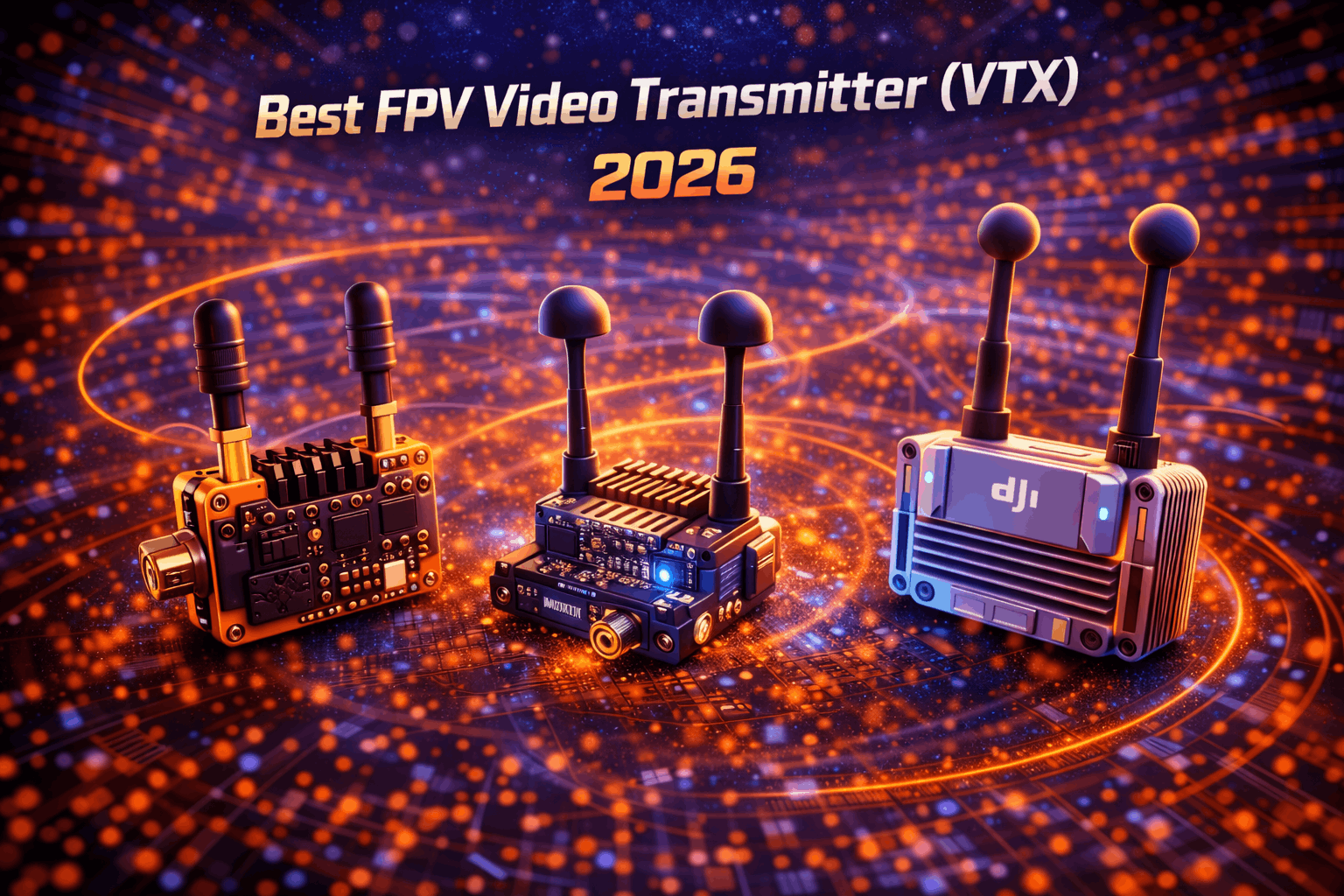
Your video transmitter is the critical link between your camera and goggles. Lose that signal and you're flying blind. But VTX selection has gotten more complex with digital systems changing the landscape entirely. Do you need a separate analog VTX, or should you commit to digital? If analog, what power output actually makes sense? Which protocol (SmartAudio vs Tramp) matters?
This guide makes VTX selection clear by explaining what actually matters, then matching you to the right hardware for your flying style. The goal is practical knowledge: understand how RF transmission works at a conceptual level, then choose a VTX without overthinking it.
If you’re still deciding between analog and digital FPV, explains when it makes sense to abandon standalone VTX entirely in favor of DJI, Walksnail, or HDZero.
Note: This guide contains affiliate links. If you purchase through our links, we may earn a commission at no extra cost to you. This helps support our testing and content creation.
VTX Basics: How Video Transmission Works
Your video signal travels an invisible path from your quad to your goggles. Understanding that path helps explain why certain VTX decisions matter and others don't.
The Basic Flow
Your camera captures video. The VTX takes that video signal and broadcasts it wirelessly on the 5.8GHz frequency band. Your goggles receive that signal and display it to your eyes. The quality at each step—camera, VTX, antenna quality, goggle receiver—determines your final video experience.
Think of it like a walkie-talkie conversation. Your mouth (camera) produces words. The radio transmitter (VTX) broadcasts those words. The antenna determines how effectively they travel. The receiver goggles listen and reproduce what they hear. A weak transmitter with a poor antenna is like whispering into a walkie-talkie on low power—you'll only be heard at close range.
The Analog vs Digital Decision
This is the foundational VTX choice. Analog VTX are standalone components you install in your drone and configure independently. Digital systems (DJI O4, Walksnail Avatar, HDZero) integrate the VTX and receiver into a complete ecosystem where you don't choose the VTX—it's built into the air unit, and you choose the system instead.
For analog flying: You're reading this guide. Analog requires selecting a VTX component.
For digital flying: Your VTX is predetermined by your ecosystem choice. The real decision is system selection, not individual VTX specs.
Understanding VTX Specifications
VTX specifications matter, but they matter in specific ways. Some specs are marketing noise. Others directly affect your flying experience.
Power Output: What the Numbers Actually Mean
VTX power is measured in milliwatts (mW). The range spans from 25mW to 2000mW+ depending on the VTX.
Here's the counterintuitive part: Power increases don't scale linearly. Doubling from 25mW to 50mW is a huge range improvement. Doubling from 200mW to 400mW is a modest improvement. Going from 400mW to 800mW adds penetration more than range.
The reason: range is logarithmic in RF. In open air conditions, jumping from 25mW to 200mW gives you roughly 3-4x range. Jumping from 200mW to 800mW gives you maybe 50% more range, while quadrupling battery drain and heat output.
Practical framework:
- 25-200mW: Sufficient for typical freestyle within visual range
- 200-600mW: Sweet spot for balanced range, heat, and efficiency
- 600-1000mW: Needed for long-range penetration through obstacles
- 1000mW+: Long-range and difficult environments, with serious heat trade-offs
Real power output note: Some VTX don't output what their specs claim. The TBS Unify Pro32 HV, for example, is spec'd at 800mW but measured at ~2 watts in actual testing. This is fortunate (more power than advertised), but illustrates that specs aren't always reality.
For pilots pushing distance or flying through dense terrain, our long-range FPV drone build guide covers how VTX power, antennas, and battery choices work together for reliable range.
SmartAudio vs Tramp: The Control Protocol Decision
Both SmartAudio and Tramp accomplish the same goal: letting your flight controller remotely change your VTX's power output and channel through the OSD. You don't need to physically press buttons on the VTX.
SmartAudio is TBS's proprietary protocol. It's established, works reliably with TBS VTX, and includes a "CleanSwitch" feature that minimizes interference when changing channels.
Tramp is ImmersionRC's alternative protocol. It's slightly cheaper, shielded against interference, and expanding to more VTX manufacturers.
Practical difference: Minimal. Both work equally well. Choose based on which VTX you prefer (which likely determines your protocol choice automatically). The real difference is the VTX selected, not the protocol.
Setup requirement: Modern Betaflight (4.1+) handles both. You tell the FC which protocol your VTX uses, connect one signal wire, and load the VTX table specific to your model.
Antenna Connection: Why This Matters
VTX antenna connectors come in different sizes: SMA (standard), RP-SMA (reverse polarity SMA), MMCX (compact), U.FL/IPEX (micro). Your VTX antenna connector must match your VTX output—there's no universal adapter without signal loss.
The antenna connector choice is less about performance and more about physical constraints:
- SMA/RP-SMA: Larger, standard on many VTX, more robust
- MMCX: Compact, modern standard, easier to damage through rotation
- U.FL/IPEX: Micro for ultra-compact builds, fragile
Pick the VTX you want, and the connector choice comes with it.
Heat Management: An Underrated Factor
VTX get hot at high power. The relationship is simple: higher power = exponential heat increase. A VTX running 800mW continuous can reach unsafe temperatures without adequate cooling.
Heat management solutions:
- Small heatsink (passive) adds minimal weight
- Mounting location with airflow (not enclosed)
- Lower power settings when you don't need maximum
- Pit mode during setup (drastically reduces power, saves battery/heat)
Modern VTX include some thermal protection, but relying on it is poor design. Better to manage heat proactively through mounting and power settings.
Analog VTX Recommendations
Best Overall: TBS Unify Pro32 HV
The TBS Unify Pro32 HV is the industry standard for good reason. It delivers up to 800mW, includes SmartAudio control for remote configuration, and has thermal protection. Real-world testing shows it outputs approximately 2 watts (far more than the 800mW spec), providing exceptional range and penetration.
Why it excels:
- Proven reliability (thousands in use)
- Genuine output power (measured higher than spec)
- Excellent heat management
- Multiple antenna connector options (MMCX, SMA)
- Works with virtually all flight controllers
Trade-offs: Slightly heavier than compact options, higher cost (~$50-65), runs hot at max power.
Best for: Freestylers and long-range pilots who want proven performance without surprises.
You can check current availability and pricing for the TBS Unify Pro32 HV VTX here.
Best Value: SpeedyBee TX800
The SpeedyBee TX800 delivers 800mW with IRC Tramp support at a lower price point (~$35-40). The output is honest (actually outputs 800mW), making it great value for the power level.
Strengths:
- True 800mW output
- Light weight (7g)
- 20×20mm mounting (fits standard stacks)
- MMCX connector (modern)
- IRC Tramp telemetry support
Considerations: Slightly less refined than TBS Unify, fewer connector options, less thermal management heritage.
Best for: Budget-conscious builders who want 800mW without paying TBS premium.
For a strong price-to-performance option, see current listings for the SpeedyBee TX800 VTX.
High-Power: SpeedyBee VTX ULTRA
For long-range pilots, the SpeedyBee VTX ULTRA pushes to 1600mW output. It's purpose-built for range-focused flying where maximum power justifies heat and battery trade-offs.
Specifications:
- 1600mW maximum output
- IRC Tramp support
- 7V-28V input (works with 6S directly)
- 7g weight (remarkably light)
- 20×20mm mounting
- MMCX connector
Best for: Long-range and exploration pilots willing to manage heat.
If you need maximum output for exploration flying, you can view the SpeedyBee VTX ULTRA (1600mW) here.
Compact: TBS Unify Pro32 Nano
For sub-250g builds (whoops, micro racers), the TBS Nano delivers 500mW in a tiny package. It's the only truly viable option in its class, though heat management is limited.
Best for: Ultra-lightweight builds where weight budget is critical.
For ultra-light builds, you can check the TBS Unify Pro32 Nano VTX here.
Digital FPV System VTX Implications
If you're flying digital systems, the VTX decision is actually an ecosystem decision.
DJI O4 Air Unit: Best performance, integrated system, no choice in VTX specifications. The O4 delivers superior penetration and range compared to analog at equivalent power levels.
Walksnail Avatar: More affordable digital option with good image quality and reasonable penetration.
HDZero: Lighter, lower latency, lower power approach. Maximum 1W output, which somehow delivers comparable range to analog due to superior efficiency.
The VTX isn't chosen separately—it's determined by the system. The choice is system commitment.
Antenna Selection: More Important Than VTX Choice
Here's a hard truth: your antenna matters more than your VTX choice. A great VTX with a poor antenna is worse than a mediocre VTX with excellent antennas.
Polarization: The Critical Decision
Your VTX antenna and goggle antennas must use the same polarization—either all RHCP (Right-Hand Circular Polarization) or all LHCP (Left-Hand Circular Polarization). Mismatched polarization causes severe signal loss, even if the antennas are physically excellent.
Decision: Pick one (RHCP is slightly more popular historically), then commit to it across all equipment. Don't mix.
Why circular polarization? Circular polarized antennas handle multipath interference and drone rotation better than linear antennas. When your quad flips or spins, linear polarization signal can disappear. Circular polarization maintains signal through rotation.
VTX Antenna Type
Use omnidirectional antennas on your VTX (on the drone). You want signal coverage in all directions as the quad rotates and moves. Directional antennas (patch) aren't useful on the transmitter.
Popular omnidirectional options:
- Lumenier AXII 2 (excellent, widely available)
- Xilo AXII (budget option, good quality)
- TrueRC CORE (premium)
Price differences are minimal ($5-15 range)—all good options work.
Goggle Antenna Setup
If your goggles have a single receiver: Use one good omnidirectional antenna pointed upward (or toward typical flight area).
If your goggles have diversity (two antenna inputs): Use one omnidirectional antenna + one directional antenna (patch antenna). The patch adds range in your primary flying direction without sacrificing 360° coverage.
Antenna Connectors
VTX antenna connectors vary:
- SMA/RP-SMA: Standard, robust, used on older VTX
- MMCX: Modern standard on compact VTX
- U.FL/IPEX: Tiny, used on micro drones
Your VTX comes with a specific connector. Replacing antennas means buying the right connector type. No universal adapters without signal loss.
If you want a deeper explanation of antenna types, polarization, and real-world range impact, see our FPV antenna guide for range and penetration.
Power Output and Legal Considerations
Higher power isn't always better, and it's sometimes illegal.
Regional Restrictions
USA: Generally permissive under Part 15 regulations, allowing up to 1 watt in practice.
EU: Varies significantly by country. Many restrict to 25mW or 100mW unless you have special licensing.
Other regions: Check local regulations. Some ban FPV above certain power levels.
Beyond legality, always consider interference. Flying 1000mW in a group flying session is like shouting in a library—you'll disrupt every other pilot. Racing organizations will ban pilots for excessive power on shared bands.
When You Actually Need Higher Power
For typical solo freestyle: 200-400mW is plenty. Flying at 25-100m altitude with visual range? You're power-limited by range, not transmission capability.
For forest flying: 400-600mW gives better penetration through trees and obstacles.
For long-range exploration: 600-1000mW is where power starts meaningfully impacting maximum achievable distance.
For racing: 25-200mW is standard (minimizes interference). More power doesn't help and might get you disqualified.
VTX Installation and Setup
Physical Installation
Mounting location: Position the VTX where it gets airflow (not enclosed by battery or carbon frame). Heat dissipation matters at high power.
Antenna placement: Mount the antenna away from carbon fiber frame and battery. Carbon blocks RF signals. Mount vertically when possible, or at 45° angle for diverse pattern coverage.
Wire management: Keep the antenna connector away from battery/wires to prevent physical damage during crashes.
Configuration in Betaflight
- Connect the VTX control wire (SmartAudio or Tramp pin) to an available UART TX pin on your FC
- In Betaflight Configurator → Ports tab → select the UART and choose SmartAudio or Tramp
- Load the VTX table specific to your VTX model (manufacturer provides JSON file)
- Save and reboot
- Access VTX settings in OSD: throttle middle + yaw left + pitch up
Common issue: VTX stuck on 25mW despite SmartAudio being "enabled"? Your VTX table values are wrong. Re-load the correct table for your specific VTX model.
Common VTX Mistakes
Running without an antenna (or with damaged antenna): This destroys VTX in seconds. Reflected power fries the transmitter. Always check antenna security before powering up.
Excessive power for the situation: 800mW in a parking lot is overkill and generates unnecessary heat. 25mW at a race is mandatory, not a limitation.
Mismatched antenna polarization: Mixing RHCP and LHCP causes massive signal loss. Pick one and commit.
Poor antenna quality: Saving $5 on antenna while spending $50+ on VTX is backwards economics. Good antenna is cheap; bad antenna wastes the expensive VTX.
Inadequate cooling: Mounting a 600mW+ VTX without airflow, expecting it not to thermally throttle, is predictably disappointing.
Wrong connector: Buying a high-quality antenna that doesn't physically fit your VTX connector adds zero benefit.
FAQ
Q: What power VTX do I really need for typical freestyle flying?
A: For most freestyle flying within 500m range, 200-400mW is plenty and often better than higher power. More power helps with penetration through obstacles but generates exponentially more heat and drains battery faster. I fly 90% of freestyle at 400mW and rarely lose signal. Save 600-1000mW for long range or difficult environments.
Q: Can I damage my VTX by running it without an antenna?
A: Yes, and quickly. Running VTX without an antenna (or with damaged antenna) causes reflected power that fries the VTX in seconds to minutes. Always check your antenna is secure before powering up. If you see smoke or smell burning, you've learned this lesson expensively. Never bench test at high power without antenna connected.
Q: Do I need to buy an expensive VTX, or are budget options fine?
A: Mid-range VTX ($20-35) perform excellently for most pilots. Expensive VTX usually offer better heat management and more refined performance, but differences are marginal for casual flying. Budget VTX ($10-15) can work but may have reliability issues or poor heat management. The sweet spot is $25-30 for proven reliability without overpaying.
Q: Should I use linear or circular polarized antennas?
A: Circular polarized (RHCP or LHCP) is standard for FPV because it maintains signal when the quad rotates or flips. Linear antennas have slightly more range in perfect orientation but lose signal quickly during rolls. Use circular polarized unless you have specific reasons not to. Make sure your VTX antenna and goggle antennas match polarization (both RHCP or both LHCP).
Q: How do I know which channel to use when flying with friends?
A: Use racing bands (R1-R8 in Betaflight terminology)—they're specifically spaced to minimize interference. Each pilot picks a different channel. If you're the only one flying, any channel works. Many regions have specific racing channel allocations. When in doubt, ask other local pilots what they're running.
Q: Is it worth paying extra for SmartAudio or Tramp?
A: Absolutely yes. Being able to change VTX power and channel through your OSD instead of physically pressing buttons saves massive headaches, especially when the button is buried in your build. It costs maybe $5-10 extra and prevents you from having to disarm, land, and disassemble your quad to change settings. One of those features that seems minor until you don't have it.
Does VTX Choice Really Matter?
Honestly? For casual, solo freestyle flying in good conditions with a decent antenna, almost any modern mid-range VTX performs similarly.
Where VTX choice matters:
- Long-range flying (power and efficiency)
- Group flying (clean channels and interference management)
- Racing (specific power limits and pit mode)
- Difficult penetration (high power needed)
Where it's marginal:
- Casual solo freestyle in parks
- Good conditions with clear line-of-sight
- Between similar power outputs from reputable brands
- When your antenna is good
The honest recommendation: Spend more thought on antenna selection than VTX selection. Buy a proven mid-range VTX (TBS Unify or SpeedyBee), invest in good antennas, mount carefully, and fly. You'll be satisfied.
Final Recommendations by Pilot Type
Beginner/Casual Freestyler: SpeedyBee TX800 + good AXII antenna, 200-400mW power setting. Reliable, affordable, sufficient.
Serious Freestyler: TBS Unify Pro32 HV if budget allows, or SpeedyBee TX800 for value. Run 400-600mW depending on environment.
Long-Range Pilot: SpeedyBee VTX ULTRA for power, or TBS Unify Pro32 HV at max. Invest heavily in quality antennas (patch antenna for directional range). Heat management critical.
Racer: 25-200mW on Raceband channels. Pit mode is mandatory. Any proven brand works—focus on reliability over power.
Budget Builder: SpeedyBee TX800. Save money here and invest in good antenna instead.
Digital Pilot: Forget VTX selection—choose your ecosystem (DJI O4, Walksnail, HDZero). The VTX is built in.