Introduction
Your antenna is the most underrated component in your entire FPV system. Pilots spend hundreds on VTX and goggles, then slap on a cheap, damaged antenna and wonder why their range sucks. The hard truth: a quality antenna makes more difference than doubling your VTX power.
This guide builds your understanding from RF basics through practical selection and installation. By the end, you'll understand why antenna choice matters, how to avoid the most expensive mistakes, and what actually drives FPV range and reliability.
If you’re also tuning your video system as a whole, our FPV VTX buying guide for 2026 explains how antenna choice and VTX power work together for real-world range.
Note: This guide contains affiliate links. If you purchase through our links, we may earn a commission at no extra cost to you. This helps support our testing and content creation.
Antenna Basics: What They Actually Do
An antenna converts electrical signals from your VTX into radio waves, broadcasts them through space, and (on the receiver side) converts incoming radio waves back into electrical signals. It's the critical last link in your transmission chain—and it can't be fixed in software.
Your VTX is the engine, but the antenna is the wheels. A massive engine with bicycle wheels doesn't go anywhere.
Why Antenna Design Matters
The shape, materials, and design of an antenna determine how efficiently it broadcasts and receives signals. A poorly designed antenna wastes your VTX's power output. A well-designed antenna with the same VTX delivers 3-5x the effective range.
This is why antenna quality is the cheapest upgrade that makes the biggest practical difference. Moving from a damaged $5 antenna to a quality $20 antenna outperforms upgrading from 200mW to 1000mW VTX in range improvement.
Antenna as System Component
An antenna doesn't operate in isolation. It works with your VTX power output, needs to match your receiver antenna type and polarization, and interacts with the environment. Proper installation multiplies antenna performance dramatically.
Polarization Explained: The Most Misunderstood Concept
Polarization describes how the radio wave oscillates as it travels through space. This is the single most important factor in antenna performance, yet most pilots get it wrong.
Linear vs Circular Polarization
Linear polarization means the radio wave oscillates in a single plane—like a rope moving up-and-down. If you rotate the antenna, the signal drops off. This is why linear antennas are unsuitable for FPV: your quad rotates constantly, and you lose signal with every flip.
Circular polarization means the radio wave rotates like a corkscrew as it travels. As long as your antenna matches that rotation direction, you receive signal from any angle. Flip your quad? Signal maintained. Roll it? Signal maintained.
There are two directions circular polarization rotates:
- RHCP (Right-Hand Circular Polarization): Clockwise rotation
- LHCP (Left-Hand Circular Polarization): Counter-clockwise rotation
The Critical Matching Rule
Your VTX antenna and receiver antenna must use the same polarization type. RHCP to RHCP, LHCP to LHCP.
Mismatch them? You lose 20-30dB of signal—that's roughly 90% signal loss, reducing your range to 10% of normal. A pilot running RHCP on their drone and LHCP goggles might think their range is fundamentally limited to 50-100 meters when they're actually experiencing antenna mismatch, not system limitation.
Why Circular Dominates FPV
Circular polarization sacrifices 2-3dB of peak gain compared to perfectly aligned linear antennas. For FPV, that's a worthwhile trade-off because you get:
- Rotation immunity: Signal maintained regardless of drone orientation
- Multipath rejection: Your antenna automatically rejects reflected signals (signal bouncing off ground/buildings and arriving at wrong time)
- Reliability: Consistent signal across all flight attitudes
Linear antennas have zero place in modern FPV video systems. The only exception is RC control antennas (Crossfire, ELRS), which use linear dipoles because they operate in a different frequency band where circular polarization isn't practical.
Regional Standards
RHCP is the de facto global standard for FPV. Unless you have specific reasons (group flying with alternate polarization), use RHCP. Consistency matters more than the direction you choose.
Antenna Types and When to Use Them
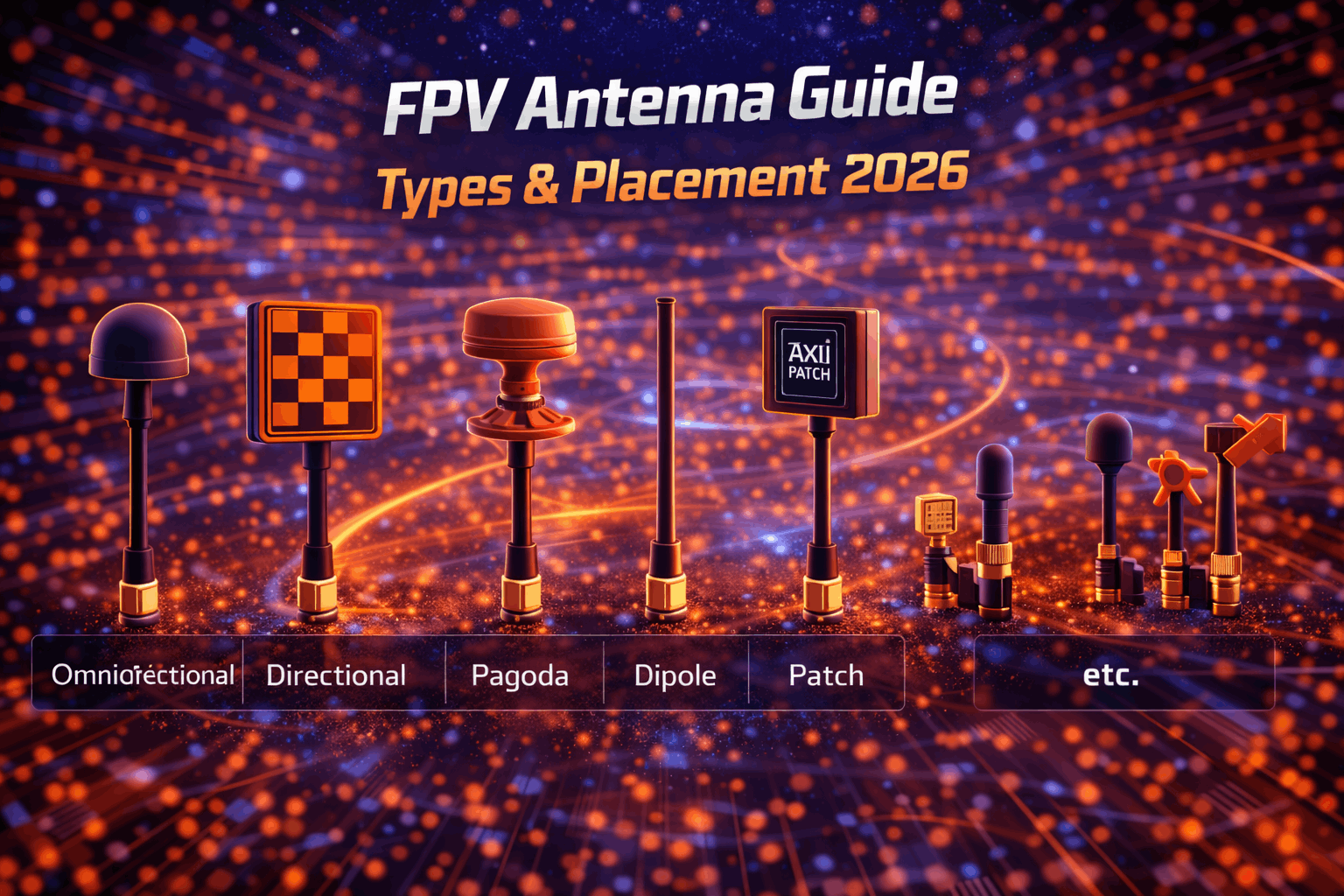
Omnidirectional Antennas (The Standard)
Omnidirectional antennas radiate signal equally in all directions around the antenna—imagine a donut shape. Coverage is 360° horizontally, with varying vertical coverage depending on design.
Common designs:
- Cloverleaf: 3-element design, oldest standard, still excellent
- Pagoda: 4-element design (newer, 2016+), very durable thanks to PCB construction
- Skew-Planar: Variant design, slightly different radiation pattern
Specifications:
- Gain: 0-3dBi typical
- All are circular polarized (RHCP/LHCP versions)
- Used on both VTX (drone) and RX (goggles)
When to use: Typical FPV flying where you don't know the exact path, freestyle flying, close-range general flying, most recreational scenarios.
Why VTX antennas must be omnidirectional: Your drone rotates and moves unpredictably. A directional antenna on the drone would point the right way sometimes and the wrong way other times. Omnis provide coverage regardless of drone orientation.
Directional Antennas (For Range Extension)
Directional antennas focus signal into a narrow beam—like focusing a flashlight instead of a bare bulb. They deliver higher gain in one direction, enabling longer range, but sacrifice coverage in other directions.
Common types:
- Patch antennas: Flat design, moderate gain (5-9dBi typical), directional in both vertical and horizontal planes
- Helical antennas: Spiral design, higher gain (8-15dBi), extremely focused
- Crosshair antennas: Specialized design, air-gap dielectric (more efficient)
When to use:
- Long-range flying where flight path is predictable
- Goggle diversity receiver systems (paired with omnidirectional)
- Spectator feeds or ground station setups
- Flying away from you (not toward)
Aiming requirement: Directional antennas require pointing toward the expected flight area. Unlike omnis where you just mount and forget, patch antennas need intentional aiming.
For pilots pushing distance, antenna choice matters even more when paired with the right build. Our long-range FPV drone build guide shows how antennas, VTX power, and battery choice combine for reliable long-range flying.
Antenna Gain: Understanding dBi
Antenna gain is measured in dBi (decibels relative to isotropic—a theoretical antenna that radiates equally in all directions). Higher gain doesn't mean "more power"—it means the antenna focuses available power into a narrower beam.
The trade-off: more gain in one direction = less coverage in other directions.
Practical implications:
- Omnidirectional antennas: 1-3dBi (balanced coverage)
- Patch antennas: 5-9dBi (focused, narrow beam)
- Helical antennas: 10-20dBi (extremely focused)
For VTX, lower gain omnis are correct because your drone moves in unpredictable ways. For RX, combining low-gain omni (coverage) with high-gain patch (range) gives best of both worlds.
Antenna Mounting and Placement
Installation quality determines whether your antenna achieves its theoretical performance or significantly underperforms.
The Carbon Fiber Problem
Carbon fiber is conductive and blocks RF signals significantly. Mounting an antenna directly against carbon frame, or even within a few centimeters of it, causes severe signal loss.
Real-world impact: An antenna mounted inside carbon fiber vs properly mounted outside can lose 50-75% of range. This is one of the most common causes of "my range sucks" problems that aren't actually antenna or VTX problems—it's placement.
Solution: Mount your antenna on standoffs (TPU mounts work well) that create physical separation from carbon. Keep active antenna elements away from carbon frame. This is more important than antenna quality differences.
Quad Antenna Placement
Standard approach: Mount omnidirectional antenna on top of frame, angled 45° forward or backward.
Why 45° angle matters: As your quad pitches forward in flight, a vertical antenna points backward (away from you). A 45° angle maintains better orientation to your goggles across different flight attitudes—horizontal, pitched, rolling.
Alternative: Side mounting works if carbon separation is maintained. Top mounting is more standard because it's further from frame.
Crash protection: Use TPU antenna guards that absorb impact. A crashed antenna with bent elements is next to useless—bent elements change SWR and radiation pattern.
Goggle Antenna Setup
Single receiver goggles: One omnidirectional antenna, mounted pointing upward or toward typical flight area. Simple.
Diversity receiver goggles: Two antenna inputs. Best setup is:
- Omnidirectional antenna: Provides 360° coverage, catches signal from any direction
- Patch antenna: Mounted toward primary flying direction, extends range in that direction
The receiver automatically switches to whichever antenna has stronger signal. Omnidirectional catches unexpected movements; patch extends range in normal flight direction.
Cable Management
Coax cable quality matters more than many realize. Poor quality coax adds insertion loss (signal loss through the cable itself). Keep cables away from carbon fiber and electronics. Check regularly for:
- Bent connectors (U.FL/IPEX especially fragile)
- Damaged coax shielding
- Poor soldering at antenna
SWR and Antenna Matching
SWR (Standing Wave Ratio) measures how well an antenna is "matched" to your system—essentially how efficiently it converts electrical power into radio waves.
SWR scale:
- 1.0:1 = Perfect (rare, doesn't exist)
- <1.5:1 = Good (>91% efficiency)
- 1.5-2.0:1 = Acceptable (80%+ efficiency)
-
2.0:1 = Poor (signal loss)
Important truth about FPV: Unlike ham radio or broadcast equipment where high SWR can damage high-powered transmitters, FPV VTX operate at such low power that SWR has minimal destructive effect. A VTX with bad SWR won't burn out.
What matters more: Antenna efficiency—how much of that power actually converts to radio waves. An antenna can have perfect SWR but poor efficiency (lossy materials, bad construction). An antenna with slightly higher SWR but better construction might outperform.
Practical implication: Focus more on antenna quality and construction than obsessing over SWR numbers. A quality antenna from a reputable manufacturer will have acceptable SWR and good efficiency.
Common Antenna Mistakes
Mistake 1: Mounting inside carbon frame. Results in 50-75% range loss. Mount outside on standoffs.
Mistake 2: Mismatched polarization. Mixing RHCP and LHCP causes 90% signal loss. Match polarization.
Mistake 3: Damaged/bent antenna. Bent antenna elements change radiation pattern and SWR. Replace damaged antennas.
Mistake 4: No antenna protection. Crashes bend antenna elements. Use TPU guards.
Mistake 5: Buying cheapest antenna. A $5 antenna might have poor construction, bad SWR, or inconsistent specs. The $15-20 sweet spot provides proven reliability without paying for premium branding.
Mistake 6: Aiming directional antenna wrong. A patch antenna pointing the wrong direction is worse than an omnidirectional. Aim directional antennas toward flight area.
Mistake 7: Not replacing damaged antenna. A slightly bent antenna might still transmit, but performance is degraded. If you've crashed, inspect antenna. If bent, replace it.
FAQ
Q: Can I really damage my VTX by using a damaged antenna?
A: Yes. A bent, broken, or disconnected antenna creates reflected power that flows back into your VTX instead of radiating outward. At high power (600mW+), this can fry your VTX in minutes. Always inspect antennas before flying. If you see smoke or smell burning, your VTX is dying from bad SWR caused by antenna damage.
Q: Do I need to match the polarization of my quad and goggle antennas?
A: Absolutely critical. RHCP quad with LHCP goggles loses 20-30dB of signal—you're left with 10% of normal range. Always match: both RHCP or both LHCP. Most FPV uses RHCP as standard. Mismatching polarization is worse than most antenna quality differences.
Q: What's the point of circular polarization if I'm not doing flips and rolls?
A: Even flying straight, you bank and turn, changing antenna orientation. But beyond that, circular polarization's real superpower is multipath rejection—it rejects bounced signal reflections that would otherwise cause static and ghosting. Even in gentle flying, you get cleaner signal with circular than linear.
Q: How much does antenna quality really matter compared to VTX power?
A: A quality antenna makes far more difference than doubling VTX power. Going from damaged cheap antenna to good antenna improves range 3-5x. Going from 200mW to 600mW improves range maybe 1.5x. Fix your antenna first; VTX power is secondary.
Q: Can I mount my antenna inside my carbon fiber frame?
A: No—carbon fiber blocks RF signals severely. Even proximity to carbon reduces performance. Mount antennas clear of carbon on standoffs. This is one of the most common mistakes causing "my range sucks" complaints.
Q: Should I angle my quad antenna at 45 degrees?
A: Yes, 45° provides better coverage across different flight attitudes. When pitched forward, a vertical antenna points backward. A 45° angle maintains better orientation to goggles. Not critical for close flying, but helps significantly beyond 200+ meters.
Q: What's the difference between a $10 and $30 antenna?
A: Build quality, consistency, and durability. Cheap antennas often have inconsistent element lengths, weak materials, or poor solder joints. The sweet spot is $12-20—well-made by reputable brands (Lumenier, TrueRC, Foxeer) with proven performance. Don't cheap out, but don't overspend either.
Does Antenna Choice Really Matter?
Honest answer: Yes, dramatically.
Where antenna differences are massive:
- Quality vs damaged (3-5x range difference)
- Proper mounting vs carbon-blocked (50-75% difference)
- Matched vs mismatched polarization (90% difference)
Where differences are subtle:
- Between quality omnidirectional options in same class
- Minor gain variations between models
The reality: An experienced pilot with a budget setup and great antennas outranges a beginner with premium equipment and cheap antennas. The antenna is where cost-per-performance improvement is best.
Final Recommendations
Beginners: Start with proven omnidirectional antenna (Lumenier AXII 2 or Xilo AXII). Don't overthink it. Ensure proper mounting off carbon. Done.
Freestylers: Same as beginners—durable omni with good crash protection. Consider TPU antenna guards.
Long-range pilots: Diversity setup with omnidirectional + patch antenna. Invest in quality. Proper mounting is non-negotiable.
Racers: Lightweight, reliable omnidirectionals. Simplicity over features. Racing bands include channel spacing designed for omni antennas.
Budget builders: Focus antenna dollars before VTX dollars. A good $20 antenna beats a cheap antenna with expensive VTX.
Priority rule: Get decent antennas before upgrading VTX power. Better antenna + lower power outperforms cheap antenna + high power.
If you’re upgrading your FPV antenna, proven options like the Lumenier AXII 2 FPV antenna deliver consistent range and signal reliability when properly mounted away from carbon fiber.
