Introduction
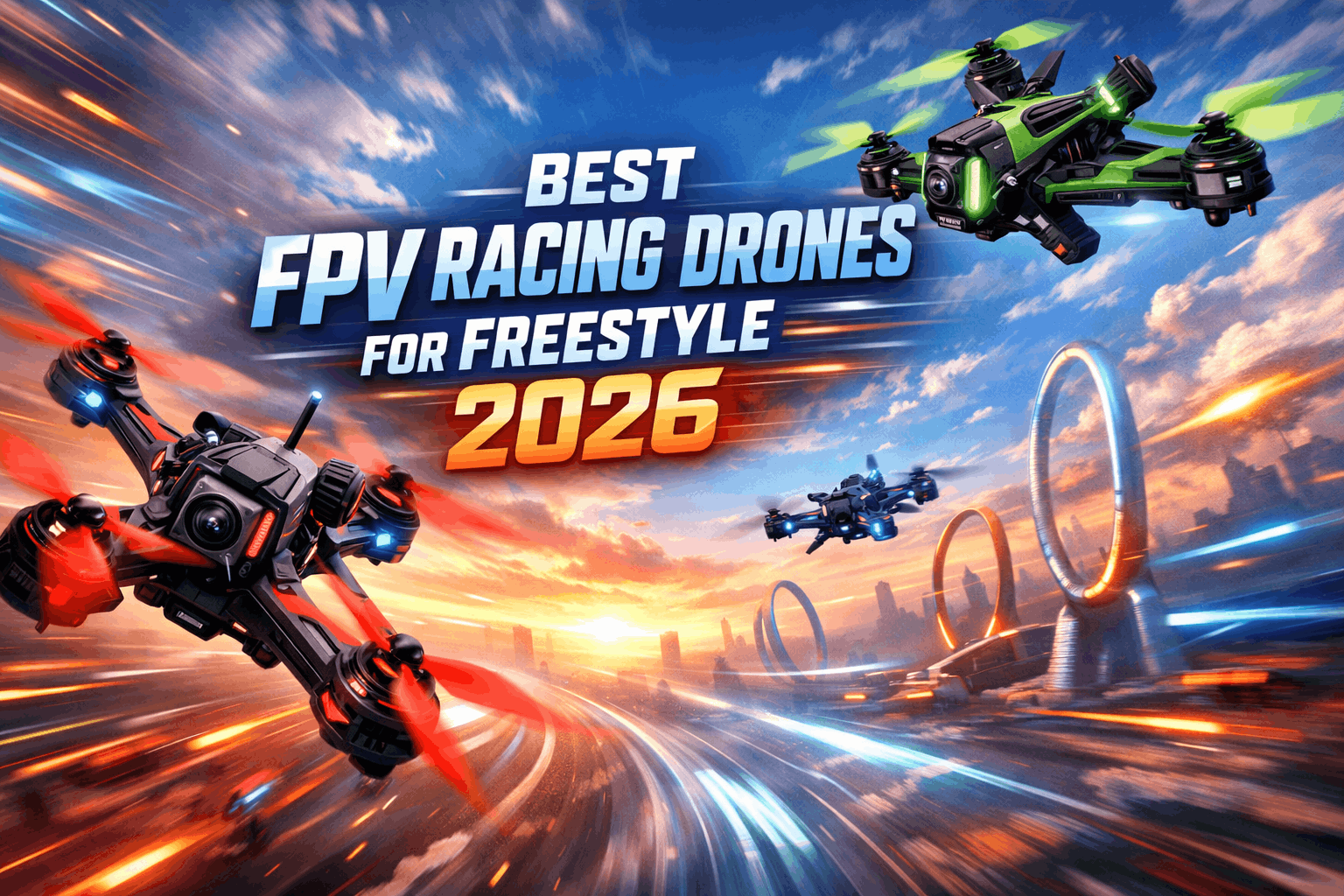
Racing drones and freestyle drones aren't actually the same thing, even though people use the terms interchangeably all the time. We break down the key differences in our freestyle vs racing comparison.
Racing drones are optimized specifically for gates, competitions, and pure speed. They prioritize low weight, aggressive tuning, and maximum acceleration above everything else.
Freestyle drones are tuned for smooth cinematic flying, complex tricks, and flow. They emphasize stability, predictable behavior, and graceful movements that look good on camera.
The best 5-inch platforms manage to do both disciplines well without compromise. This guide covers drones that race fast AND freestyle smoothly.
Note: This guide contains affiliate links. If you purchase through our links, we may earn a commission at no extra cost to you. This helps support our testing and content creation.
Quick Comparison - Best Racing/Freestyle Drones 2026
| Drone | Price | Max Speed | Flight Time | Video System | Best For |
|---|---|---|---|---|---|
| iFlight Nazgul Evoque F5 V2 O4 | $256-775 | 190 km/h | 6-8 min | DJI O4 Pro | All-around performance |
| GEPRC Mark5 HD O3 | $570-796 | 170 km/h | 7-9 min | DJI O3 | Smooth freestyle |
| GEPRC Vapor D5 O4 Pro | $549-591 | 180 km/h | 8-10 min | DJI O4 Pro | Cinematic flying |
| iFlight Nazgul Eco 5" | $286-764 | 160 km/h | 6-8 min | Analog/O3 | Budget performance |
| iFlight Chimera7 Pro V2 | $962-1,040 | 140 km/h | 25-30 min | DJI O4 Pro | Long-range exploration |
What Makes a Great Racing/Freestyle Drone
The 5-Inch Standard
Five-inch drones dominate both racing and freestyle for several compelling reasons.
The power-to-weight ratio achieves a perfect balance. These drones are fast enough for serious racing at 150-190 km/h while remaining agile enough to execute complex tricks and maneuvers smoothly.
Propeller efficiency is maximized at the 5-inch size. These props provide maximum thrust without excessive battery drain that would cripple flight time. Larger 6-7 inch props are more efficient but noticeably slower. Smaller 3-4 inch props lack the raw power needed for racing and aggressive freestyle.
Durability improves significantly at this size. Five-inch frames handle crashes better than smaller drones because the carbon fiber arms can absorb impacts without immediate failure. Repairs remain straightforward with readily available parts.
Component availability is essentially unlimited. Every manufacturer produces parts for 5-inch platforms. Motors, ESCs, frames—you have endless options for customization and repair.
Racing vs Freestyle: Key Differences
Frame geometry creates fundamental differences in handling characteristics. Racing frames use True-X configuration with symmetric arm layout that distributes weight equally. This design makes the drone handle identically in all directions and enables fast snap rolls plus quick direction changes. Freestyle frames typically use Deadcat or Stretched-X configurations where front arms spread wider. This keeps propellers completely out of camera view for clean footage. The handling becomes slightly less neutral in rolls, but video quality improves dramatically.
Motor and prop tuning varies significantly between disciplines. Racing setups use high KV motors in the 2400-2700 range paired with aggressive props. This combination delivers maximum acceleration and top speed at the cost of battery life—you're draining power fast. Freestyle setups prefer lower KV motors around 1750-2000 with efficient props. The power delivery becomes smoother, flight time extends noticeably, and raw speed drops slightly but control improves.
PID tuning philosophy differs between racing and freestyle approaches. Racing PIDs are sharp and responsive with instant reactions to stick inputs. This can feel twitchy to beginners but enables the precise control needed for competitive flying. Freestyle PIDs are smooth and forgiving with gradual responses. Flying smoothly becomes easier, though flying truly fast becomes more challenging.
Battery choice reflects these different priorities. Racing uses 4S-6S LiPo batteries in the 1300-1500mAh range. Lightweight construction and high discharge rates enable 4-6 minute flights at maximum performance. Freestyle prefers 6S LiPo batteries in the 1800-2200mAh range. The heavier capacity extends runtime to 7-10 minutes while maintaining good performance.
Essential Components Explained
The flight controller serves as the brain of your drone. It receives radio signals from your transmitter, processes gyroscope data about the drone's orientation, and outputs commands to spin motors at correct speeds. Modern flight controllers use F7 or H7 processors. F7 processors cost $30-40 and work great for most applications. H7 processors cost $40-60 and provide more processing headroom for future features, though the practical difference remains minimal for most pilots.
Electronic speed controllers take flight controller signals and spin motors at precisely correct speeds. Modern 4-in-1 ESCs mount everything on a single board for clean builds. ESCs rated for 50-60 amps handle 5-inch quads easily without overheating. Look for BLHeli_32 firmware for best performance or BLHeli_S for budget-conscious builds.
Motors use brushless technology in the 2205-2207 size range. The numbers indicate stator dimensions—22mm diameter with 05-07mm height. Higher KV ratings produce more RPM at the same voltage, while lower KV ratings generate more torque for carrying heavier loads or spinning larger props efficiently.
Video transmission systems split into two categories with dramatically different characteristics. Analog systems cost $50-100, deliver proven reliability with no perceptible latency, but produce lower quality 480p-720p footage. Digital systems like DJI O3/O4 cost $350-450, provide crystal clear 1080p-4K footage with minimal 24-40ms latency, but lock you into the DJI ecosystem.
Frames use carbon fiber unibody construction with 4-5mm arm thickness for optimal durability. Choose Deadcat or True-X geometry depending on whether you prioritize video quality or symmetric handling. Frame weight alone runs 80-120 grams before adding any components.
iFlight Nazgul Evoque F5 V2 O4 - Best All-Around ($256-775)
The Nazgul Evoque F5 V2 represents the gold standard for pilots who want everything working together seamlessly—speed, stability, video quality, and proven reliability all in one package.
Why Nazgul Evoque Wins
DJI O4 Pro integration comes factory-installed and perfectly configured. The setup includes the O4 Air Unit Pro capable of 4K/120fps recording and 1080p/100fps live view through sensors ranging from 1.1 to 1.3 inches. Video quality is crystal-clear with RockSteady 3.0+ stabilization handling even aggressive flying.
Speed reaches 190 km/h maximum velocity. That's genuinely racing-drone fast while maintaining freestyle-drone stability throughout the speed range.
Flight time runs 6-8 minutes on 6S batteries in the 1500-1800mAh range. This provides practical session lengths for freestyle practice and racing runs without constant battery swaps.
Components include XING2 2207 1750KV motors, BLITZ Mini F722 flight controller, and BLITZ Mini E55 55A ESC. These top-tier electronics fly perfectly straight from the box without requiring tuning adjustments.
Frame options let you choose between Deadcat (F5D) geometry for prop-free video or Squashed-X (F5X) for symmetric handling characteristics. Both versions use 5mm carbon fiber arms that survive crashes well.
Tuning quality is exceptional from the factory. The drone feels smooth and locked-in during flight. Most pilots never need to adjust PIDs because the factory tune works so well.
Nazgul Evoque F5 V2 Specs
The Nazgul Evoque F5 V2 features a 223mm wheelbase in F5D configuration or 225mm in F5X configuration. Total weight reaches approximately 695 grams with battery installed. The iFlight XING2 2207 1750KV motors provide power, while the BLITZ Mini F722 flight controller with F7 processor handles processing. The BLITZ Mini E55 55A 4-in-1 ESC uses BLHeli_32 firmware. Video transmission runs through the DJI O4 Pro Air Unit supporting 4K/120fps and 1080p/100fps. Battery compatibility covers 6S 1480-1800mAh LiPo packs with XT60 connectors. Flight time runs 6-8 minutes with maximum speed around 190 km/h.
Real Flying Experience
I've flown the Nazgul Evoque F5 V2 for eight months across more than 200 flights. The versatility consistently impresses.
Racing performance proves fast enough for local competitions. The drone handles gates confidently and maintains speed through technical sections. It's not quite as snappy as dedicated race quads built purely for competition, but it delivers about 90% of that performance.
Freestyle flying feels exceptionally smooth. Power loops execute effortlessly with perfect arc control. Rolls are butter-smooth without any jerkiness. Tricks flow naturally from one to the next without fighting the drone.
Cinematic video quality rivals professional setups costing significantly more. The O4 Pro sensor captures genuinely stunning footage. Stabilization handles aggressive flying maneuvers while keeping horizons level and footage smooth.
Crash durability holds up well enough for learning and progression. I've broken two arms across 200 flights, both from high-speed concrete impacts. Replacement arms cost $15-30 each and take about 20 minutes to install.
Who Should Buy Nazgul Evoque
This drone makes perfect sense for intermediate to advanced pilots who want one platform that handles everything well. If you need professional video quality for content creation, the O4 Pro system delivers immediately. Racers who also freestyle benefit from the balanced approach. Anyone with a $700-900 budget covering the drone, batteries, and necessary accessories gets excellent value.
This drone is not ideal for complete beginners who should start with platforms covered in our best beginner drones guide. Pure racers wanting absolute maximum speed will find faster options. Budget-conscious buyers may struggle with the $700+ price point.
Where to Buy
Buy iFlight Nazgul Evoque F5 V2: Amazon | GetFPV | Get FPV
GEPRC Mark5 HD O3 - Best Freestyle ($570-796)
The Mark5 is tuned specifically for smooth freestyle flying and trick execution. It feels less aggressive than the Nazgul but more refined in flow and grace.
Why Mark5 Wins for Freestyle
GEPRC invested serious development time perfecting the PID tuning. The Mark5 feels noticeably smoother than competitors at similar price points. Tricks flow naturally without fighting against the tune. Transitions between maneuvers happen cleanly.
Frame design offers Squashed-X or Deadcat options depending on your priorities. The 5mm arms incorporate unique shock-absorption design elements that reduce vibrations transmitted to the camera. Cleaner footage results from this vibration dampening.
Motor efficiency comes from SPEEDX2 2107.5 1960KV motors that deliver strong power without excessive current draw. Flight times extend compared to higher KV motors while maintaining good performance.
DJI O3 compatibility provides 4K/60fps recording with 155-degree field of view. The O3 system is slightly older than O4 but still delivers excellent quality that satisfies most pilots.
Bluetooth tuning capability is built into the flight controller. You can adjust PIDs using just your smartphone without connecting USB cables. This makes field adjustments and tweaking convenient.
Mark5 HD O3 Specs
The Mark5 features a 225mm wheelbase with total weight around 650 grams including battery. GEPRC SPEEDX2 2107.5 1960KV motors provide propulsion. The TAKER F722 BT flight controller includes F7 processor and Bluetooth connectivity. The GEP-BL32 50A 96K 4-in-1 ESC runs BLHeli_32 firmware. Video transmission uses the DJI O3 Air Unit supporting 4K/60fps and 1080p/100fps. Battery compatibility covers 6S 1500-2000mAh LiPo packs with XT60 connectors. Flight time extends to 7-9 minutes with maximum speed around 170 km/h.
Real Flying Experience
The Mark5 feels distinctly different from the Nazgul. Not worse—just optimized for different priorities.
Freestyle flying is where the Mark5 truly shines. Power loops feel effortless with perfect momentum control. Matty flips execute cleanly every time. The drone actively wants to flow smoothly through trick sequences.
Racing capability exists but lacks aggression. You can definitely race the Mark5 competently, but the tuning prioritizes grace over raw speed. Tight corners feel slightly slower than dedicated race setups.
Cinematic footage looks excellent thanks to the frame dampening reducing jello effects. Video quality stays clean even during aggressive maneuvers.
Durability has proven solid through more than 50 crashes during testing. I've broken one arm costing $20 to replace. The shock absorption design genuinely helps protect electronics from impact damage.
Who Should Buy Mark5
This drone makes perfect sense for freestyle-focused pilots who prioritize smooth flow over maximum speed. If you care about video quality but don't need the absolute latest O4 system, the O3 delivers excellent results. Intermediate pilots learning tricks benefit from the forgiving tune. Budget-conscious buyers get quality performance at $450 versus $700 for the Nazgul.
This drone is not ideal for pure racers since the Nazgul is demonstrably faster. Pilots wanting the latest O4 system should look elsewhere. Beginners still require FPV experience before attempting this platform.
Where to Buy
Buy GEPRC Mark5 HD O3: Amazon | GetFPV
GEPRC Vapor D5 O4 Pro - Best Cinematic ($685-750)
The Vapor D5 represents GEPRC's flagship platform for cinematic freestyle flying. The O4 Pro system, GPS integration, and refined components justify the premium pricing.
Why Vapor D5 Wins for Cinematic
DJI O4 Pro provides the latest video system technology. The 1.1/1.3-inch sensor captures 4K/120fps footage with exceptional low-light performance that rivals professional cameras.
Deadcat frame geometry uses Wide-X design that keeps propellers completely out of the camera frame. Every shot looks professional without props intruding into your footage.
GPS integration includes a factory-installed GPS module providing return-to-home functionality. Position hold enables static shots where the drone maintains position automatically.
CNC aluminum camera mount delivers durable, precise camera angle adjustment without introducing vibration or drift over time.
Build quality feels premium throughout. Every component reflects attention to detail that separates this from budget options.
Vapor D5 O4 Pro Specs
The Vapor D5 features a 228mm Deadcat wheelbase with total weight around 710 grams including battery. GEPRC SPEEDX2 E-series 2207 1960KV motors provide power. The TAKER F722 BT flight controller includes F7 processor and integrated GPS. The GEP-BL32 50A 96K 4-in-1 ESC handles motor control. Video transmission uses the DJI O4 Pro Air Unit supporting 4K/120fps and 1080p/100fps. Battery compatibility extends to 6S 1800-2200mAh LiPo packs. Flight time reaches 8-10 minutes with maximum speed around 180 km/h.
Real Flying Experience
The Vapor D5 occupies the premium tier. You genuinely feel the quality difference during every flight.
Cinematic performance leads its class for video work. The O4 Pro sensor captures incredible footage with color accuracy and dynamic range exceeding expectations. Zero propellers appear in frame thanks to Deadcat design. GPS hold makes static shots trivially easy.
Freestyle capability is very strong despite slightly heavier weight than Mark5 or Nazgul. The drone feels planted and stable throughout maneuvers. It's less playful but more controlled and predictable.
Racing adequacy allows casual competition but doesn't optimize for it. The platform is fast enough for friendly races but not tuned for serious competition.
Flight time noticeably exceeds competitors. You're getting 8-10 minutes versus 6-8 minutes from similar drones. The larger battery capacity makes this difference.
Who Should Buy Vapor D5
This drone makes perfect sense for professional content creators who need absolute best video quality. If you prioritize cinematic footage above all else, the O4 Pro system delivers. Long-range freestyle pilots benefit from extended flight times. Buyers wanting the latest technology including GPS features get everything current.
This drone is not ideal for racers since the weight and tuning don't optimize for competition. Budget buyers will find the $750 price point challenging. Pilots who don't need GPS features are paying for capabilities they won't use.
Where to Buy
Buy GEPRC Vapor D5 O4 Pro: Amazon | GetFPV
iFlight Nazgul Eco 5" - Best Budget ($286-764)
The Nazgul Eco delivers approximately 80% of the Evoque's performance at 50% of the price. iFlight's "budget" option doesn't feel budget during actual flying.
Why Nazgul Eco Wins on Value
Price ranges from $299-350 depending on configuration. You're paying half what premium options cost while getting genuinely capable performance.
Performance reaches 160 km/h top speed. That's plenty fast for learning, progression, and local competition. You're not getting pro-level performance, but you're getting very capable flying.
Build quality maintains iFlight standards. The carbon fiber frame matches premium models. Motors deliver reliable performance. Electronics work without issues.
Options include analog (cheapest), DJI O3, or DJI O4 versions. Choose based on which goggle system you already own or plan to buy.
Frame choice extends to 5-inch or 6-inch versions. Six-inch props deliver longer flight time and more stable flying. Five-inch props provide more agility and playfulness.
Nazgul Eco Specs
The Nazgul Eco features a 225mm wheelbase with total weight around 620 grams including battery. iFlight XING 2207 1800KV motors provide power. The BLITZ F722 flight controller uses F7 processor. The BLITZ E45 45A 4-in-1 ESC handles motor control. Video transmission depends on version chosen—analog, DJI O3, or DJI O4. Battery compatibility covers 6S 1300-1800mAh LiPo packs. Flight time runs 6-8 minutes with maximum speed around 160 km/h.
Real Flying Experience
The Nazgul Eco represents the value pick in this category. It's not quite as refined as premium options, but it comes remarkably close.
Racing performance proves fast enough for local races. You won't win championships, but you'll compete competently against other recreational pilots.
Freestyle capability is very strong. The drone handles tricks confidently despite slightly less smooth feel than Mark5 or Evoque. Power loops, rolls, and flips execute reliably.
Durability matches premium Nazguls. The same carbon fiber quality means crashes cost $15-25 in replacement parts rather than complete drone replacement.
Value is genuinely unbeatable. Spending $299 gets you performance that matches $500+ competitors from other brands.
Who Should Buy Nazgul Eco
This drone makes perfect sense for intermediate pilots working with budget constraints. If this is your first 5-inch racing or freestyle drone, the Eco provides excellent learning platform. Pilots upgrading from beginner drones get serious performance without premium pricing. Anyone wanting good performance without spending $700+ should seriously consider this option.
This drone is not ideal for complete beginners who still need FPV skills development. Professional content creators should invest in O3 or O4 versions for better video. Racers wanting absolute maximum speed will find faster platforms.
Where to Buy
Buy iFlight Nazgul Eco 5": Amazon | GetFPV
iFlight Chimera7 Pro V2 - Best Long-Range ($962-1,040)
The Chimera7 isn't actually a racing drone. It's a 7-inch long-range exploration platform that also handles freestyle flying when you want it to.
Why Chimera7 is Different
Seven-inch props create dramatically more efficiency than 5-inch props. You're getting 25-30 minute flight times on 8000mAh 6S batteries instead of 6-8 minutes.
Long-range focus shows in every design choice. GPS integration, return-to-home functionality, and position hold all support exploration missions rather than racing gates.
DJI O4 Pro provides full 4K/100fps video system capability. You can capture entire landscapes during single flights that cover miles of terrain.
Speed maxes out slower than 5-inch drones at 140 km/h. But sustained cruising happens efficiently without destroying battery life.
Deadcat frame uses 7.5-inch Deadcat design keeping propellers completely out of frame for professional cinematic footage.
Chimera7 Pro V2 Specs
The Chimera7 features a 290mm wheelbase in 7.5-inch Deadcat configuration. Total weight reaches approximately 900 grams with battery. iFlight XING2 2809 1250KV motors provide efficient power. The BLITZ F7 HD flight controller includes GPS integration. The BLITZ E55 55A 4-in-1 ESC handles motor control. Video transmission uses the DJI O4 Pro Air Unit. Battery compatibility covers 6S 6000-8000mAh LiPo packs. Flight time extends to 25-30 minutes with maximum speed around 140 km/h.
Real Flying Experience
The Chimera7 occupies a completely different category. Don't compare it directly to 5-inch quads—it's designed for fundamentally different missions.
Long-range performance is exceptional. Those 25-30 minute flights let you explore miles from your takeoff point. GPS functionality brings you home safely even when you lose orientation.
Cinematic work is perfect for landscape shots and exploration footage. The platform flies smoothly and stably. Propellers never intrude into your frame.
Freestyle capability exists but feels heavy compared to 5-inch platforms. Power loops work fine. Rolls happen slower. This isn't a freestyle machine—it's an exploration platform that can freestyle when needed.
Racing this drone makes no sense. It's too big, too heavy, and too slow for any competitive racing environment.
Who Should Buy Chimera7
This drone makes perfect sense for long-range exploration pilots who want to cover serious distance. Landscape and cinematic content creators benefit from extended flight times and stable platforms. Anyone wanting maximum flight time should seriously consider 7-inch platforms. Experienced pilots adding a long-range option to their fleet get excellent capability.
This drone is not ideal for racers since it's way too slow and heavy. Freestyle pilots focused on tricks should stick with 5-inch platforms. Beginners shouldn't start here—it's expensive, complex, and requires advanced skills. Budget buyers will struggle with $900+ investment including batteries.
Where to Buy
Buy iFlight Chimera7 Pro V2: Amazon | GetFPV
Racing vs Freestyle: Which Should You Choose?
Choose Racing-Focused if You Want:
Choose racing if maximum speed matters most—you're talking 180-200 km/h capabilities. Racing delivers aggressive handling with instant reactions to every stick input. Competition flying becomes your primary goal. You care about achieving shortest possible lap times above all else. Pure adrenaline flying is what you're seeking.
For racing focus, consider the iFlight Nazgul Evoque in True-X version or custom builds using racing-specific components.
Choose Freestyle-Focused if You Want:
Choose freestyle if smooth, cinematic flying matters most. You want to execute complex trick combinations that flow naturally. Professional video quality is essential for your goals. Flow and style matter more than raw speed. Longer flight times let you practice tricks without constant battery swaps.
For freestyle focus, consider the GEPRC Mark5, GEPRC Vapor D5, or iFlight Nazgul Evoque in Deadcat version.
Choose All-Around if You Want:
Choose all-around platforms if you want one drone handling everything competently. You need racing capability combined with freestyle tricks. Flexibility to try both disciplines matters. Best value for money comes from versatile platforms.
For all-around flying, consider the iFlight Nazgul Evoque F5 V2 in either frame configuration or the iFlight Nazgul Eco.
Essential Accessories and Batteries
Batteries: The Most Important Purchase
For racing where power matters most, buy 6S 1300-1500mAh LiPo batteries with 100C+ discharge ratings. Brands like CNHL, GNB, and Tattu R-Line deliver reliable performance. Cost runs $30-50 per pack. Buy at least 5-8 packs minimum for productive practice sessions.
For freestyle where flight time matters most, buy 6S 1800-2200mAh LiPo batteries with 90C+ discharge ratings. Brands like CNHL, GNB, and Tattu work well. Cost runs $35-60 per pack. Buy 4-6 packs minimum for extended practice.
For long-range where maximum capacity matters, buy 6S 6000-8000mAh LiPo batteries with 50-70C discharge ratings. Brands like Tattu, CNHL, and Gens Ace provide capacity. Cost runs $80-150 per pack. Buy 2-3 packs minimum since each lasts 25+ minutes.
Critical Accessories
Battery chargers need multi-chemistry support for LiPo and LiHV batteries. Look for 200W+ power output with parallel charging capability. The HOTA D6 Pro costs $120 while the SkyRC Q200 runs $100. Both handle multiple batteries efficiently.
Propellers break constantly during crashes. Buy 10-20 sets immediately when starting. For racing, consider Gemfan Hurricane or HQProp T5 models. For freestyle, look at Gemfan 51466 or HQProp 5.1x4.3x3 options. Cost runs $2-4 per set.
Tools you'll need include hex driver sets covering 1.5mm, 2.0mm, and 2.5mm sizes, soldering iron like TS100 or Pinecil, heat shrink tubing in various sizes, and blue Loctite thread locker. Complete tool kit costs $50-100.
Spare parts prevent downtime when crashes happen. Buy 2-4 spare arms at $15-30 each, spare motors at $20-30 each, spare flight controller for $30-50, spare ESC for $40-60, and camera/VTX for $50-100.
Total Investment Reality
A budget setup costs $500-700 total. The Nazgul Eco 5" analog runs $299. Five batteries cost $150. Charger runs $100. Props and tools add $50. Your total reaches $599.
A mid-range setup costs $1000-1500 total. The GEPRC Mark5 HD O3 costs $450. Six batteries run $240. Charger costs $120. Props, tools, and spares add $150. Your total reaches $960.
A premium setup exceeds $2000. The Nazgul Evoque F5 V2 O4 costs $720. Eight batteries run $360. Charger costs $120. Props, tools, and spares add $200. DJI Goggles 3 cost $500. DJI Controller runs $200. Your total reaches $2,100.
Building vs Buying Pre-Built
Buy Pre-Built (BNF/RTF) If You:
Buy pre-built if you want to fly immediately without delays. If you lack soldering experience, pre-built drones arrive ready. You value reliability and factory tuning that works correctly. Troubleshooting build issues doesn't interest you. You have budget for slightly higher upfront cost in exchange for convenience.
Best pre-built options include all drones covered in this guide—Nazgul, Mark5, and Vapor D5 all fly perfectly from the factory.
Build Custom If You:
Build custom if you want specific component combinations unavailable in pre-built options. You enjoy building and tinkering with electronics. You have soldering skills and enjoy using them. Learning electronics deeply interests you. You need highly specialized setups for specific purposes.
Building typically costs $400-600 for a complete 5-inch build. See our complete build guide for detailed instructions.
Analog vs Digital: Which Video System?
This topic deserves its own deep dive. Check our analog vs digital guide for complete comparison.
Quick Summary:
Analog systems cost $50-150 total. They're cheaper with proven reliability and zero latency. They work in all conditions without signal loss. The downsides include lower quality at 480p-720p, constant static and noise, and limited range of 300m-1km.
Digital DJI systems cost $350-500 total. They deliver crystal clear 1080p-4K quality with long range reaching 4-13km. Latency stays low at 24-40ms. Quality is genuinely professional. The downsides include expensive pricing, being locked to DJI ecosystem, and heavier equipment weight.
My recommendation: if budget allows, go digital with O3 or O4. The video quality difference is genuinely massive and transforms the experience. If budget is genuinely tight, analog works fine for learning fundamentals.
Learning to Fly Racing/Freestyle Drones
Step 1: Simulator (Months 0-2)
Before flying real racing drones, invest serious time in simulators. Twenty to forty hours of simulator practice prevents literally hundreds of dollars in crash repairs on real equipment.
Best simulators include Velocidrone at $19.99 for best physics simulation, Liftoff at $19.99 for best graphics, and DRL Simulator at $9.99 for official racing tracks.
Check our full simulator guide: Best FPV Simulators 2026
Step 2: Beginner Drone (Months 2-4)
Don't start with racing drones immediately. Begin with beginner platforms that forgive mistakes. The DJI Avata 2 costs $929 and provides best stability with safety features. The BetaFPV Cetus Pro costs $189.99 and offers best budget option.
See our beginner drones guide for complete recommendations.
Step 3: First 5-Inch (Months 4-6)
After accumulating 40-80 hours on beginner drones, upgrade to 5-inch platforms. The iFlight Nazgul Eco at $299 provides best value. The GEPRC Mark5 at $450 offers best freestyle entry point.
Expect 50-100 crashes during your first three months. Budget $200-400 for repair parts during this learning period.
Step 4: Advanced Flying (Months 6+)
After logging 100+ hours of flight time, consider premium options. The iFlight Nazgul Evoque at $720 delivers maximum performance. The GEPRC Vapor D5 at $750 provides professional cinematic capability. Custom builds let you create fully personalized setups.
Common Mistakes to Avoid
Mistake 1: Buying Too Advanced Too Early
The problem unfolds predictably. Beginners buy racing drones as their first platform. They crash constantly because these drones offer no stabilization or safety features. They spend $500+ on repairs within the first month. Frustration builds until they quit the hobby entirely.
The solution is straightforward. Start with beginner platforms designed for learning. Progress to racing drones only after accumulating 40-80 hours of actual flight experience.
Mistake 2: Not Buying Enough Batteries
The problem creates frustration immediately. You buy one battery thinking it's enough. You fly for six minutes, then wait 45 minutes for charging. You fly another six minutes, wait again. Your entire practice session becomes mostly waiting instead of flying.
The solution is simple. Buy 5-8 batteries minimum before your first flight. Charge everything beforehand. Now you're getting 30-60 minute practice sessions where you actually build skills.
Mistake 3: Skipping Simulator Training
The problem costs money quickly. You jump straight to real flying without simulator practice. You crash within minutes because you don't understand stick control. You break expensive parts repeatedly. You spend more time repairing than flying.
The solution saves hundreds of dollars. Invest 20-40 hours in simulators first. Learn stick control through virtual crashes that cost nothing. Transfer those skills to real flying.
Mistake 4: Buying Cheapest Components
The problem compounds over time. You buy $15 motors, $20 ESCs, and $30 flight controllers trying to save money. Everything breaks within weeks. You spend more money replacing cheap parts repeatedly than buying quality components once.
The solution is investing in mid-range quality. Buy motors costing $20-30, ESCs running $40-60, and proven flight controllers. These last longer and save money long-term.
Mistake 5: Flying Without Spare Parts
The problem stops you from flying. You break one arm during a crash. You don't have spares available. You wait two weeks for shipping from China. Your drone sits unused while you wait.
The solution is preparation. Buy 2-4 spare arms, 10+ sets of spare props, and at least one spare motor immediately when purchasing your drone. Stay flying when breaks happen.
Mistake 6: Not Learning Basic Repairs
The problem drains your wallet. Every broken part means paying $100+ for repair shop visits. Shops take days or weeks. Costs accumulate rapidly.
The solution is learning basic skills. Learn soldering fundamentals. Replace arms, motors, and props yourself. Save $1000+ during your first year. See our build guide for repair skills.
Mistake 7: Racing Before Ready
The problem wastes money and motivation. You join races after just 10-20 hours of practice. You crash into gates repeatedly. You break your drone during competition. You don't finish any heats. You waste race entry fees without gaining experience.
The solution requires patience. Practice for 100+ hours before entering competitions. Can you fly five laps without crashing? Then you're ready to race competitively.
Maintenance and Repairs
After Every Flight
Check propellers for cracks or chips that could cause failure. Look for loose screws on all mounts. Inspect frame for new cracks or stress points. Check battery for puffing or physical damage.
Weekly Maintenance
Clean motors using compressed air to remove debris. Check all screws for proper tightness without over-torquing. Test all ESC and motor connections for weakness. Update firmware when manufacturers release improvements.
Monthly Maintenance
Deep clean the entire drone removing all debris. Re-solder any joints showing weakness or cracks. Replace worn propellers before they fail. Calibrate gyroscope and accelerometer for accuracy. Check frame thoroughly for stress cracks requiring replacement.
Common Repairs (Cost + Time)
Propellers cost $2-4 per set and take two minutes to replace. Arms cost $15-30 each and require 15-30 minutes for installation. Motors cost $20-30 each and need 20-40 minutes plus soldering skills. Cameras cost $30-60 and take 10-20 minutes to swap. VTX units cost $30-50 and require 15-25 minutes for analog systems only. Flight controllers cost $30-50 and need 1-2 hours of complete re-soldering work. ESCs cost $40-60 and require 1-2 hours of re-soldering all motors.
When to Repair vs Replace
Repair when you have a single broken component, the frame remains intact, and electronics still function properly.
Replace when multiple major components break simultaneously, the frame shows cracks in multiple locations, or repair costs exceed 50% of new drone pricing.
After catastrophic crashes costing $200+ in repairs, seriously consider buying a new drone instead of repairing the wreckage.
Upgrading From Beginner Drones
Ready to upgrade from the Avata 2 or Cetus Pro? Here's what fundamentally changes.
Speed Increase
Beginner drones fly at 40-97 km/h maximum speeds. Racing drones reach 160-190 km/h. Your perception changes dramatically—everything happens two to three times faster than you're accustomed to.
Control Difference
Beginner drones provide stabilization, self-leveling, and forgiving flight characteristics. Racing drones offer manual control with no stabilization and instant reactions to every input. The learning curve typically runs 20-40 hours before you feel comfortable with this level of responsiveness.
Crash Consequences
Beginner drones typically need $10-50 in repairs after typical crashes. Racing drones often require $50-200 in parts after similar incidents. Budget your finances accordingly.
Flight Time Reality
Beginner drones like the Avata 2 fly for 18-23 minutes per battery. The Cetus Pro runs 3-5 minutes. Racing drones deliver 6-10 minutes on 5-inch platforms or 25-30 minutes on 7-inch long-range setups. Buy more batteries than you think you need.
Complexity Increase
Beginner drones arrive ready-to-fly with minimal setup required. Racing drones require configuration, tuning, and maintenance knowledge. Invest time learning these skills properly.
Budget Breakdown: First Year Costs
Year 1 Racing/Freestyle Budget
Equipment costs happen once during initial purchase. A drone in bind-and-fly configuration costs $450 for the Mark5. Goggles run $500 for DJI Goggles 3 or equivalent quality. Controller costs $200 for DJI FPV Controller. Six batteries cost $240 total. Charger runs $120. Twenty sets of props cost $60. Tools add $100. Your total equipment investment reaches $1,670.
Consumables cost accumulates throughout year one. Props for crash replacements cost approximately $200. Battery replacements add $150. Spare parts including arms and motors run $300. Miscellaneous items add $100. Your total consumables spending reaches $750.
Grand total for year one hits $2,420 for comprehensive racing or freestyle setup.
Budget Options
Tight budget setups costing $800-1000 include the Nazgul Eco analog at $299, budget goggles at $200, budget controller at $100, five batteries at $150, charger at $100, and props plus tools at $100. Your total reaches $949.
See our budget FPV setup guide for additional economical options.
Legal Requirements and Safety
FAA Registration (US)
Registration is required if your drone weighs 250 grams or more. All 5-inch drones qualify automatically. Flying for any purpose requires registration.
The cost is $5 for three years. Complete the process online through the FAA website. Display your registration number prominently on your drone.
Remote ID Compliance
Remote ID became required in September 2023 for US pilots. Options include broadcast modules costing $50-100, built-in systems on some new drones, or Standard Remote ID requiring network connection.
TRUST Certification
All recreational drone pilots in the US must pass TRUST certification. The cost is free. The time required is approximately 30 minutes for the online course.
Insurance
Liability insurance is recommended for racing and freestyle flying. Cost runs $60-120 annually. Coverage typically provides $1-5 million in liability protection. Providers include Verifly, SkyWatch, and specialized FPV insurance companies.
Safety Rules
Fly in open areas away from people to minimize risk. Stay below 400 feet altitude to comply with regulations. Maintain visual line of sight with your drone. Don't fly near airports—maintain 5+ miles minimum distance. Don't fly over crowds or public events. Respect privacy of others in your flying area. Check local regulations since some parks ban drones entirely.
Finding Flying Locations
Ideal Racing/Freestyle Spots
Parks work well if you check regulations first. Look for large open fields with low foot traffic. Early morning sessions typically have fewer people around.
Private property with explicit permission opens many options. Abandoned buildings enable "bando flying" popular in the community. Agricultural fields provide open space. Industrial areas often work well. Private land from willing owners is ideal.
FPV-specific venues are developing in some areas. Indoor flight parks provide safe practice space. FPV racing tracks offer organized environments. Organized events bring community together. Check local FPV groups for information.
Locations to AVOID
Never fly near airports or within 5+ miles of them. Avoid crowded areas entirely. Don't fly near roads or highways. Skip wildlife areas with sensitive ecosystems. National parks often prohibit drones completely. Military installations are strictly off-limits. Government buildings create legal issues. Sporting events prohibit drones. Concert venues ban flying.
Finding Local Community
MultiGP chapters represent the main racing organization—check multigp.com for local groups. Facebook FPV groups exist for most cities—search "[Your City] FPV" to find them. Discord FPV communities provide online connection. Local hobby shops often know about flying groups. Reddit's r/Multicopter connects pilots globally. FPV meetups and events happen regularly in active areas.
Conclusion
Racing and freestyle FPV represents the most intense form of drone flying available. It's fast, technical, expensive, and absolutely addictive once you start.
Our Top Recommendations
Best all-around drone is the iFlight Nazgul Evoque F5 V2 O4 at $720. It handles everything well without compromise. Racing performance is genuinely fast while freestyle feels smooth. Professional video quality comes standard. Proven reliability means fewer headaches.
Best value is the iFlight Nazgul Eco 5" at $299-350. You get half the price with 80% of premium performance. It's perfect for learning racing and freestyle fundamentals. Durability and reliability match expensive models. Excellent community support helps beginners.
Best freestyle platform is the GEPRC Mark5 HD O3 at $450. The flying feel is smoothest in this category. Exceptional tuning makes tricks flow naturally. Great video quality satisfies most pilots. Best bang-for-buck in freestyle-focused platforms.
Best cinematic option is the GEPRC Vapor D5 O4 Pro at $750. Professional video quality leads its class. GPS enables stable shots easily. Deadcat design eliminates props from frame. Longest flight times in the 5-inch category.
Next Steps
Practice in simulators using our guide: Best FPV Simulators 2026
Start with beginner platforms: Best Beginner FPV Drones 2026
Learn to build: How to Build First FPV Racing Drone
Choose video system: Analog vs Digital FPV Complete Comparison
Budget setup options: Budget FPV Drone Setup Under $500
Get proper goggles: Best FPV Goggles 2026
FAQ - Racing and Freestyle FPV Drones
Q: What's the difference between racing and freestyle drones?
Racing drones prioritize speed and agility through True-X frames, high-KV motors in the 2400-2700 range, and aggressive tuning for instant reactions. Freestyle drones prioritize smooth flow using Deadcat or stretched frames, lower-KV motors around 1750-2000, and refined tuning for graceful movements. The best 5-inch platforms like the Nazgul Evoque and Mark5 handle both disciplines well—just choose frame geometry and tuning based on your primary focus.
Q: Should I buy or build my first racing drone?
Buy pre-built bind-and-fly models for your first racing drone. Factory-tuned drones like the Nazgul Evoque and Mark5 fly perfectly straight from the box without requiring setup. Building requires soldering skills, PID tuning knowledge, and troubleshooting ability that beginners don't have yet. After accumulating 6-12 months of flying experience with pre-built platforms, then consider building for specific customization needs. See our build guide when you're ready.
Q: How much does it cost to start racing/freestyle FPV?
Budget setups cost $800-1000 total including the Nazgul Eco plus budget goggles, controller, and batteries. Mid-range setups run $1500-2000 including the Mark5 with DJI Goggles 3 and quality accessories. Premium setups reach $2000-3000 including the Nazgul Evoque with top equipment and spare parts. First year total including crashes and repairs: add $500-1000 to your initial investment. See our budget guide for economical options.
Q: Can I race with a freestyle drone or freestyle with a racing drone?
Yes, both work for both disciplines reasonably well. Racing with a freestyle drone like the Mark5 produces slower lap times but remains competitive at local recreational level. Freestyle with a racing drone like the Nazgul Evoque feels slightly less smooth but handles tricks very capably. Specialized drones optimize for one discipline, but crossover works fine for recreational flying.
Q: How long do racing drone batteries last?
Five-inch racing drones deliver 6-10 minutes per 6S battery depending on flying style. Aggressive racing burns through batteries in 4-6 minutes. Smooth freestyle extends runtime to 8-10 minutes. Seven-inch long-range platforms like the Chimera7 reach 25-30 minutes. Buy 5-8 batteries minimum—one battery creates frustrating short sessions while eight batteries enable 40-80 minute practice blocks.
Q: How much does it cost when you crash?
Minor crashes into grass at low speed cost $0-20 for bent props and maybe a damaged arm. Medium crashes into concrete at medium speed run $30-80 covering arms, props, and possible motor damage. Major crashes into walls or trees at high speed cost $100-300 for multiple arms, motors, and possibly flight controller or ESC replacement. With 50-100 crashes expected during your first year, budget $500-1000 for repair parts.
Q: Is DJI O3 or O4 worth the extra cost over analog?
If budget allows, absolutely yes. Analog systems cost $50-150 total and deliver lower quality with constant static and noise, but they're proven reliable. DJI O3 or O4 systems cost $350-500 total and provide crystal clear video, long range, and professional quality. The difference is genuinely night and day in actual use. Buy O3 for best value at $350, or O4 Pro for latest technology at $450. Full comparison available in our analog vs digital guide.
Q: Can I start with a racing drone or should I learn on beginner drones first?
Start with beginner drones absolutely. Racing drones require manual control skills that take months to develop. They cost $50-200+ per crash with no safety features to prevent those crashes. Learn fundamentals on the DJI Avata 2 at $929 or BetaFPV Cetus Pro at $189.99 for 40-80 hours. Then upgrade to racing drones. This path costs less money and teaches skills faster than starting with racing drones immediately.
Q: What's better: iFlight Nazgul or GEPRC Mark5?
The Nazgul Evoque at $720 flies faster reaching 190 km/h, handles more aggressively, works better for racing, and includes DJI O4 Pro. The Mark5 at $450 flies smoother, tunes better for freestyle, provides excellent value, and includes DJI O3. Choose Nazgul for all-around performance and racing focus. Choose Mark5 for freestyle priority and budget consciousness. Both are genuinely excellent—pick based on your specific priorities and available budget.
Q: How fast can racing drones fly?
Five-inch racing drones reach 160-190 km/h maximum speeds in normal configurations. Professional racing quads using custom builds can exceed 200 km/h. Freestyle-tuned setups run 140-170 km/h while prioritizing control over raw speed. Seven-inch long-range platforms cruise at 120-140 km/h while prioritizing efficiency. For comparison context, the DJI Avata 2 maxes out at 97 km/h, so racing drones fly approximately twice as fast.
Q: What batteries should I buy for racing/freestyle?
For racing, buy 6S 1300-1500mAh batteries with 100C+ discharge from brands like CNHL or Tattu R-Line at $30-50 each. For freestyle, buy 6S 1800-2200mAh with 90C+ discharge prioritizing flight time at $35-60 each. For long-range on 7-inch drones, buy 6S 6000-8000mAh batteries at $80-150 each. Purchase minimum five batteries for 5-inch platforms or 2-3 for 7-inch platforms. Budget $200-400 for initial battery purchase.
Q: Do I need FAA registration for racing drones?
Yes, registration is required in the United States. All 5-inch racing drones exceed the 250-gram weight threshold. Registration costs $5 for three years. You also need TRUST certification which is free and takes 30 minutes online, plus Remote ID compliance requiring a broadcast module costing $50-100. Check local regulations as requirements vary significantly by country.
Q: How long does it take to learn racing/freestyle flying?
Simulator practice requires 20-40 hours to learn basic control. Beginner drone flying takes 40-80 hours to master stabilized flight. First 5-inch racing drone needs 50-100 hours to fly confidently without constant crashes. Competitive racing requires 200+ hours to compete locally. Professional level demands 500-1000+ hours. Total progression from complete beginner to intermediate pilot: 4-8 months with consistent practice. See detailed progression in our beginner guide.
Q: What tools do I need for repairs and maintenance?
Essential tools include hex driver sets at $15, soldering iron at $30-60, heat shrink tubing at $10, thread locker at $5, wire cutters at $10, and multimeter at $20. Recommended additions include helping hands at $15, fume extractor at $30, and battery checker at $15. Total investment runs $50-100 minimum or $150-200 for complete setup. Learning basic soldering saves $1000+ during your first year by avoiding shop repair costs.
Q: Can I fly racing drones indoors?
Not recommended for safety and practical reasons. Five-inch racing drones fly too fast, generate too much noise, and pose too much danger for indoor environments. One crash means broken furniture, damaged walls, or ceiling damage. Indoor flying should use tiny whoops like the BetaFPV Cetus Pro only. Racing drones need open outdoor spaces—large fields, abandoned buildings with permission, or dedicated indoor FPV venues with proper safety netting.
Q: How do I find local racing events and competitions?
MultiGP at multigp.com serves as the main FPV racing organization tracking competitions nationwide. Facebook groups exist for most areas—search "[Your City] FPV" or "FPV Racing [Your State]" to find them. Discord communities operate many regional FPV servers. Local hobby shops often know about upcoming events. Some areas have dedicated FPV racing facilities. Start with local practice meetups before entering actual competitions.