Introduction
I flew analog exclusively for my first year in FPV. Static, dropouts, blurry video — I loved it because I didn’t know anything better. Then a friend let me try his DJI goggles at the field and I couldn’t go back. Sold my analog setup within a week.
But here’s the thing — I recently put an analog system back on a beater quad for a specific reason, and I realized analog still has genuine advantages that digital can’t match. This isn’t a “digital is better, period” article. I’ve flown both extensively and each has real strengths depending on what you’re trying to do.
This guide contains affiliate links. Purchases through these links support FPVDroneGuide.com at no extra cost to you.
Quick Comparison
| Analog | Digital (DJI/Walksnail/HDZero) | |
|---|---|---|
| Image quality | Blurry, 480-540p | Clear, 720p-1080p |
| Latency | Near-zero (<5ms) | 10-40ms depending on system |
| Range | 1-3km typical | 2-20km+ depending on system |
| Signal failure | Graceful (static increases) | Abrupt (freezes then black) |
| Cost (full system) | $100-200 | $420-800 |
| Weight | 10-25g VTX | 30-60g air unit |
Analog: What It’s Actually Like
The Image
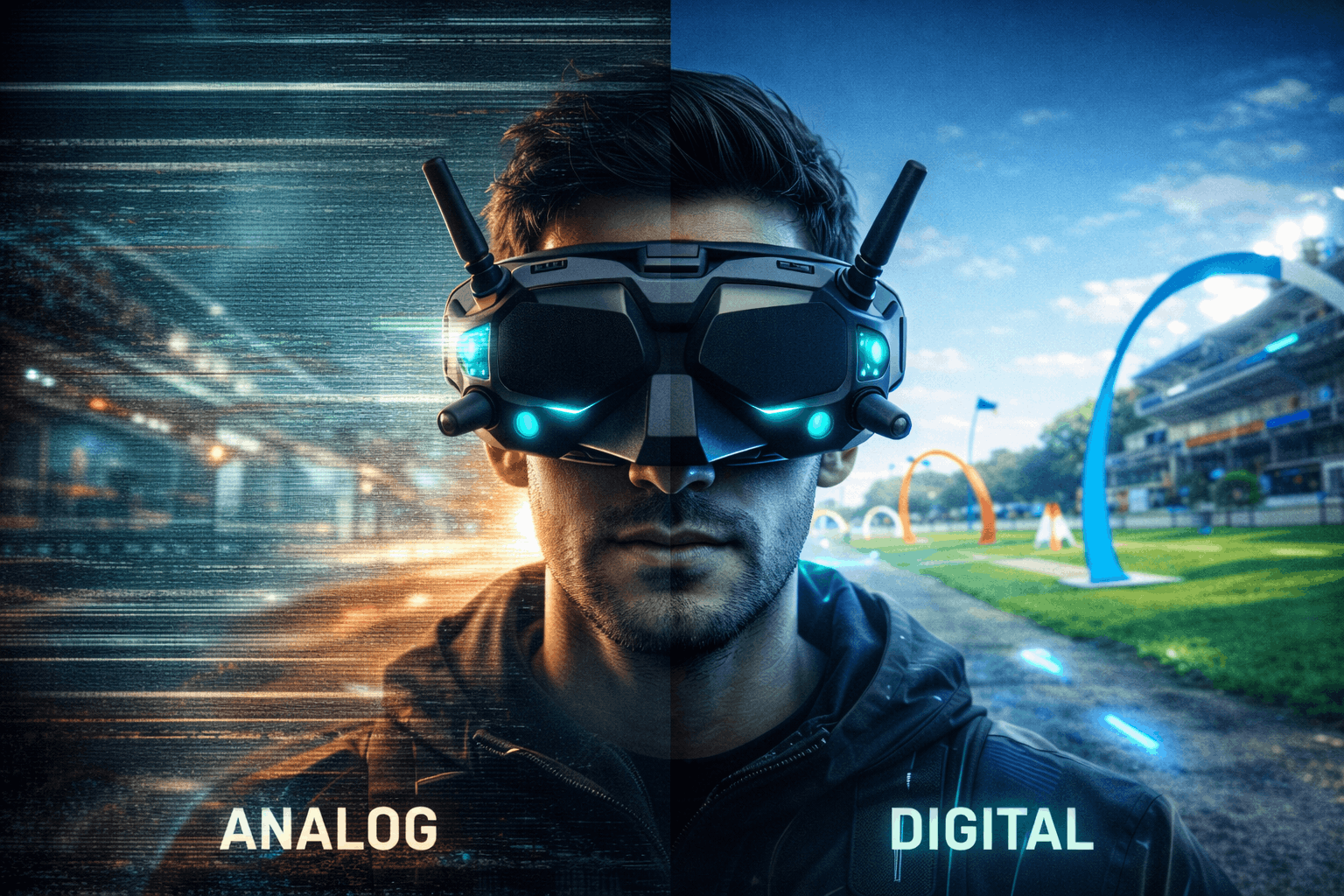
Analog video looks like old TV — soft, noisy, with scanlines visible if you look for them. Resolution is roughly equivalent to 480p. Colors are washed out. Fine details like thin branches, power lines, and small gaps are hard to distinguish, especially at distance. When I flew analog, I relied on spatial memory more than visual detail. I’d scope out a spot by walking around first, memorizing where the obstacles were, then fly the route I’d planned because I couldn’t always see them clearly in the goggles.
With digital, I can spot obstacles in real-time that analog would’ve hidden. I remember one session on analog where I clipped a wire fence I literally couldn’t see in the video feed — it was too thin and too similar in color to the background. On digital, that same fence is obvious.
But here’s what analog does better: the image degrades gradually. As you fly further out, static increases progressively — like turning down the signal on an old TV. You always have SOME image, even if it’s noisy. Digital systems freeze, pixelate, then go completely black with no warning. I’ve had my DJI feed cut to a black screen for 2-3 seconds at range extremes, which is terrifying when your quad is moving at 80km/h. With analog, I always had enough visual information to orient myself and bring the quad back, even at the very edge of range. That graceful degradation is a genuine safety advantage that digital hasn’t solved.
Latency: Analog’s Genuine Advantage
Analog latency is essentially zero — the image you see is what’s happening RIGHT NOW. Digital systems encode, transmit, decode, and display, which adds 10-40ms of delay depending on the system.
For casual flying and freestyle, I genuinely cannot feel the difference between analog’s 0ms and DJI O4’s 15-20ms. My brain adapted within one flight. But a racing friend who competes regularly and switches between analog and digital for different events swears analog feels more “connected” through tight gates. He describes it as the difference between looking through a window versus looking at a screen — technically seeing the same thing, but the analog feed feels more immediate. Whether that’s measurable performance difference or psychological, it’s a real experience for competitive pilots.
I tested this myself during a practice race session. I flew the same track on analog and DJI digital, same quad otherwise. My lap times were within 0.3 seconds — not enough to conclude anything. But the analog runs felt more responsive, even if the times didn’t prove it.
Why I Put Analog Back on a Quad
Weight. My micro beater quad — a 3” toothpick build that I fly recklessly through parks — runs analog because the VTX weighs 3g versus 30g+ for any digital air unit. On a 150g all-up build, that’s a 20% weight difference. The quad flies noticeably more agile with analog — faster rolls, snappier response, better power-to-weight ratio on tiny motors. For pure proximity freestyle where image quality doesn’t matter (I’m 5-15 meters from the quad anyway), analog still makes practical sense.
There’s also the “don’t care if it breaks” factor. An analog VTX costs $15. A digital air unit costs $150-300. When I’m sending my 3” toothpick through sketchy gaps and occasionally into brick walls, I’d rather risk a $15 component than a $200 one.
Digital: What Changed Everything
The Image Revolution
The first time I looked through DJI digital goggles, I literally said “oh wow” out loud at the field. After a year of analog, seeing 1080p clarity — individual leaves on trees, text on signs, the texture of brick walls — was transformative. I could fly through gaps I wouldn’t have attempted on analog simply because I could SEE them clearly. My camera choices matter more on digital too. On analog, every camera looked roughly the same because the transmission bottleneck smeared out any quality differences. On digital, the difference between a cheap camera and a good one is clearly visible in the goggles.
The confidence boost was immediate. Within a week of switching to digital, I was flying tighter proximity than I’d ever attempted on analog — not because my skills improved overnight, but because I could actually see what I was flying near. Gaps that looked like dark blobs on analog were clearly defined openings on digital.
Range: No Contest
My analog setup reliably worked to about 1km in open areas with clear line of sight. Past that, static became distracting and I was making decisions partly on faith. Past 1.5km, I’d start heading back because the image was too degraded to fly confidently.
My DJI O4 setup works crystal clear to 8km+ in rural terrain. I’ve tested it over agricultural fields and the feed at 6km looked identical to the feed at 200 meters. My Walksnail reaches about 4km before noticeable degradation. Even HDZero at 2-3km beats analog for usable image at range. For any long-range flying, digital is mandatory — and it’s not close.
Recording Quality
Analog DVR (recorded footage from the goggles) looks terrible — blurry, noisy, with visible interference artifacts. I never shared analog DVR footage because it was genuinely unwatchable by modern standards. Any footage I wanted to keep had to come from an action camera mounted on the quad, which adds weight and cost.
Digital DVR is actually good. My DJI O4 DVR footage is 1080p and looks respectable posted on YouTube or social media. It’s not GoPro quality, but it’s shareable and recognizable. For pilots who want to document their flights without the expense and weight of an action camera, digital DVR is a genuine benefit that analog simply can’t match.
Cost Breakdown: Real Numbers
Analog Full System
- VTX (transmitter): $15-30
- Camera: $15-30 (like the Runcam Phoenix 2)
- Goggles: $70-150 (Eachine EV800D or similar box goggles)
- Total: $100-210
DJI O4 Full System
- Air unit: $200-300
- DJI Goggles 3: $400-500
- Total: $600-800
Walksnail Avatar Full System
- Air unit: $150-200
- Walksnail goggles or compatible: $300-400
- Total: $450-600
HDZero Full System
- VTX + camera: $120-160
- HDZero goggles: $300-400
- Total: $420-560
For a detailed comparison of all three digital systems, see our Walksnail vs DJI O4 vs HDZero guide.
The gap is real: analog is 3-6x cheaper for a complete system. For budget builds under $500, analog makes the math work because you can put the savings toward more batteries and better components elsewhere. For multi-drone setups, analog saves hundreds because you only need cheap VTXs ($15-30) on additional quads versus expensive digital air units ($150-300) each.
When to Choose Each
Choose Analog If:
- You’re on a strict budget and want to fly NOW — $100-200 for a complete video system versus $450-800 for digital
- You’re building ultra-lightweight micros where every gram matters — my 3” toothpick is 20% lighter with analog
- You’re building multiple beater quads and don’t want $200+ air units on each crash-prone build
- You race competitively and want absolute minimum latency — some MultiGP racers still prefer analog for this reason
Choose Digital If:
- You want the best flying experience available (this is most people)
- You fly long-range or cinematic — analog’s 1km usable range is a hard limitation
- You want usable DVR footage without mounting an action camera
- You can afford the upfront cost and plan to fly regularly
- You’re a beginner and want orientation to be easy — digital’s clarity makes learning significantly less frustrating
My Personal Setup
I run digital (DJI O4) on my main freestyle 5”, my cinematic builds, and my long-range 7”. I run analog on my 3” beater toothpick. If I could only choose one system for everything, digital wins — the image quality advantage improves every aspect of flying. But I’m glad I still have an analog quad for specific situations where weight and cost matter more than video quality.
The Transition Experience
If you’re currently on analog and considering switching: the adaptation takes about 2-3 flights. The latency feels weird for the first pack — everything seems slightly delayed, like the video is playing back a recording instead of showing you real-time. By the third pack, your brain recalibrates and you stop noticing. By the fifth pack, you can’t believe you ever flew analog on a 5” quad.
Going BACK to analog (which I did for the toothpick build) is harder. The image quality shock is brutal — it genuinely looks broken after months of digital clarity. I spent the first session squinting at the goggles thinking something was wrong with the VTX. But after a few packs, my brain re-adapted and I was fine. Humans are remarkably good at adjusting to image quality in both directions. The point is: don’t worry about the transition either way. Your brain handles it faster than you’d expect.
FAQ
Is analog really dead?
No. It’s declining but still used for specific applications — micro builds, beater quads, racing (where some pilots prefer zero latency), and budget setups. Analog components are still manufactured and widely available. The used market is also flooded with cheap analog gear from pilots who upgraded. It’s not going anywhere in the next 2-3 years.
Can I start analog and upgrade to digital later?
Yes, and many pilots do. The radio transmitter and controller transfer between systems — only the VTX, camera, and goggles change. I did exactly this transition: started analog, switched to DJI after 8 months. The flying skills transfer perfectly. The only “waste” is the analog goggles you’ll no longer use, but those resell for $40-80.
Which digital system should a beginner pick?
DJI O4 if budget allows — most mature ecosystem, easiest setup, best overall experience, and the strongest long-term support. Walksnail Avatar is a solid budget alternative if DJI’s price is too steep. See our full digital system comparison for a detailed breakdown of all three options.
Will I notice 15ms latency difference from analog?
In freestyle and cinematic flying: almost certainly not. I can’t reliably tell in blind testing. In competitive racing through tight gates at high speed: possibly, but the evidence is more anecdotal than scientific. If you’re not racing competitively, latency should not drive your analog vs digital decision. The image quality difference matters infinitely more for everyday flying.
Can I use analog goggles with digital systems?
No. They’re completely incompatible. Analog goggles receive analog radio signals. Digital goggles decode proprietary digital signals. There’s no adapter or converter that bridges them. This is the main cost barrier to switching — digital means new goggles ($300-500), and that’s the most expensive single component in any FPV video system.