Introduction
$300 isn't much for FPV. But it's real money for many people, and a real budget constraint. The good news: you can absolutely start flying FPV for $300—not with premium gear, but with legitimate equipment that works.
This guide covers complete system recommendations, smart compromises, used market strategies, and realistic expectations. We'll respect the budget without recommending garbage.
Note: This guide contains affiliate links. If you purchase through our links, we may earn a commission at no extra cost to you. This helps support our testing and content creation.
The $300 Budget Reality Check
What $300 Can Actually Buy
Legitimate FPV experience. Real learning platform. Hours of flying fun. Community participation. Upgrade foundation.
What $300 cannot buy: Premium components. Multiple quads. Extensive spare parts. Latest technology. Professional-grade anything.
The Honest Mindset
"If I can only spend $300, can I really learn FPV?" Yes. Will you have the best gear? No. Will it be enough? Absolutely.
The budget isn't a failure of commitment—it's a constraint you're working within. Many successful FPV pilots started with similar budgets. The limiting factor isn't money; it's patience through learning.
Smart Budget Strategies
Used market savvy matters. Quality used goggles at half new price fundamentally change what's possible in $300. You'll keep goggles years; drones you'll crash.
Refurbished opportunities exist. Retailer open-box items, manufacturer refurbs, demo units—all save money without sacrificing function.
Priority spending hierarchy. Some components matter more for learning. Understand where dollars matter most.
Realistic timeline. You're not staying at $300 forever. This is phase one. Plan phase two.
Complete System Requirements
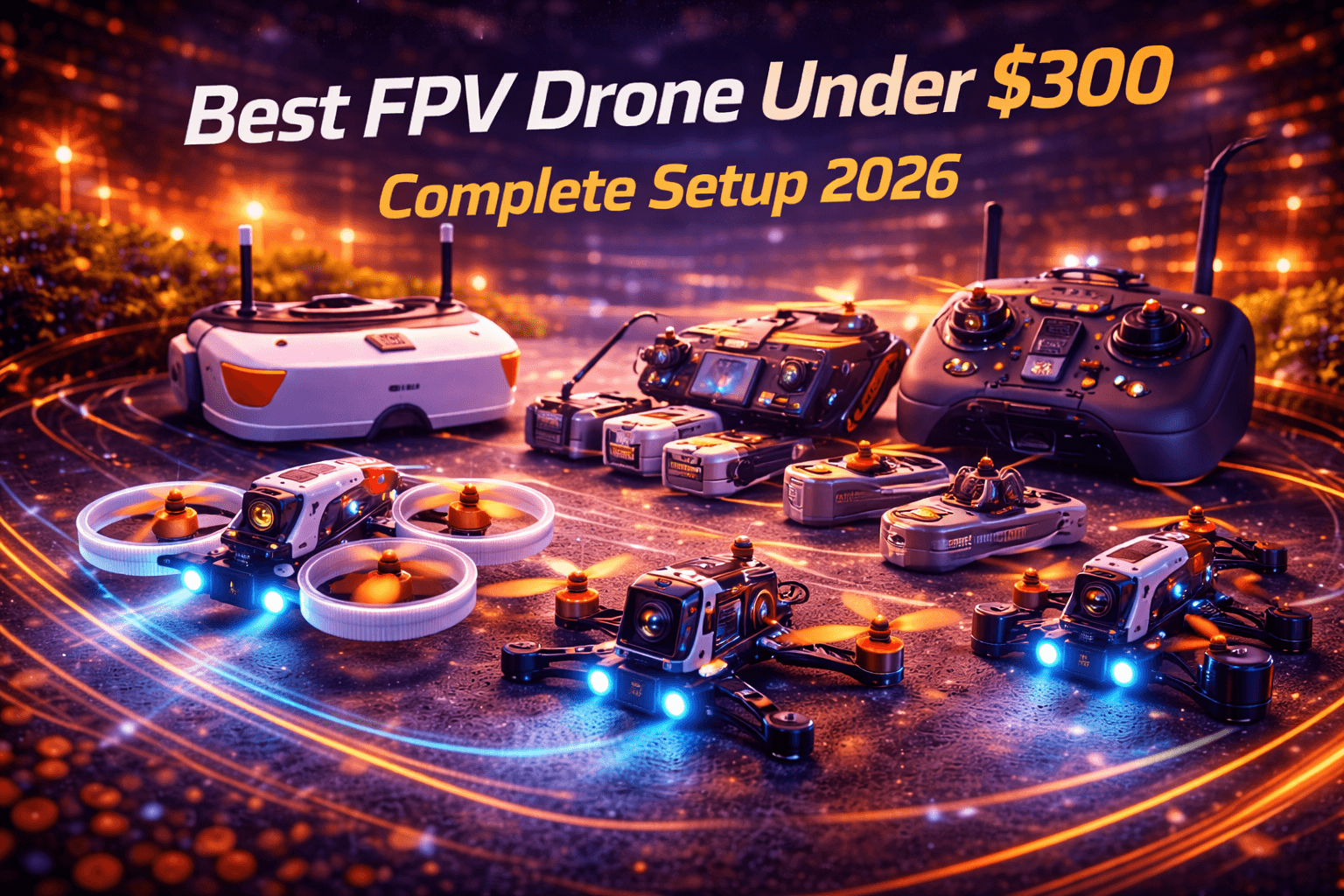
What You Actually Need (And Total Costs)
The drone ($80-150): Your learning tool. You'll crash it. Budget-friendly.
FPV goggles ($80-150): How you see. You'll keep these years. Worth investing in.
Radio transmitter ($50-80): Controls the drone. Budget models work fine.
Batteries ($30-50 for 3-4): Fuel for flying. New only (safety).
Charger ($10-30): Charges batteries safely. New only (safety).
Total: $250-410 (tight, but workable)
The Math Challenge
$300 for everything is aggressive. It forces choosing: do you buy all new budget stuff, or mix new/used strategically?
Most successful $300 pilots use hybrid approach: used quality goggles + new budget drone + new batteries/charger + used or budget radio.
Smart Budget Allocation Strategies
Scenario 1: All New, All Budget ($300)
Allocation:
- Tinyhawk 3 RTF kit: $239-299
- Extra batteries: $20-30
- Spare props: $5-10
What this gives you: Everything brand new, warranties included, tested compatibility, zero learning curve to use it.
What you sacrifice: Goggles might be tight budget (basic box), minimal spare parts, no wiggle room for damage.
Best for: Risk-averse learners, older people, those valuing safety/simplicity.
Scenario 2: Strategic Used Focus ($300)
Allocation:
- Used quality goggles (Fatshark, Sky Zone): $120
- Budget new tiny whoop drone: $100-120
- Used quality radio (Radiomaster, FrSky): $50-70
- New batteries (3-4): $35-45
- New charger: $15-20
What this gives you: Better core components, goggles that don't suck, radio that feels good to hold.
What you sacrifice: Used market risk (no warranty), need to verify functionality, research time.
Best for: Technically savvy learners, patient shoppers, those with access to used market knowledge.
Scenario 3: Hybrid Balanced ($300)
Allocation:
- Refurbished/sale Emax Tinyhawk 3: $200-240
- Budget new goggles (Eachine EV800D): $80-90
- Basic radio or used quality: $50-70
- New batteries: $30-40
- Charger: $10-20
What this gives you: Balanced risk/quality, proven RTF kit, acceptable goggles, new components for safety.
What you sacrifice: Some goggle quality, minimal emergency funds.
Best for: Most people with $300 exactly.
Recommendation: Most beginners should prioritize decent goggles (you keep them years) and get a budget drone (you'll crash it). For more context, see our budget FPV setup guide.
Top Complete Setup Recommendations
Best New Equipment Setup: Emax Tinyhawk 3 RTF (~$270-300)
The Conservative, All-New Approach
What you get:
- Complete RTF kit includes: drone, goggles, radio, 2 batteries, charger, props
- Beginner-friendly power level
- Proven reliability and community support
- Everything works together (compatibility guaranteed)
- Warranties on all components
What you sacrifice:
- Basic goggles (adequate for learning, not premium)
- Only 2 batteries (limiting session length)
- Minimal spare parts
- Zero budget for upgrades immediately
Why it works:
- Tested system with no compatibility questions
- Support widely available
- Proven learning platform
- New everything = peace of mind
- Ready to fly in 30 minutes
Cost breakdown:
- Tinyhawk 3 RTF: $239-299
- Extra 1S batteries (2-3): $20-30
- Total: $259-329
Read our full Emax Tinyhawk 3 review for detailed analysis. You can find the Tinyhawk 3 RTF kit on Amazon.
Experience you get: Complete beginner FPV system, frustration-free setup, confident learning progression.
Best Value Used Setup: Mixed New/Used (~$300)
The Savvy, Strategic Approach
Drone: Budget new or used Tinyhawk/Cetus ($80-120)
- Why: You'll crash it, so budget is fine
- New advantage: warranty, guaranteed function
- Used advantage: saves $20-40, still reliable
Browse budget FPV drones on Amazon. For detailed recommendations, check our best tiny whoop guide.
Goggles: Used quality goggles ($100-130)
- Why: You keep goggles for years—worth investing in quality
- Used Fatshark Scout: $120-150
- Used Sky Zone Sky 020: $150-180
- Used Eachine budget: $70-90
- Why used: New equivalent costs $150-200
- Inspection critical: power on, focus check, no dead pixels
See our best FPV goggles guide for what to look for. When ready for new, browse FPV goggles on Amazon.
Radio: Used quality Radiomaster or FrSky ($50-70)
- Why: Quality transmitter feels better, lasts longer
- Used Radiomaster TX12: $60-80
- Used FrSky Taranis: $70-100
- New budget option: Radiomaster Pocket $65
Check our FPV controllers guide for recommendations. Browse FPV radios on Amazon.
Batteries: New only ($35-45 for 4)
- 1S 650mAh batteries: $8-12 each
- Never used—safety critical
- Battery checker essential: $5
Find 1S LiPo batteries on Amazon. Read our FPV battery guide for proper care.
Charger: New ($15-20)
- Basic balance charger sufficient
- Safety critical—buy new
Total: $280-365 (tight on upper end, target $300)
What this gives you: Better quality components, goggles you'll want to keep, radio that feels professional, balanced quality.
What you sacrifice: Used market hunting time, compatibility research, no warranties, verification needed.
Used Market Shopping Guide
Where to Find Quality Used Gear
Facebook Marketplace FPV groups: Active community, local pickup available, can inspect before buying.
Reddit r/RCClassifieds: Reputation system, active sellers, shipping common.
RCGroups classifieds: Older platform, established sellers, good deals.
Local FPV clubs: Best option—meet pilots, inspect gear, get advice.
eBay: Protection for buyers, established sellers, higher prices than direct sales.
What to Inspect Before Buying
Goggles:
- Power on successfully
- Check for dead pixels
- Focus adjustment works
- Battery holds charge
- All buttons function
- No physical cracks
Radio:
- Gimbals smooth (no grinding)
- All switches work
- Battery compartment clean
- Charge port functional
- Test range if possible
Drones:
- Motors spin freely
- Frame intact (no cracks)
- Wires properly connected
- Bind with radio
- Hover test if possible
Red Flags to Avoid
"Sold as-is, no returns" might mean broken.
"Never tested" or "found in garage" probably broken.
Heavily modified unless you understand modifications.
Incomplete kits without clear parts list.
Suspiciously cheap compared to market value.
What You're Compromising at $300
Equipment Compromises (Being Honest)
Goggles quality: Budget goggles have lower resolution, less comfort on face, shorter battery life. But they work. You can learn FPV in them.
Drone capability: Budget drones have less power, fewer features, heavier builds. But they fly. You can learn on them.
Radio ergonomics: Budget radio might feel cheap, have fewer channels, less comfortable grip. But controls work fine.
Spare parts buffer: Minimal—one broken prop means you're grounded until replacement arrives.
Charging speed: Basic charger slow. Limited simultaneous charging. Planning around charge time required.
Experience Compromises
Can't fly multiple quads: One drone means limited session variety.
Limited battery endurance: Few batteries means short sessions between charges.
Slow charging creates downtime: Waiting for batteries discourages practice.
Less comfortable gear means less flying: Uncomfortable goggles = less eager to fly.
What You're NOT Compromising
Ability to learn FPV: Budget gear learns the same skills as expensive gear.
Legitimate flying experience: You're flying real FPV, in real goggles, controlling real drone.
Community participation: Budget pilots are everywhere. Welcome.
Skill development: Smooth flying comes from practice, not price.
Fun factor: $300 quad is genuinely fun to fly.
Critical point: These compromises delay convenience and comfort, not core learning.
Realistic Upgrade Path from $300
Priority Upgrade Order
1. More batteries (immediate value): Add 4-6 batteries for $35-60. Immediately extends sessions from 10 minutes to 30-40 minutes flying.
2. Better charger (efficiency gain): Upgrade to 6-channel charger for $40-60. Charge multiple batteries simultaneously instead of one-at-a-time.
3. Improved goggles (quality of life): Save $150-300 over time for better goggles. Better view, better comfort, better experience.
4. Additional/better drone (capability): Once comfortable, maybe want different quad type. 5-inch racing, indoor cinewhoop, etc. Check our guides on best FPV drones and beginner FPV drones.
5. Advanced radio (last priority): Current radio works fine—upgrade when wanting advanced features.
Why this order: First three maximize current gear immediately. Drone you'll eventually outgrow or crash; keep saving for goggles instead.
Budget Upgrade Timeline
Month 1-3: Fly $300 setup, assess actual needs.
Month 3-6: Add batteries ($50-100) + better charger ($30-50) = $80-150 invested, doubled capability.
Month 6-12: Save toward goggles upgrade ($150-300).
Total invested over first year: $300 + $150-450 = $450-750 for solid mid-range setup through gradual accumulation.
Making $300 Work Long-Term
Maintenance Extends Equipment Life
Careful flying extends quad life: Controlled crashes > aggressive crashes. Learn smooth flying protects your investment. Practice in FPV simulators first.
Regular maintenance: Clean sensors, inspect for damage, store properly. See our FPV maintenance guide.
Battery care critical: Proper storage, balanced charging, never over-discharge.
Component inspection: Catch wear early before catastrophic failure.
Spare Parts Planning
Props first priority: Break constantly. Stock $10 worth. Find replacement props on Amazon.
Common failure items: Motors ($15), arms ($5), solder joints.
Budget gradually: $20-30 monthly adds up to useful spare parts stock.
Learning to Repair
DIY maintenance saves money: Soldering, prop replacements, motor swaps. Check our soldering guide.
Basic soldering essential: Iron, solder, practice. ~$50 investment saves $200+ in repair costs.
Community help: FPV community shares knowledge freely.
YouTube tutorials: Free repair guides for nearly everything.
Flying Smart
Practice in safe spaces: Grass fields > concrete. Fewer crashes. See our guide on best places to fly.
Avoid expensive crash patterns: Crashing into water, electrical lines, unsafe locations. Read our crash recovery guide.
Progression at your pace: Master smooth flight before attempting difficult shots.
Simulator supplements real flying: Liftoff costs $20 but prevents expensive crashes.
FAQ
Q: Is $300 really enough to start FPV, or am I wasting money?
A: $300 is tight but legitimate for starting FPV if you're smart about component selection. Thousands of pilots learned on similar budgets. The risk isn't that $300 is insufficient—it's buying the wrong $300 worth of gear. Follow proven recommendations, accept you won't have premium equipment, focus on learning smooth flying. You can upgrade later without regret. Money is wasted buying junk that doesn't work or doesn't fit your needs—smart $300 spending gets you flying.
Q: Should I buy everything new or go used on a $300 budget?
A: Strategic mix works best. ALWAYS buy batteries new (safety). New charger too (safety). Used goggles justified—quality used goggles at $100-120 vs new budget at $80-100, but used are better. Used drones acceptable if you verify functionality. Used radio fine if quality model. Most savvy buyers: used goggles + new drone + new batteries/charger + budget or used radio.
Q: What's the biggest mistake people make with $300 FPV budgets?
A: Buying the cheapest possible everything. A $40 drone that doesn't fly right plus $50 goggles you can't see through wastes $90. Better to spend $300 on fewer quality items. Second mistake: not budgeting for batteries—need minimum 4-5 for meaningful sessions. Third: expecting $300 gear to perform like $1000 setups, getting disappointed. Realistic expectations + proven gear selection = success.
Q: Can I start with just a drone and upgrade goggles/radio later?
A: Don't do this. You need goggles to fly FPV—they're not optional. Phone FPV via WiFi has terrible latency (unusable). Budget goggles under $70 are usually junk. If $300 is absolute max, either save $100-200 more or look at complete RTF bundles ($350-400) including everything. Proper FPV requires proper goggles from day one.
Q: How long will $300 budget gear last before needing upgrades?
A: Physical durability: properly maintained budget gear lasts years. Performance limitations: you'll outgrow beginner drones in 6-12 months (want more power/capability), but goggles can serve 1-2+ years. Budget doesn't mean disposable—it means basic. You'll want upgrades as skills grow, not because gear failed. Budget for incremental improvements ($50-100 every few months) rather than complete replacement.
Q: What if I crash and break my entire $300 setup?
A: Most crashes damage replaceable parts (props, arms, motors). Budget $20-30 for initial spare parts kit. Catastrophic crashes destroying everything are rare with careful flying. Worst case: you're out $100-150 on drone replacement, but keep goggles/radio. This is why learning smooth flying matters—budget gear means repair costs hurt more. Practice simulator first, fly cautiously initially, build confidence gradually. Smart flying protects investment.
Q: Should I wait and save $500 instead of starting now with $300?
A: Depends on timeline and motivation. $500 buys noticeably better gear—more comfort, better capability, less compromise. If you're certain about FPV commitment, waiting 2-3 months for better setup makes sense. But if excited now and $300 available, start flying. Experience gap between $300 and $500 is real but not game-changing for learning. You're mastering same fundamentals either way.
Q: What's the bare minimum I could spend and still have a real FPV experience?
A: Around $250-300 with smart shopping. Below that enters "toy-grade junk" territory. Absolute floor with aggressive used market hunting: $150-200 if finding incredible deals. But realistically, $250-300 minimum for satisfying beginner experience. Under that, compromises actively hurt learning. If $200 absolute max, it's possible but extremely basic. Most people find $300 practical minimum.
Final $300 Recommendation
The winning strategy:
If buying all new: Emax Tinyhawk 3 RTF ($239-299) + spare batteries.
If mixing new/used: Used quality goggles ($100-120) + new budget drone ($100-120) + new batteries ($35-40) + basic charger ($15-20) + radio ($40-60).
Critical success factors:
- Research before buying (wrong gear wastes money)
- Buy proven equipment, not cheapest
- Account for ALL costs upfront
- Budget for spare parts ($20-30)
- Plan upgrade path ($100-150 over 6 months)
- Start flying and learning immediately
- Don't apologize for budget—maximize it
Your $300 gets you:
- Real FPV experience
- Legitimate learning platform
- Community participation
- Foundation for upgrades
- Hours of genuine enjoyment
It's not premium, but it's real. Start here, fly, learn, upgrade thoughtfully. Every experienced pilot started somewhere—many started with less than $300.
The budget isn't the limitation. Your willingness to learn is what matters.
If you're ready to start your budget FPV journey, browse complete beginner FPV packages on Amazon. Smart component selection makes all the difference at this price point.