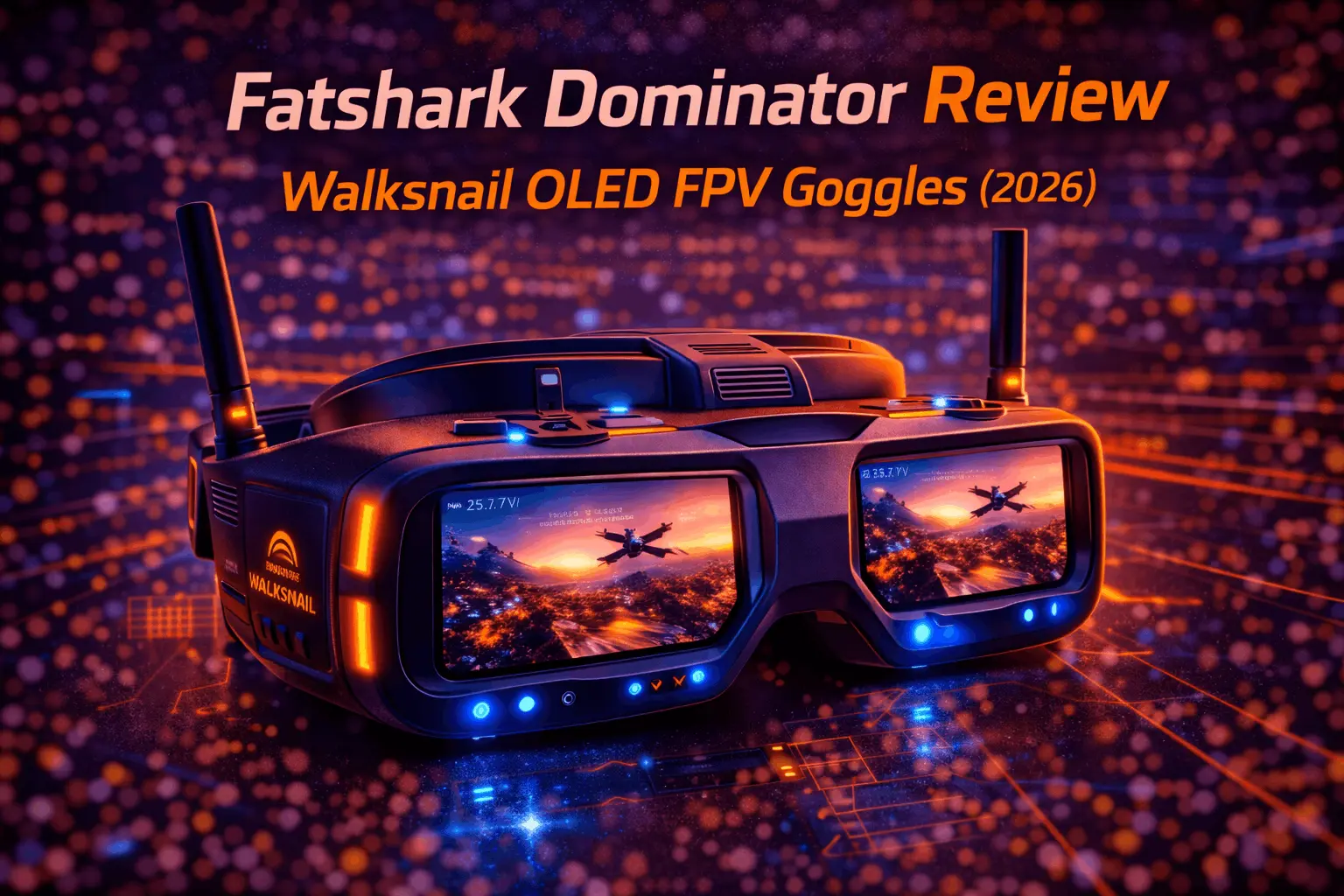
The Fatshark Dominator HD (FSV1125) marks Fatshark’s return to relevance in the digital FPV era. Built around Walksnail Avatar technology with dual Full HD OLED panels, these goggles deliver genuinely impressive image quality in a compact, comfortable package. After months of flying them across freestyle sessions, park rips, and lazy weekend whoop flights, here’s my honest take on whether they justify the ~$600 price tag.
Let me be upfront about what these goggles are: dedicated Walksnail Avatar goggles with OLED screens. They don’t support analog, HDZero, or DJI natively. No module bay, no AV input, no HDMI input. If you need multi-system support, you’re looking at the wrong goggles. But if you’re committed to the Walksnail ecosystem and want the best possible display for it, the Dominator makes a strong case.
Specifications
| Specification | Fatshark Dominator HD |
|---|---|
| Model | FSV1125 |
| Display Type | Dual OLED Micro Displays |
| Resolution | 1920×1080 per eye (Full HD) |
| Field of View | 46° diagonal |
| IPD Adjustment | 57–70mm (mechanical) |
| Focus Adjustment | +2 to -6 diopters |
| Supported System | Walksnail Avatar (V1 & V2 VTX) |
| DVR | Built-in HD recording |
| Video Output | USB-C |
| Input Voltage | 7–21V (2S–5S LiPo) |
| Weight | ~200g (without battery) |
| Head Strap | Adjustable, padded |
| OSD Support | Betaflight Canvas Mode |
A few critical things the spec sheet doesn’t scream at you: antennas are NOT included (budget another $30–50 for a set of Lumenier AXII HD or similar), battery is NOT included ($25–40 for a 2S goggle pack), and diopter lenses are separate ($30–50 per set). That $600 price tag climbs quickly once you factor in the essentials.
What’s in the Box
The Dominator ships with the goggles, adjustable head strap, carry case, XT60 power cable, lens cloth, and documentation. You’ll need to source antennas, a battery, and a Walksnail Avatar VTX/camera separately. Fatshark’s page is clear about this—these goggles need to be paired with a compatible Avatar VTX and camera to function.
Display Quality: The Reason You’d Buy These
The OLED panels are the Dominator’s strongest argument, and they deliver. This is the section where the money shows.
Resolution and Clarity
1920×1080 per eye is a massive step up from older LCD goggles. Individual pixels vanish at normal viewing distance—you get a clean, continuous image rather than a visible pixel grid. OSD text is sharp and readable at a glance, even the smaller Betaflight telemetry elements. When you’re threading gaps in a bando or reading battery voltage mid-pack, that clarity matters. Coming from 720p LCD goggles, the jump is dramatic. Coming from other 1080p options, the OLED rendering still gives the Dominator an edge in perceived sharpness thanks to the contrast characteristics.
OLED Contrast and Color
This is where OLED earns its premium. True blacks—not “dark gray that your brain learns to call black.” When you’re flying through a shadowed tree line with patches of bright sky, the Dominator renders both extremes simultaneously without washing out either end. Colors are vibrant without being oversaturated. Flight footage looks natural and alive through these panels.
I’ve flown back-to-back with LCD goggles using the same Walksnail VTX, and the Dominator makes the same feed look noticeably better. The contrast advantage is most obvious in mixed-lighting conditions—exactly the scenarios where you’re doing interesting flying.
Brightness and Outdoor Use
Brightness is adequate for most conditions. Indoor, shaded outdoor, and overcast flying are all fine. Direct sunlight is the weak point—you’ll want to position yourself with your back to the sun or find shade. The light shields help, but this is a compact goggle reality, not a Dominator-specific flaw. Adjustable brightness settings let you optimize for conditions, and most flying sessions happen in acceptable lighting.
Field of View: The Trade-Off
At 46° diagonal, the Dominator sits in “comfortable but not immersive” territory. It’s wide enough that you don’t feel like you’re looking through binoculars, but narrower than box-style goggles (often 50°+) or the DJI Goggles 3 at ~51°. If you’ve flown box goggles and loved the wide peripheral view, 46° will feel like a step back. If you’ve used other compact Fatshark goggles, it’ll feel familiar.
For FPV flying specifically—where your attention is locked on the center of the feed—46° works. You’re not playing VR games; you’re flying through gaps and reading your OSD. The moderate FOV is the price you pay for the compact form factor that makes these comfortable.
Comfort: Where Fatshark Earns Its Reputation
After 90+ minutes of continuous flying, the Dominator is still comfortable on your face. This matters more than most spec comparisons suggest.
Weight and Fit
At roughly 200g without battery, the Dominator doesn’t create that neck-strain feeling you get from heavier goggles during long sessions. The foam padding covers all contact points without compressing flat after a few uses. Weight distribution is balanced across the adjustable three-point head strap—top and sides—so there’s no single pressure point pulling the goggles down your nose.
The strap materials feel durable. After months of use, mine haven’t shown the fraying or loosening I’ve experienced with cheaper goggle straps. Small detail, but when you’re adjusting fit between pilots at a group fly, it matters.
IPD and Vision Correction
The mechanical IPD adjustment covers 57–70mm, which fits most adults. Getting this dialed correctly is worth spending time on—wrong IPD means eye strain and blurry edges that you’ll blame on the display when it’s actually your setup.
For pilots who wear glasses: the Dominator is tight with anything but the smallest frames. Diopter correction lenses (sold separately, ~$30–50) are the practical solution. They install as inserts and work well. If you wear contacts for flying, this isn’t a concern. Budget for diopters during your purchase—trying to fly with glasses crammed under these goggles isn’t a good experience.
Heat and Extended Use
Moderate warmth during typical flying is normal. The optional fan-equipped faceplate (sold separately) helps with circulation and fog prevention. In hot weather, you’ll notice heat more, but it’s manageable for typical session lengths. The anti-fog ventilation design works well enough that I rarely deal with fogged lenses, even transitioning from air-conditioned cars to humid outdoor flying.
Walksnail Avatar Integration
The Dominator is built for Walksnail Avatar, and the integration shows. This isn’t a generic goggle with Walksnail bolted on—it’s a purpose-built display for the Avatar ecosystem.
What Works
Pairing with Avatar VTX units (V1 and V2) is straightforward. Power on, bind, fly. Full HD quality displays correctly on the OLED panels, and the combination of Walksnail’s feed with OLED contrast genuinely produces a better-looking image than the same system displayed on LCD alternatives. All Walksnail latency modes function as designed. OSD integration through Betaflight Canvas Mode works cleanly. DVR recording captures your flights internally.
Firmware updates happen via microSD card. Walksnail pushes regular updates that improve performance, and the Dominator receives corresponding firmware to maintain compatibility. The update process is straightforward if occasionally tedious.
What Doesn’t
No multi-system support. This is the Dominator’s biggest limitation. There’s no built-in analog receiver, no module bay for HDZero, no HDMI input, no AV input. If you own quads running different video systems, the Dominator only covers your Walksnail builds. Your analog whoop? Different goggles. Your DJI quad? Different goggles. This is a meaningful constraint for pilots with mixed fleets.
The Walksnail ecosystem itself is smaller than DJI’s. Fewer tutorials, fewer community resources, and firmware updates that sometimes break things before they fix them. That’s a Walksnail consideration rather than a Dominator one, but it affects your experience with these goggles.
How It Compares
Versus Walksnail Avatar HD Goggles X (~$459)
The Avatar Goggles X is the direct successor to the Dominator, and this comparison matters most for anyone considering the Dominator today.
The Goggles X brings a wider 50° FOV, lighter 290g weight (somehow lighter despite more features), broader multi-system support (Walksnail, analog, and HDZero with adapter), and 100fps capability for lower latency. The Dominator counters with… a lower price if you find it discounted, since retailers are clearing stock.
Honestly, if you’re buying new today, the Avatar Goggles X is the better buy in most scenarios. The Dominator makes sense if you find it significantly discounted or if the 50° FOV of the X somehow doesn’t suit you.
Versus DJI Goggles 3 (~$499)
Different ecosystems entirely. DJI Goggles 3 works with DJI O3/O4 air units. The Dominator works with Walksnail Avatar. If you’re already committed to one ecosystem, this comparison is academic. For system-agnostic buyers: DJI offers a wider FOV, more mature ecosystem, and better integration with DJI quads. The Dominator offers OLED contrast advantages and Walksnail’s open-ecosystem approach. Your system choice drives this decision, not the goggle comparison. Check our Walksnail vs DJI O4 vs HDZero comparison for the system-level decision.
Versus HDZero Goggle 2 (~$649)
The HDZero Goggle 2 targets racers with 3ms glass-to-glass latency and supports both HDZero and analog. It’s a box-style goggle with wider FOV but bulkier form factor. If racing latency is your priority, HDZero wins. If Walksnail image quality and compact comfort matter more, the Dominator wins. Different tools for different flying styles.
Who Should Buy the Fatshark Dominator
Buy If:
You’re committed to Walksnail Avatar and want the best OLED display experience for the system. The Dominator genuinely makes Walksnail footage look its best.
You prioritize comfort for long flying sessions. Fatshark’s fit is earned, not marketed. If you fly multiple packs per session, comfort compounds.
You found them heavily discounted. With the Avatar Goggles X now available, Dominator stock is clearing at significant discounts. At $400 or under, they’re excellent value for Walksnail-committed pilots.
You value compact form factor. The Dominator packs into a bag more easily than box-style alternatives. Travel-friendly for flying trips.
Skip If:
You need multi-system support. No analog, no HDZero, no DJI. If your fleet runs mixed systems, look at the Avatar Goggles X or HDZero goggles with module support.
You’re buying new at full price. At $600 retail, the Avatar Goggles X at $459 offers more features and flexibility. The math doesn’t favor the Dominator at MSRP anymore.
DJI is your primary system. DJI goggles are the only real option for DJI air units. The Dominator has zero DJI compatibility.
You’re a first-time buyer unsure of your system. Committing $600 to Walksnail-only goggles before you know your preferred ecosystem is premature. Start with something more flexible or use a simulator first, then decide on your video system.
Battery and Power
The Dominator accepts 7–21V input (2S–5S LiPo) via XT60 connector. Common choices include dedicated 2S 2000–3000mAh goggle packs, 18650-based battery cases, or small 3S–4S packs if you prefer lighter weight with higher voltage.
A 2S 3000mAh pack gives roughly 3–4 hours of use—more than enough for a full day of flying unless you’re doing marathon sessions. Budget $25–40 for a goggle battery. Fatshark sells a USB-charging battery pack with LED indicator as an accessory, which is convenient if you don’t want to deal with LiPo charging for your goggles.
FAQ
Can I use the Dominator with DJI, analog, or HDZero?
No. The Fatshark Dominator HD (FSV1125) only works with Walksnail Avatar VTX units. There’s no analog receiver, no module bay, no HDMI input, and no AV input. It’s a Walksnail-only goggle. If you need multi-system support, look at the Walksnail Avatar Goggles X or the Fatshark HDO+ with receiver modules.
Is the Dominator the same as the Walksnail Avatar Goggles?
Essentially yes. The Fatshark Dominator HD and the Walksnail Avatar HD Goggles use identical Walksnail Avatar technology and share the same firmware. The Dominator is white, the Avatar version is black. Same internals, same capabilities.
Are the Dominator goggles still worth buying in 2026?
At full retail price (~$600), probably not—the Walksnail Avatar Goggles X offers more features for less money. At a significant discount ($350–400 range), the Dominator becomes a solid deal for pilots committed to the Walksnail ecosystem who want excellent OLED display quality.
What antennas should I buy for the Dominator?
Lumenier AXII HD antennas are the most popular recommendation and work well. Budget $30–50 for a pair. The goggles ship without antennas, so this is a required purchase, not optional.
How does OLED compare to LCD in FPV goggles?
OLED provides true blacks, higher contrast ratios, and more vibrant colors. In practical FPV use, this means better visibility in mixed-lighting conditions—shadows stay dark while bright areas don’t wash out. LCD goggles have improved significantly, but OLED still holds a visible advantage in contrast and color reproduction. Whether that advantage justifies the price premium depends on your priorities.
Is 46° FOV too narrow?
For most FPV flying, 46° is adequate. Your attention is focused on the center of the feed during flight, so extreme peripheral immersion matters less than in VR gaming. Pilots coming from wider box goggles may initially notice the difference but typically adjust within a few sessions. If maximum immersion is your priority, look at box-style options or the Avatar Goggles X at 50°.
Where to Buy
Antennas (required, not included):
Lumenier AXII HD Antennas on GetFPV
Goggle Battery (required, not included):
FPV Goggle Batteries on GetFPV
Diopter Correction Lenses:
Fatshark Diopter Lenses on GetFPV
Final Verdict
The Fatshark Dominator delivers excellent OLED display quality and genuine comfort for Walksnail Avatar pilots. The screens are beautiful, the fit is comfortable for hours, and Walksnail integration works seamlessly. As a dedicated Walksnail goggle, it does its job well.
But the market has moved. The Avatar Goggles X offers more flexibility, wider FOV, and a lower price. At full retail, the Dominator is hard to recommend over its successor. At a discount—and retailers are discounting them as stock clears—it becomes a compelling option for pilots who know they want Walksnail and prioritize OLED quality and Fatshark comfort over maximum versatility.
If you’re deep in the Walksnail ecosystem and find the Dominator at a good price, it’s a solid buy. If you’re shopping fresh with no system commitment, explore your options with our complete goggles buyer’s guide first.