Introduction
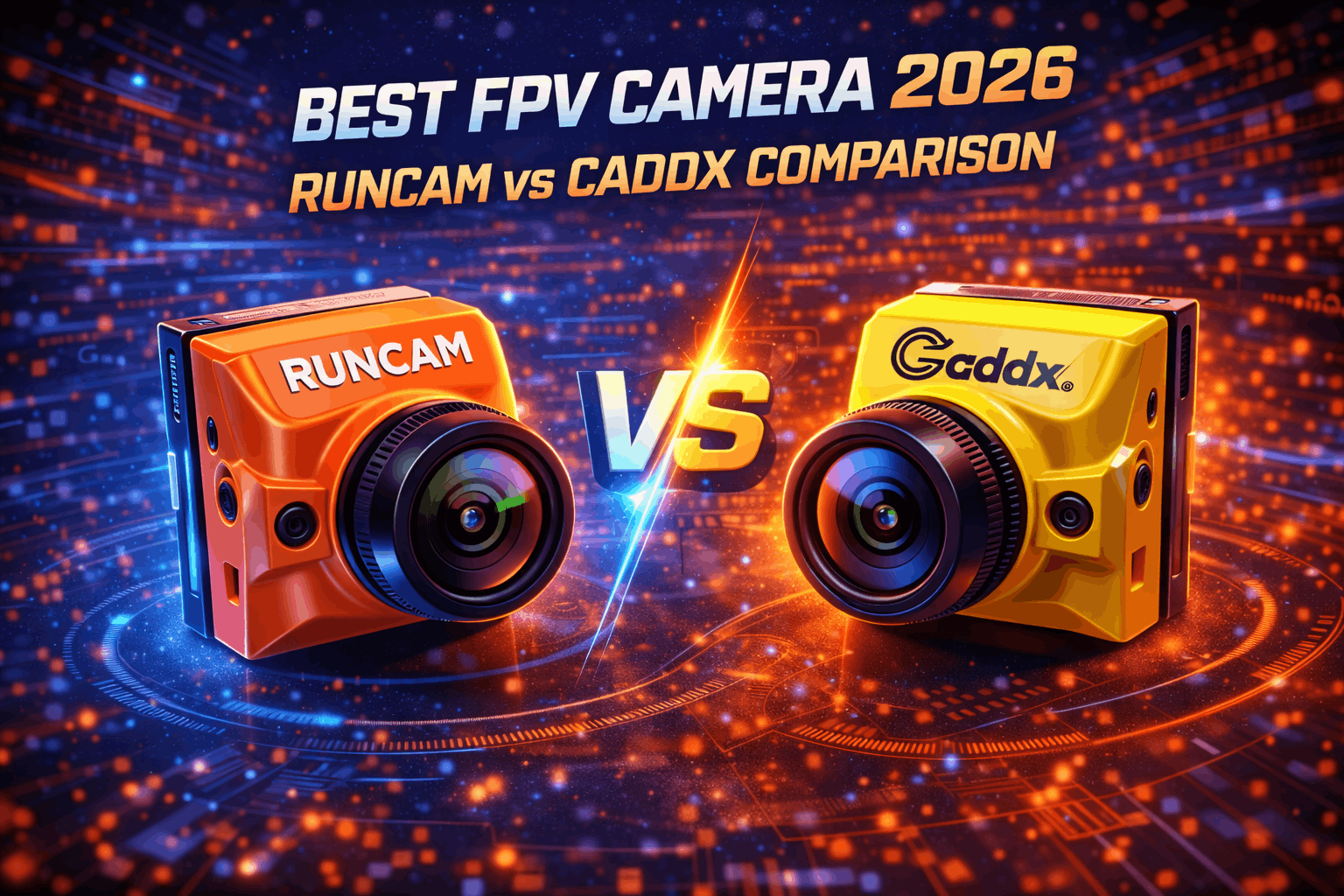
I’ve flown with pretty much every FPV camera Runcam and Caddx have made over the past three years. And the honest truth? For most pilots, the differences are smaller than forums make them seem. But for specific situations — low light, racing latency, tight builds — camera choice genuinely matters.
Your FPV camera isn’t making cinematic footage. It’s feeding your brain information fast enough that you don’t hit things at 100 km/h. Latency, dynamic range, and crash survival matter more than resolution specs or color science.
This guide covers what I’ve actually noticed across dozens of cameras, which models I keep coming back to, and where Runcam vs Caddx genuinely differs versus where it’s just preference.
This guide contains affiliate links. Purchases through these links support FPVDroneGuide.com at no extra cost to you.
What Actually Matters in an FPV Camera
I wasted money on my first few camera upgrades chasing specs that didn’t translate to better flying. Here’s what I learned matters — and what doesn’t.
Latency is everything. The delay between reality and your goggles determines how the quad “feels.” I switched from a 30ms-latency camera to a sub-10ms one on the same build, same VTX, same goggles. The difference was dramatic — gates I’d been clipping suddenly felt easy because I was seeing them earlier. Most quality analog cameras from both Runcam and Caddx sit under 10ms now, but cheaper models can creep up to 25-35ms and it’s instantly noticeable.
Dynamic range is the real differentiator. Flying from bright sunlight into a dark tree canopy in half a second is the hardest thing an FPV camera does. Good WDR (Wide Dynamic Range) means you can still see branches in shadows while the sky isn’t blown out. I’ve crashed twice specifically because a cheap camera went completely dark transitioning from sun to shade. My Runcam Phoenix 2 handles these transitions noticeably better than budget options.
Low-light capability varies wildly. If you fly at dusk — and I do regularly because it’s the best light for freestyle footage — camera choice matters enormously. The difference between a Caddx Ratel 2 and a budget cam at golden hour is like comparing HD to standard definition. At full darkness, specialized night cameras (Runcam Night Eagle series) are the only option that’s actually flyable.
What doesn’t matter much: TVL resolution differences between 1200 and 1600 TVL are academic — I can’t tell the difference in flight. Color accuracy is personal preference, not performance. Brand loyalty is pointless; both Runcam and Caddx make good and bad cameras.
My Top Picks
Best Overall: Runcam Phoenix 2 ($35-40)
This has been on three of my builds for over a year, and it’s the camera I recommend most. The WDR handling is the best I’ve used in analog — transitions from bright to dark are smooth without the “blink” some cameras do. Latency is sub-8ms. The 1000 TVL resolution is plenty. It’s survived maybe 15 hard crashes across my builds without failure.
The only downside is the form factor is standard size (19x19mm), so it doesn’t fit micro builds. For anything 3” and up, this is my default choice.
Check Runcam Phoenix 2 on Amazon
Best Budget: Caddx Ant ($15-20)
For the price, the Ant is ridiculous. I put one on a beater quad I expected to destroy, and the image quality surprised me. It’s a nano-size camera (14x14mm) that fits everything from tiny whoops to 5” builds with an adapter. Latency is around 10-12ms — not the fastest, but totally fine for freestyle and casual flying.
Where it falls short: WDR is mediocre compared to the Phoenix 2. Sun-to-shade transitions cause a brief washout. And in low light it gets grainy fast. But for $15? I’ve bought four of these as crash replacements and don’t regret any of them.
Best Low-Light: Runcam Night Eagle 3 ($40-45)
If you fly at dusk or dawn, this camera is a different world. I tested it side by side against my Phoenix 2 at sunset — the Phoenix was getting unusable grainy while the Night Eagle 3 was still producing a clean, flyable image 20 minutes later. It uses a specialized sensor with massive light sensitivity.
The trade-off: image is black and white. No color. And in bright daylight, it actually looks worse than standard cameras because of the sensor characteristics. I keep a Night Eagle on one specific quad for evening sessions and swap cameras on everything else. It’s a specialist tool, not an all-rounder.
Check Runcam Night Eagle 3 on Amazon
Best for Racing: Caddx Ratel 2 ($30-35)
My racing quad runs a Ratel 2 because the combination of low latency (sub-7ms in my testing), good WDR, and wide FOV gives me the best gate visibility. The 1200 TVL resolution provides slightly sharper edges than the Ant, which helps when you’re judging gate distances at speed.
The Ratel 2 and Phoenix 2 are honestly very close. I slightly prefer the Ratel for racing because of the marginally lower latency, and the Phoenix for freestyle because of better WDR. But either would work for both — we’re talking subtle differences.
Runcam vs Caddx: Honest Comparison
After using both brands extensively, here’s where they actually differ:
Build quality: Very similar. Both survive crashes well. I’ve had one Runcam lens crack and one Caddx connector break across probably 40+ combined hard crashes. Neither brand has a durability edge in my experience.
Menu systems: Runcam’s OSD menu is slightly more intuitive. Caddx menus work fine but the navigation takes an extra step to figure out. Minor difference once you set it up once and never touch it again.
Color profiles: Runcam tends toward warmer, slightly saturated images. Caddx tends cooler and more neutral. Neither is “better” — it’s pure preference. I prefer Runcam’s look for freestyle and Caddx’s for racing, but that might be placebo.
Availability and price: Both are widely available on Amazon. Caddx is typically $5-10 cheaper at the budget end. Runcam charges slightly more for premium models but not enough to matter.
Bottom line: Brand choice in 2026 is basically personal preference. Both make cameras that range from excellent to adequate. Pick based on the specific model that fits your needs, not brand loyalty.
Does Camera Choice Even Matter in 2026?
This is the section most camera guides won’t write. Here’s my honest take: if you’re flying digital (DJI O4, Walksnail, HDZero), your camera is integrated into the system and you don’t choose it separately. The entire Runcam vs Caddx debate is analog-only.
And within analog, the gap between a $15 camera and a $40 camera is much smaller than the gap between analog and digital. If you’re still on analog and considering a $40 premium camera, honestly consider whether that $40 is better spent saving toward a digital system.
Where analog camera choice still matters:
- Micro builds where digital doesn’t fit — tiny whoops and sub-3” quads
- Beater quads you expect to crash hard and often
- Budget builds where every dollar counts in the total setup cost
- Racing where some pilots prefer analog’s lower and more consistent latency
For these use cases, camera choice genuinely matters and the picks above reflect my real experience.
Camera Mounting Tips
A few things I learned the hard way:
Camera angle affects image quality. At steep angles (40°+), the top of your image catches more sky, which throws off auto-exposure and makes the ground darker. I run 25-30° for freestyle which keeps exposure more balanced across the frame.
Vibration kills image quality more than camera choice. A $15 camera on proper soft-mount TPU looks better than a $45 camera hard-mounted to a carbon plate. I spent weeks thinking my camera was bad before realizing my TPU mount had cracked and was transmitting motor vibration directly. Replaced the $2 mount, image was crystal clear.
Protect the lens, not just the camera. A $3 replacement lens saved my Phoenix 2 after a face-plant into gravel. I keep spare lenses in my field bag. The camera survived but the original lens was scratched beyond usability. Takes 30 seconds to swap with a tiny screwdriver.
Route your camera wire carefully. I had a camera cable get nicked by a prop after a crash shifted things around. Lost video mid-flight. Now I always zip-tie camera cables away from prop paths and check routing after every crash repair.
Common Problems and Fixes
Image is dark/washed out: 90% of the time, this is a WDR setting issue in the camera OSD, not a hardware problem. Reset to defaults and adjust from there. I’ve “fixed” three friends’ cameras this way.
Random static lines: Usually a power filtering issue, not the camera itself. Adding a capacitor to your flight controller power cleaned up static on two of my builds. Cost: $0.50 per cap.
Image flickers in certain lighting: LED lights and some artificial lighting operate at frequencies that interact with camera sensors. I notice this indoors more than outdoors. Switching between PAL and NTSC in camera settings usually fixes it.
Camera dies after crash: Check the connector first — it’s almost always a loose ribbon cable, not a dead camera. I’ve “revived” probably 5 cameras just by reseating the connector firmly.
FAQ
Does FPV camera resolution (TVL) really matter?
Barely. I’ve flown 600 TVL, 1000 TVL, and 1200 TVL cameras back to back. Above 800 TVL, the difference is marginal in flight. You’re not pixel-peeping through goggles at 100km/h. Latency, WDR, and low-light performance matter far more than TVL numbers. Don’t pay a premium for higher TVL alone.
Is analog still worth it in 2026?
For specific use cases, yes. Micro builds, budget builds, and racing still benefit from analog’s simplicity, low latency, and low cost. But for 5” freestyle and cinematic flying, digital has become the standard for good reason. If you’re building new, I’d go digital unless budget is the primary constraint.
Runcam or Caddx — which brand is better?
Neither. Both make excellent cameras and both make mediocre ones. My top pick (Phoenix 2) is Runcam, my budget pick (Ant) is Caddx, and my racing pick (Ratel 2) is Caddx. Buy the specific model that fits your needs, not the brand.
Do I need a separate camera for night flying?
If you actually fly in darkness, yes. Standard cameras are borderline unusable below civil twilight. The Runcam Night Eagle 3 is the only camera I’ve tested that produces genuinely flyable images in near-darkness, but it’s black-and-white only. For dusk/golden hour, a good WDR camera like the Phoenix 2 or Ratel 2 works fine.
How often do FPV cameras break?
Less often than you’d think. I’ve broken maybe 3 cameras total across hundreds of crashes over three years. Lenses break more often than sensors — carry spares. Connectors come loose more than components fail. The $15 Caddx Ant I expected to destroy after a week lasted 6 months of aggressive freestyle before I retired it for a different reason (upgrading the build to digital).
Should beginners worry about camera choice?
Not much. If you’re on a beginner drone, the stock camera is fine for learning. Upgrade when you can specifically identify what your current camera does poorly. “I crash into shade and can’t see” = upgrade WDR. “Everything looks grainy at sunset” = upgrade low-light. Don’t upgrade because a forum told you to.