Introduction
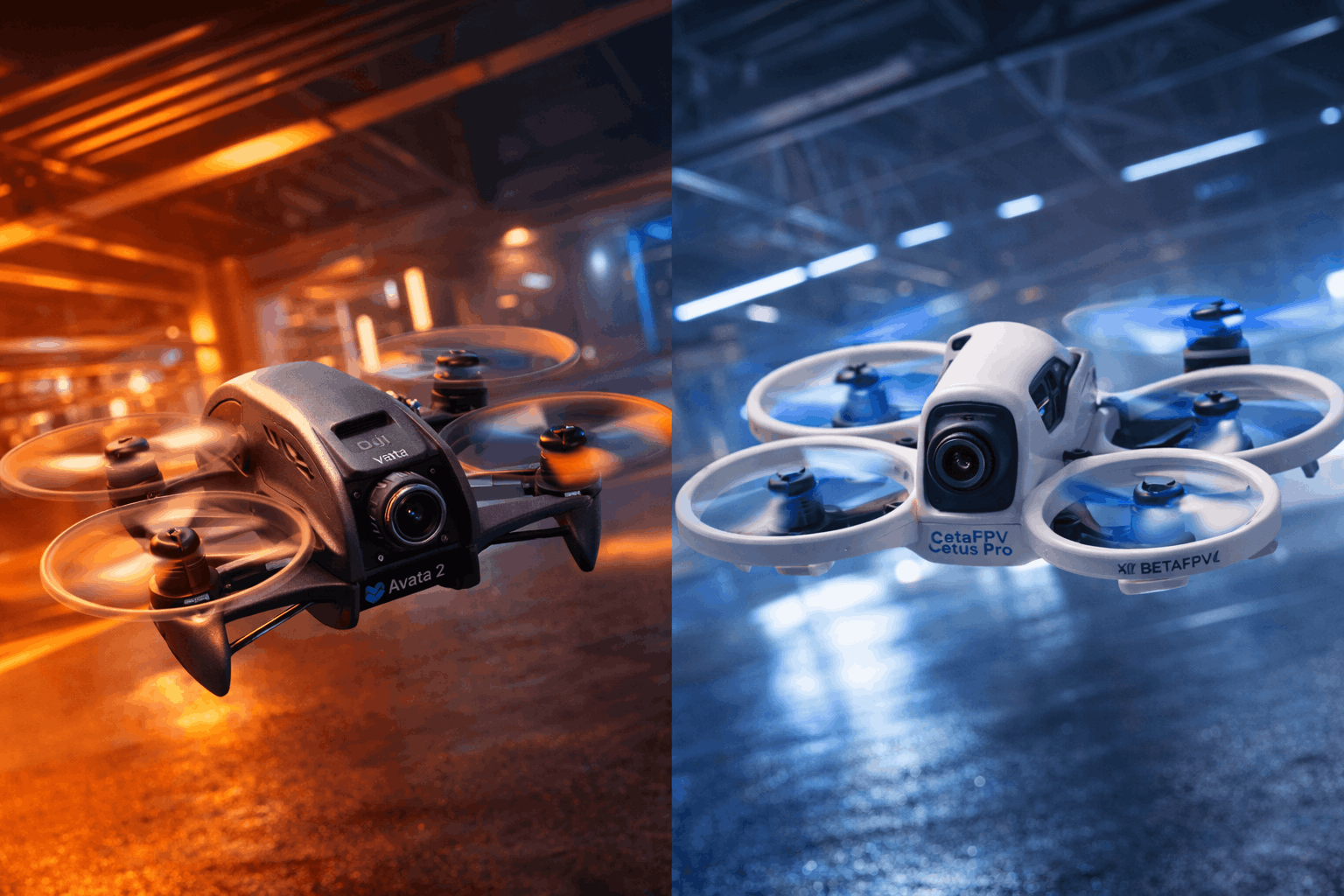
I own both of these drones. The Avata 2 is my cinematic flyer — I use it for smooth footage in parks and urban environments. The Cetus Pro was the first FPV drone I handed to my cousin who had never touched a drone in his life. Two completely different drones for two completely different situations.
The internet will tell you the Avata 2 is “better.” And spec-for-spec, it is. But “better” doesn’t mean “right for you.” I’ve watched 5 beginners learn on each of these, and the best choice depends entirely on your budget, your goals, and how committed you are to the FPV hobby.
This guide contains affiliate links. Purchases through these links support FPVDroneGuide.com at no extra cost to you.
The Price Reality Nobody Talks About
Cetus Pro: $189 and you’re flying
The kit includes everything — drone, goggles, radio, batteries, charger. You open the box, charge, and fly. No accessories needed. Total investment: $189.
I had my cousin flying indoors within 15 minutes of unboxing. No app setup, no firmware updates, no compatibility questions.
Check BetaFPV Cetus Pro on GetFPV | Check on Amazon
Avata 2: $849 is just the start
The Avata 2 Fly More Combo at $999 includes the drone, one battery, DJI Goggles 3, and the motion controller. But realistically you need extra batteries ($65 each, I’d get at least 2 more), and if you want to transition to real FPV sticks later, the DJI FPV Remote 3 is another $159.
My actual Avata 2 total: ~$1,250 before I felt properly equipped. That’s 6.5x the Cetus Pro investment.
Check DJI Avata 2 on GetFPV | Check on Amazon
How They Actually Fly
Cetus Pro Flight Experience
Three flight modes that progressively remove training wheels, and this progression is genuinely well-designed — it’s the best structured learning system I’ve seen in a beginner drone.
Normal mode: Altitude hold, limited speed, limited angle. My cousin’s first flight in this mode was immediately stable — he was doing laps around the living room within 10 minutes. It feels more like driving an RC car than flying a drone because altitude is handled for you. I’d recommend spending a full week here, even if it feels easy. You’re building spatial awareness that pays off later.
Sport mode: More angle, more speed, still some stabilization. This is where real learning happens. My cousin spent about 2 weekends here before the drone felt intuitive. The speed increase is noticeable — he clipped a bookshelf on his first Sport mode flight because he was used to Normal’s gentle response. But no damage, which is the whole point.
Manual/Acro mode: Full control, no stabilization. This is real FPV flying. The transition from Sport to Manual was rough for my cousin — he crashed probably 30 times in the first session. The drone just drops when you’re not managing throttle, and that’s a shock after two modes of altitude hold. But the Cetus Pro’s prop guards absorbed every impact with zero damage. After a week in Manual, he was flying smoothly. After two weeks, he was attempting basic rolls.
The downside I noticed: The analog video system is noticeably blurry. Indoors at short range it’s fine — you can see where you’re going, orient yourself, spot obstacles. Outdoors at 30+ meters, the image breaks up enough that orientation becomes tricky. Two of my beginners struggled with outdoor flying specifically because of video quality. One of them switched to line-of-sight (watching the drone, not the goggles) for outdoor flying because the analog feed was too unreliable in bright sunlight.
The included goggles are functional but uncomfortable after 30+ minutes. The foam pressing around your eyes gets hot, and the resolution makes fine details impossible to see. For learning, it’s fine. For enjoying the experience? You’ll want to upgrade eventually.
Avata 2 Flight Experience
The motion controller is the Avata 2’s secret weapon for beginners. Tilt your hand forward = drone goes forward. Tilt right = drone goes right. My friend’s mom — someone who has never played a video game — was flying the Avata 2 confidently within 5 minutes using the motion controller. I’ve never seen that with any other FPV product.
The obstacle avoidance works. I’ve tested it intentionally — flew directly at a wall at walking speed and it stopped itself. This gives beginners genuine crash protection that no other FPV drone offers. I’ve had zero structural damage on my Avata 2 despite letting 5+ beginners fly it. One of them flew it directly at a parked car — the Avata 2 stopped itself, hovered, and waited for input. That feature alone justifies the price for nervous beginners.
The DJI O4 video is stunning. Crystal clear 1080p feed in the goggles makes orientation effortless. The difference between Avata 2’s digital feed and Cetus Pro’s analog feed is like comparing HD TV to a security camera. Beginners never struggle with orientation on the Avata 2 because they can see everything in detail. For a deep dive on digital vs analog, see our comparison guide.
4K onboard recording is something the Cetus Pro simply can’t match. If you want to capture cinematic footage of your flights — parks, beaches, mountain trails — the Avata 2 produces genuinely usable content. I’ve posted Avata 2 footage on social media that people assumed was from a professional rig. The Cetus Pro’s DVR footage looks like a security camera from 2005.
The downside nobody mentions: The motion controller teaches you NOTHING transferable to real FPV. When my friend transitioned from Avata 2 to a traditional quad with sticks, she basically had to relearn flying from scratch. Three weeks of motion controller muscle memory actually worked against her — she kept trying to tilt the radio instead of moving the sticks. If your goal is eventually flying a freestyle drone, the Avata 2’s motion controller is a detour, not a shortcut.
You CAN use the Avata 2 with the DJI FPV Remote 3 (traditional sticks), which fixes the skill transfer problem. But that’s an extra $159, and at that point you’re well over $1,100 invested.
Durability: The Real Test
Cetus Pro Crash Survival
My cousin crashed the Cetus Pro probably 200+ times during his learning phase. Indoors into walls, furniture, the ceiling, the floor. Outdoors into grass, concrete, a fence once. Total damage over 3 months: zero broken parts. The prop guards and lightweight construction (33g) mean impacts are absorbed without structural damage.
I replaced one set of props ($3) because they were chewed up, not because they broke in a crash.
Avata 2 Crash Survival
The Avata 2 is heavier (377g) and hits harder. The integrated prop guard design protects it well at low speeds — I’ve bumped walls and bounced off objects without issues dozens of times. The guards are genuinely well-engineered for the kind of slow-speed impacts beginners have.
But at higher speeds or in manual mode, crashes are more consequential. One beginner I let fly took it into a tree at moderate speed. Result: two bent prop guard arms ($20 replacement) and a cracked propeller. Fixable, but not free. Another time, someone landed it hard on concrete from about 2 meters — scratched the bottom shell and cracked a prop but the internals were fine.
Repair cost comparison over 3 months of beginner use:
- Cetus Pro: $3 (one set of props, preventive replacement)
- Avata 2: $45 (prop guard arms + 2 prop sets + one shell scratch that was cosmetic only)
The Avata 2 isn’t fragile, but at 11x the weight of the Cetus Pro, physics wins — heavier objects hit harder and break more things. For a deeper look at crash recovery techniques, see our repair guide.
The Honest Verdict
Buy the Cetus Pro if:
- Your budget is under $500
- You want to test whether FPV is for you before committing
- You plan to eventually build your own drone and want to learn real stick skills
- You want to fly indoors (apartments, houses, offices)
- You’re OK with blurry video during the learning phase
Buy the Avata 2 if:
- You have $1,000+ to spend and want the best beginner experience
- Cinematic footage matters to you (4K onboard recording)
- You want obstacle avoidance as a safety net
- You don’t necessarily plan to transition to traditional FPV
- Outdoor flying in open areas is your main use case
The path I’d recommend:
If you’re budget-conscious: Cetus Pro → 3 months learning → budget 5” build. Total investment spread over time.
If money isn’t the constraint: Avata 2 for cinematic flying + Tinyhawk or Cetus Pro on the side for learning manual. You keep the Avata 2 for footage and develop real FPV skills on the cheap trainer.
What I tell every beginner who asks: the Cetus Pro makes you a better FPV pilot. The Avata 2 gives you a better experience immediately. Both are valid — it depends on what you want from FPV.
FAQ
Can I upgrade from Cetus Pro to Avata 2 later?
Yes, and nothing carries over. Different goggles, different radio, different ecosystem. Think of them as completely separate products. The skills transfer (stick coordination, spatial awareness) but the hardware doesn’t.
Is the Avata 2 too easy? Will I get bored?
In motion controller mode, yes — most people outgrow it in a few weeks. But the Avata 2 also supports manual/acro mode with the FPV Remote 3, which is genuinely challenging and fun. The drone itself isn’t limited; the motion controller is.
Can I fly the Avata 2 indoors?
Technically yes, in large spaces like warehouses or gyms. In a normal house? No. It’s too big (180mm) and too fast even at low settings. The obstacle avoidance helps but it’s not foolproof in tight spaces. I clipped a doorframe with mine once — no damage, but it proved the point. Indoors = Cetus Pro.
Will the Cetus Pro’s analog video make me a worse pilot?
No. I learned on analog and it forced me to develop spatial awareness independent of video quality. When I switched to digital, everything felt easier because I wasn’t dependent on perfect image quality to orient myself. Some experienced pilots argue analog training produces better instincts.
Which holds resale value better?
The Avata 2, significantly. DJI products retain 60-70% value after a year. The Cetus Pro kit drops to $80-100 used because it’s a starter product people outgrow. If resale matters, the Avata 2 is a better financial decision long-term.