Introduction
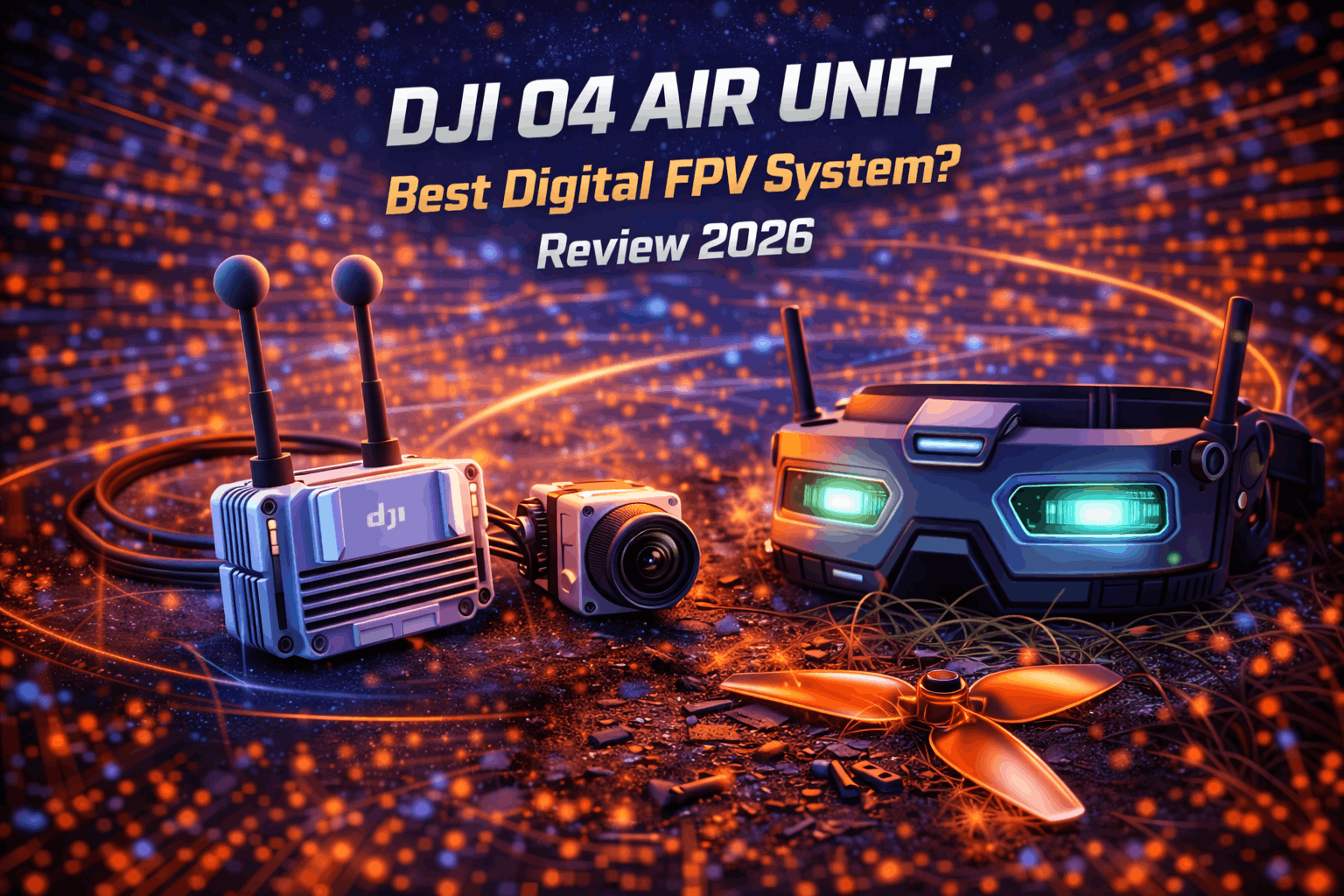
DJI released the O4 Air Unit series in early 2025, and it represents the company's latest flagship digital FPV system. After months of real-world testing, the answer to "best" is complicated. The O4 is objectively the best-performing digital FPV system in measurable specifications. The image quality is genuinely stunning, the latency in Race Mode is competitive with anything available, and the range/penetration capabilities outclass alternatives.
But "best performance" and "best choice" are different questions.
This review evaluates the O4 honestly: what makes it excellent, where it commands premium pricing, and whether that premium justifies itself for different pilot categories. The goal is clarity on whether the O4 deserves your money, not cheerleading for DJI's latest product. For broader context on how current digital FPV systems compare.
Note: This guide contains affiliate links. If you purchase through our links, we may earn a commission at no extra cost to you. This helps support our testing and content creation.
What's New in the O4
The O4 isn't a revolutionary departure from the O3—it's a mature evolution of DJI's digital FPV technology. Understanding what actually improved matters for deciding whether to upgrade from O3 or choose O4 over Walksnail.
Performance Upgrades (Real Improvements)
Latency Refinement
The O4 Pro achieves 15ms in Race Mode (down from O3's 20ms). The O4 Lite sits at 20ms. These aren't massive jumps—you won't consciously feel the difference in casual flying—but in competitive racing where every millisecond affects lap times, the improvement is measurable. Testing with world-class racer Evan Turner showed O4 performance within 0.1 seconds of HDZero lap times, proving the latency is genuinely race-viable.
Image Processing Leap
The O4 uses H.265 10-bit 4:2:2 color encoding (versus O3's 8-bit 4:2:0). In practical terms: the O4 captures more color information and handles dynamic range more gracefully. Flying from deep shade into bright sunlight, the O4 manages the transition without crushing shadows or blowing highlights. The bitrate increase to 60Mbps in live feed means fewer compression artifacts during aggressive maneuvers. This is where you actually see the money spent: the image quality is noticeably better than O3.
Improved Penetration
The O4 operates on 60MHz wideband with higher transmit power (1200mW FCC). Real-world testing shows significantly better range and penetration through obstacles—forests, buildings, dense vegetation. Long-range pilots report maintaining clean signal at distances where O3 would start breaking up. For anyone regularly flying beyond 3km or in challenging terrain, this is a legitimate advantage.
Low-Light Performance
The larger sensor (especially on the O4 Pro with its 1/1.3-inch image sensor) handles darkness noticeably better. Flying under tree canopy or during late-afternoon sessions, you see details that competitors render as muddy shadows. For cinematic or content creation flying in variable lighting, this matters.
What Stayed the Same (Ecosystem Lock-In)
The fundamentals didn't change. You're still locked into DJI's ecosystem. The O4 only works with DJI Goggles—no third-party support. If you own Walksnail or Fatshark goggles, the O4 is incompatible. If you own old DJI Goggles V1 or V2, they won't work with O4; you need Goggles 2, Integra, N3, or V3.
The weight class remains similar (~8g for the O4 Lite, heavier for the Pro). Integration complexity is unchanged—you're still managing camera placement, wiring, and Betaflight configuration like previous air units.
The O4 is an excellent system that addresses specific O3 shortcomings (latency, color grading, range). It's not a fundamental rethink; it's engineering maturity.
Image Quality and Latency: The Core Performance
These are the two reasons pilots choose DJI O4 over alternatives.
Video Feed Quality in Real-World Flying
Coming from other systems, the O4's image quality hits immediately. Colors are accurate without the punched-up oversaturation some systems apply. Reds are actually red. Greens show natural variation instead of uniform lawn color.
In high-motion scenarios—aggressive rolls, gap threading, freestyle tricks—the 60Mbps bitrate shows its value. Details stay crisp without the macroblocking you'd see at lower bitrates. The H.265 compression is excellent; bandwidth is used efficiently.
The dynamic range improvements are subtle but consistent. Flying through mixed lighting (forest sections transitioning to open sky), the O4 handles exposure smoothly. Shadow detail is preserved without the blown-out sky effect that plagues competitors in bright conditions. For content creators, this is meaningful—less aggressive color correction needed in post.
Low-light performance deserves specific mention. Late afternoon flying when competitors fade to darkness, the O4 maintains visible detail. This extends your flying season and improves safety in variable conditions.
The 4K recording at 60fps (120fps on the Pro) provides excellent footage for retrospective analysis and content sharing. While not replacing a dedicated action camera for cinematic work, it's "very good backup" quality—suitable for social media and most amateur purposes.
Latency Reality
Here's the honest latency assessment: 20-24ms in Race Mode feels fast. You can't consciously detect the difference from 15ms (HDZero) in typical flying. In competitive racing at the highest levels, the difference matters. For everyone else, the latency is adequate and the image quality advantage far outweighs the latency tradeoff.
Testing pilots reported that O4 handling felt responsive, without the sluggishness that plagued earlier digital systems. Race Mode delivers genuine advantages for track-focused flying—faster lap times were observed, and racers adapted quickly.
The comparison: O4 Race Mode matches analog performance, beats standard Walksnail, and is competitive with HDZero. Pick the system based on image quality and ecosystem, not latency—they're all "fast enough."
Range and Signal Stability
The 60MHz bandwidth and increased power output translate to real-world advantages. At 2km in open conditions, the O4 maintains clean 60Mbps signal. At 5km, expect 20Mbps—still flyable for racing. At extreme range (8km+), performance degrades gracefully rather than falling off a cliff.
In forests, the O4's penetration is noticeably better. Flying through dense trees where Walksnail would lose signal, the O4 maintains connection. This is worth the premium if you regularly explore challenging terrain.
Urban penetration (flying around buildings, through gaps) shows similar advantage. The higher power and wider bandwidth mean more robust signal in RF-hostile environments.
The maximum range spec (15km for Pro, 10km for Lite) is practical in unobstructed environments. In real flying, you're limited by battery endurance and safety regulations, not signal.
Installation and Integration
The O4 fits in standard racing and freestyle quads (5-inch focus). Physical mounting is straightforward if you've built FPV drones before. The 8.2g weight (Lite version) is negligible in weight budgets—most racing quads run 250g+ fully loaded.
Camera positioning requires careful consideration. The O4 Pro's larger camera module (32g total) impacts balance on smaller frames. The Lite version solves this with a smaller form factor, but sacrifices the better low-light performance and D-Log recording.
Binding to goggles is standard DJI procedure. Betaflight configuration is simplified for O4—OSD support is native, tuning is familiar. There's no learning curve if you've flown digital before.
The real integration question: which goggles? If you own older DJI goggles, you'll need to upgrade. Goggles N3 ($260-270) offers excellent value and Race Mode support. Goggles 3 ($400+) provides the best 15ms latency and 100Hz display. Goggles 2 or Integra work with O4 in compatibility mode (higher latency, no Race Mode access).
For new pilots: the Goggles N3 + O4 Lite combination is the sweet spot for cost and capability. For competitive racers: Goggles 3 + O4 Pro justifies the premium.
Race Mode Deep Dive
DJI markets Race Mode as a breakthrough feature. Is it?
Race Mode locks the O4 to Race Band channels, reduces processing overhead, and pushes latency to the floor: 15ms on Pro, 20ms on Lite. In practice, the latency improvement is real but marginal—you won't feel 5ms difference in typical flying.
What matters: Race Mode support for up to eight aircraft simultaneously with minimal interference, proper race-mode timing integration, and competitive-level latency. This matters if you're flying organized races or competing against serious pilots.
For freestyle, casual flying, and even club-level racing, standard Mode (higher latency, more flexibility) is fine. Race Mode is a feature you unlock if you need it, not something everyone needs.
The honest assessment: Race Mode is well-implemented, reduces latency genuinely, and proves DJI can compete in racing. Whether you personally need it depends on your competition level and goggle choice (only Goggles 3 and N3 support it).
Recording and Content Creation
The O4 Pro records 4K at 130Mbps with D-Log M color mode. This is genuinely useful for color grading—you get the latitude of professional tools without the file size burden of RAW.
The O4 Lite records 4K at 100Mbps without D-Log, but the image quality is still excellent for social media and casual content.
Honest comparison to GoPro: The O4 isn't replacing an action camera for serious cinematic work. The O4 has less dynamic range, fewer color science options, and can't match GoPro's image stabilization. The trade-off: the O4 is lighter, includes FPV perspective, and removes the need for separate recording systems.
For YouTube content, FPV social media clips, and personal documentation, the O4 recording is "very good." For professional broadcast work or feature-length FPV cinematography, pair the O4 with Gyroflow post-stabilization or add a GoPro.
The recording capability isn't a weakness; it's "good enough for most purposes" with the clear understanding that it's not replacing dedicated cinema cameras.
O4 vs Competition: Real Comparison
This is where honest evaluation separates gadget reviews from practical guidance.
DJI O4 vs Walksnail Avatar HD
Image Quality: O4 wins clearly. The O4's color grading, dynamic range, and low-light performance are noticeably better. The Walksnail, despite recent improvements, still tends toward muddy shadow detail and oversaturation.
Latency: Walksnail Avatar delivers ~22ms. O4 Race Mode hits 15-20ms. Walksnail is "close enough" that pilots don't report noticing the difference; O4 is measurably better for racing.
Range/Penetration: O4 wins decisively. The 60MHz wideband and higher power mean better long-range stability and obstacle penetration.
Cost: This is Walksnail's advantage. A complete Avatar HD system is $150-250 cheaper than equivalent O4 + Goggles package.
Ecosystem Flexibility: Walksnail wins. You're not locked into a single goggle ecosystem. Different camera options, more third-party support, clearer upgrade paths.
When to choose Walksnail: Budget is primary concern, you value ecosystem flexibility, or you're satisfied with 1080p recording quality. The Avatar still delivers 90% of O4 performance for 50% cost.
When to choose O4: Professional content creation, competitive racing, long-range flying, or you're committed to DJI's ecosystem already.
DJI O4 vs HDZero
These are different philosophies. HDZero prioritizes absolute lowest latency and pure racing. O4 prioritizes image quality and versatility.
Latency: HDZero ~15-16ms, O4 Pro ~15ms, O4 Lite ~20ms. In direct comparison, nearly identical.
Image Quality: O4 wins decisively. 1080p vs HDZero's 720p recording makes the difference obvious.
Field of View: HDZero's wider FOV (130°+) vs O4 Lite's 117° is significant for racing. Narrower FOV requires more head rotation to maintain situational awareness.
Racing Performance: Practical testing shows competitive lap times (within 0.1 seconds). The system differences are smaller than pilot skill differences.
Durability: HDZero reputation is greater durability in crashes. O4 Lite noted as more fragile.
When to choose HDZero: Pure racing focus, weight minimization, or you prefer analog-like reliability over digital image quality.
When to choose O4: Content creation matters, you want versatility beyond pure racing, or you need better range.
DJI O4 vs Analog
In 2026, analog is still relevant. Analog racers boast about durability, simplicity, and no proprietary ecosystem.
Latency: Analog ~20ms matches O4 standard mode. Within margin of error.
Image Quality: O4 wins decisively, but analog racers don't prioritize image quality.
Cost: Analog is cheapest option if you already own goggles. Entry cost for new pilots is higher than digital.
Community: Analog racing remains popular at grassroots levels. Ecosystem is mature and proven.
When to choose Analog: You're racing competitively and value durability over image quality, cost is critical, or your community still uses analog exclusively.
Analog FPV still plays a role in competitive racing. We break that down in our analog vs digital FPV comparison guide.
The DJI Ecosystem Reality
Buying the O4 is choosing an ecosystem, not just an air unit.
Here's what DJI lock-in means practically:
Goggles Requirement: The O4 only works with DJI goggles. If you own Walksnail or Fatshark goggles, they're paperweights to the O4. This isn't a technical limitation; it's a business decision by DJI. You're committed to upgrading goggles when DJI releases new standards.
Upgrade Path: When the O5 releases (inevitably), you'll want to upgrade the air unit. Your goggles will likely still work, but you'll be invested in DJI hardware across multiple components.
Parts & Support: DJI's reliability is genuine. Updates are consistent, support is available, parts are stocked. This is the advantage of ecosystem lock-in—you get professional support. The tradeoff is you can't choose alternatives.
Resale Value: DJI systems have stronger resale because the ecosystem is locked-in (everyone buying O4 needs DJI goggles). The lock-in actually maintains equipment value better than open systems.
Cost Implications: Entry cost is higher (you need compatible goggles). Upgrade cost is higher (replacing goggles for new air units). But the ecosystem works reliably once you're in.
The honest take: Ecosystem lock-in isn't necessarily bad—it depends on your priorities. If reliability and integration matter more than flexibility, DJI's ecosystem is excellent. If you value equipment portability and avoiding vendor lock-in, choose open-source alternatives.
Who Should Buy the O4
Clear guidance on whether the O4 fits your situation.
Buy the O4 if:
- You're racing competitively. The 15ms Race Mode latency and image quality give genuine advantages. The Pro variant's D-Log capability is useful for post-race analysis.
- You create FPV content professionally. The image quality and recording capability make O4 viable for content production without external cameras.
- You're flying long-range. The 60MHz bandwidth and high power deliver measurably better penetration in challenging environments. For pilots focused on extreme range and penetration, see our long-range FPV drone build guide.
- You're committed to DJI ecosystem. Already own DJI Avata or other DJI systems? The O4 integrates seamlessly.
- Image quality is priority. The O4's color and dynamic range are best-in-class for digital FPV.
Skip the O4 if:
- Budget is primary concern. Walksnail Avatar delivers 90% of performance for 50% cost. If you’re building your first digital setup, our
budget FPV drone setup under $500
covers more affordable alternatives. - You value ecosystem flexibility. Open-source or multi-system support is important to you.
- You're casual/recreational pilot. The improvements won't transform your flying enjoyment. Standard digital (Walksnail or HDZero) is adequate.
- You own old DJI goggles. The upgrade cost (new goggles + air unit) is substantial. Stick with O3 or consider alternatives.
- You already have Walksnail. The upgrade isn't compelling unless racing competitively.
Consider Alternatives if:
- Weight is critical. HDZero with lightweight goggles is lighter than O4 + DJI Goggles combination.
- You want maximum latency advantage. HDZero and analog are still fractionally lower latency.
- Durability in crashes matters most. Analog and HDZero have proven crash-durability reputation. O4 Lite noted as more fragile.
Pros & Cons
Pros:
- Industry-leading 1080p image quality with excellent color reproduction and dynamic range
- Lowest latency (15ms) in Race Mode competitive with anything in market
- 60Mbps bitrate delivers clean footage in high-motion flying
- Exceptional range and obstacle penetration (best-in-class for digital FPV)
- Reliable DJI ecosystem with consistent updates and professional support
- Strong low-light performance handles challenging lighting conditions
- Race Mode delivers competitive advantage for organized racing
- 4K recording capability (130Mbps on Pro) enables content creation without external camera
- Mature system with proven reliability and widespread professional adoption
Cons:
- Premium pricing ($109-229 for air unit alone)
- DJI ecosystem lock-in eliminates system flexibility (only works with DJI goggles)
- Requires expensive goggles (Goggles N3 $260+, Goggles 3 $400+) to access full capabilities
- No analog compatibility or fallback options
- Heavier than HDZero comparable configurations
- Race Mode benefits minimal for non-competitive pilots
- Proprietary system vs open-source alternatives like Walksnail
- Total system cost is highest in market (air unit + mandatory goggles + radio)
- O4 Lite noted as more fragile than competitor systems in crashes
FAQ
Q: Is the DJI O4 worth the extra cost over Walksnail Avatar?
A: Depends on priorities and budget. The O4 delivers measurably better image quality, lower latency in Race Mode, and superior range/penetration. These advantages matter for competitive racing, professional content, and long-range flying. For weekend freestyle and casual flying, Walksnail's 90% performance at 50% cost is compelling. Ask yourself: will you actually use O4's advantages? If yes, the premium is justified. If you're flying casually, Walksnail is better value.
Q: Can I feel the 20ms latency difference from HDZero or analog?
A: Most pilots can't consciously detect 20ms latency difference in typical flying. The human reaction time is ~200ms, so sub-100ms latency is functionally equivalent. Competitive racers notice timing differences, but casual pilots won't. The image quality advantage of O4 over HDZero is far more noticeable than the tiny latency difference. If you're not racing professionally, don't obsess over latency specs.
Q: What goggles work with the O4, and do I need the expensive V3?
A: The O4 works with Goggles V3, N3, Goggles 2, and Integra. You don't need the V3—Goggles N3 ($260-270) delivers excellent O4 performance at half the V3 price. The image quality comes from the air unit, not the goggles. The V3 offers a better display and full 15ms Race Mode latency; the N3 achieves 19ms Race Mode. Unless you're racing competitively and every millisecond matters, the N3 is the smart choice.
Q: How does O4 recording quality compare to carrying a GoPro?
A: The O4 records excellent video (1080p at 100fps, 4K at 60fps), perfectly suitable for social media and personal sharing. It's not replacing a GoPro Hero for professional cinematography—the dynamic range is narrower, color grading options are more limited, and stabilization options are fewer. Think of O4 recording as "very good backup" or "good enough for amateur purposes." For professional FPV content creation, pair the O4 with Gyroflow stabilization or add a GoPro. For hobby content sharing, the O4 recording capability often suffices.
Q: Can I upgrade from O3 to O4, and is it worth it?
A: You can upgrade by purchasing a new O4 air unit—they're not interchangeable. Your existing DJI goggles will work with O4 (if they're V3, N3, Goggles 2, or Integra). Whether it's worth upgrading depends on use. For competitive racing, the 5ms latency improvement and image quality are meaningful. For casual freestyle, the O3 is still excellent—upgrade when O3 fails. The O4 is evolutionary, not revolutionary, so unless you're racing competitively or creating content professionally, the upgrade isn't compelling.
Q: Is the O4 too expensive for a beginner, or should I start with it?
A: The O4 isn't too powerful for beginners—the image quality and latency help inexperienced pilots see and react better. The real concern is cost: spending $400+ on complete O4 system (air unit + goggles) is risky if you're not committed to the hobby. Beginners crash frequently, and the O4 Lite is noted as more fragile than alternatives. Consider starting with Walksnail ($200-250 complete) to test commitment, then upgrade to O4 once you're serious. If money isn't tight and you know you're committed, the O4 is fine to start with—the learning curve isn't steeper.
Q: What's the best use case where O4 clearly beats all alternatives?
A: Long-range flying in challenging environments (forests, mountains, urban areas). The O4's 60MHz bandwidth and high power output deliver penetration and range that competitors can't match. If you regularly fly 2-5km through trees or around buildings, maintaining clean signal where competitors break up, the O4 justifies its premium pricing through pure capability. It's also genuinely best for competitive racing where Race Mode's 15ms latency and image quality matter. For these specific use cases, nothing competes.
Final Verdict
The DJI O4 Air Unit is the best-performing digital FPV system available in 2026. The image quality is genuinely excellent, the latency in Race Mode is competitive, the range and penetration are industry-leading, and the ecosystem support is professional and reliable.
If you decide the O4 fits your flying style, you can check current pricing for the DJI O4 Air Unit here.
But "best performance" isn't the same as "best choice for everyone."
DJI built the premium product at a premium price. The O4 represents the mature evolution of their digital FPV technology, and it shows in every metric. For pilots who can afford it and will actually leverage its capabilities—competitive racers, content creators, long-range enthusiasts—the O4 delivers value that justifies the cost.
For everyone else, the value proposition gets murky. Walksnail delivers 90% of the performance for 50% of the cost. HDZero offers competitive racing capabilities with lower weight. Analog remains relevant for pure racing.
The honest recommendation: Choose the O4 if you're racing competitively and image quality/range matter, or if you're creating FPV content professionally. Choose Walksnail if budget is primary and you want ecosystem flexibility. Choose HDZero if pure racing is the only priority. Choose analog if your racing community is analog-focused.
The O4 isn't the best system for everyone. It is the best system for specific use cases where its capabilities matter. Evaluate whether those use cases are yours.