Introduction
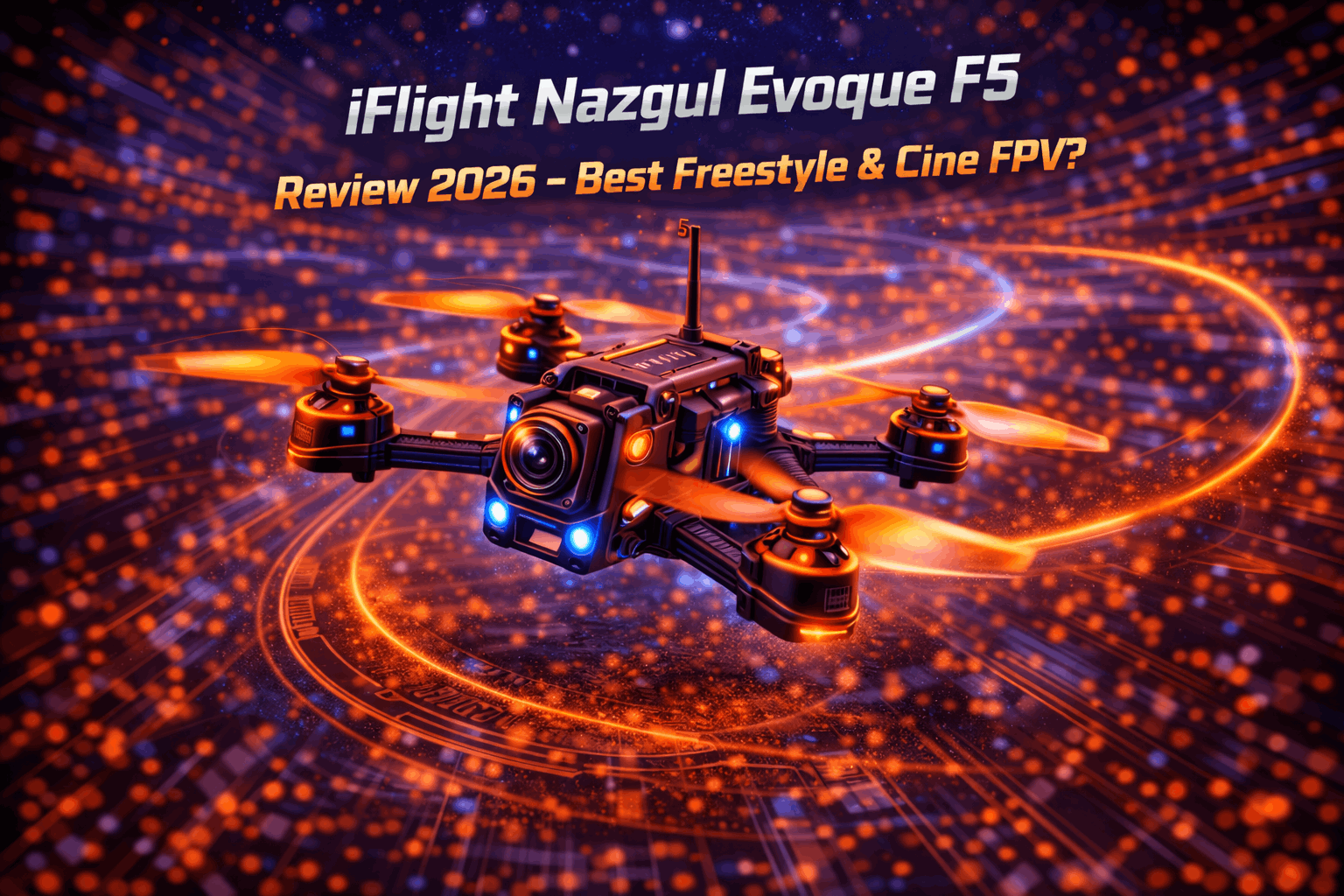
The iFlight Nazgul has been the go-to ready-to-fly freestyle platform for years. The Evoque variant represents the refined evolution of that formula—not revolutionary, but mature. In 2026, asking whether the Nazgul is still relevant sounds obvious (of course), but the real question is whether it's the right choice when newer platforms exist.
This review evaluates the Nazgul Evoque F5 honestly: what makes it excellent as a proven platform, where it lags behind cutting-edge options, and whether the predictable reliability justifies premium ready-to-fly pricing. After months of flight testing, the verdict is clear: the Nazgul is the Honda Civic of freestyle quads. It just works, consistently, without surprises.
If you’re still comparing ready-to-fly options in 2026, our best FPV drones of 2026 buyer’s guide breaks down how platforms like the Nazgul Evoque compare to newer freestyle and long-range builds.
Note: This guide contains affiliate links. If you purchase through our links, we may earn a commission at no extra cost to you. This helps support our testing and content creation.
What You Get: The Complete Package
Opening a Nazgul Evoque box reveals iFlight's attention to detail. The frame components, flight controller, ESC stack, and camera system arrive pre-assembled. Nothing here feels compromised or cheap.
Frame and Build Quality
The Nazgul Evoque F5 uses 4mm carbon fiber arms that feel genuinely solid with zero flex. The frame geometry is available in two configurations: DeadCat (DC) for cinematic flying with no propellers in view, or true X geometry for aggressive freestyle. The F5 V3 introduced a switchable design, letting you reconfigure between frames without rebuilding—a genuine quality-of-life improvement that shows iFlight listens to pilots.
The 20x20mm flight controller and ESC stack is compact, pushing modern miniaturization limits. Despite this density, iFlight's build quality remains professional. Solder joints are clean, wires route through the frame center cleanly, and protective side plates—added in the Evoque generation—minimize dust ingestion during prop-out flying.
The camera cage is machined aluminum, offering protection without excessive weight penalty. USB-C ports on the flight controller come with rubber caps, protecting against debris. Small touches like this accumulate into a quad that feels designed by people who fly FPV, not just engineers.
Electronic Components
Flight Controller: The BLITZ Mini F722 is an F7 processor with modern features and solid Betaflight support. iFlight ships it with professional tuning pre-configured, but the controller remains fully customizable for pilots who want to tinker.
ESC Stack: The BLITZ Mini E55 4-IN-1 is a 55A capable unit supporting 2-6S batteries. The anti-spark filter built into the XT60 connector eliminates harsh battery plug pops, extending connector lifespan. The dual-BEC power supply (12V 2A + 5V 2.5A) handles both traditional and digital FPV systems without compromise.
Motors: XING2 2207 motors with 1750KV rating deliver smooth, predictable power across the throttle range. The unibell construction (single-piece bell) eliminates seams where cheaper motors develop play. Japanese NSK bearings feel smooth spinning by hand, and the 7075 aluminum bells are crash-resistant. These are among the best 2207 motors available, and iFlight chose them deliberately.
Video System: Available in DJI O4 (latest), O3 (proven), or analog options depending on configuration. Digital systems integrate seamlessly with the frame design. The O4 version includes D-Log M recording capability, enabling professional-level color grading.
What's NOT Included
Battery: You'll need 1300-1550mAh 6S LiPo batteries. Budget $30-45 per pack.
Charger: iCharger or similar 6S-capable charger required.
Controller: Requires FrSky, Crossfire, or ExpressLRS-compatible transmitter (receiver included with ELRS versions).
Props: Spares always recommended. The included Nazgul F5 props are quality, but crashes demand replacements.
Flight Performance: Where It Shines
The Nazgul Evoque's defining characteristic is predictability. It feels planted in the air, confident, and honest. After 50+ packs through the Evoque, the word that keeps returning is "trustworthy"—it does exactly what you command, when you command it, without personality quirks.
Freestyle Handling
The quad excels at flow-based freestyle. Momentum carries beautifully through power loops without lazy energy loss. Rolls snap crisply without feeling twitchy. Inverted flying is stable and controllable, even on aggressive inputs. The ~700g all-up weight (with battery) isn't the lightest 5" quad available, but that mass is actually advantageous for freestyle progression—the quad's inertia creates predictable momentum rather than requiring constant stick corrections.
High-speed line flying is where the Evoque truly feels confident. The frame rigidity translates to minimal vibration, the motors respond instantly to throttle inputs, and the tune prioritizes responsiveness without nervousness. You can push tight maneuvers without fighting oscillation or lag.
Low-speed control is equally composed. Hovering isn't this quad's purpose, but gentle inputs hover smoothly. The tune allows smooth proportional responses down to minimal stick movements, making technical tricks achievable.
Out-of-Box Tuning
iFlight ships the Evoque with professional factory tuning that "just works" for most flying styles. The default PIDs and filter settings are conservative enough to feel smooth without being sluggish. Expert pilots might adjust rates or add custom curves, but beginners can literally charge a battery and fly without tuning adjustments.
This is rare in ready-to-fly drones. Most require pilot tuning tweaks. The Evoque being plug-and-play reflects iFlight's experience—they've tuned this frame geometry with these motors thousands of times.
Flight Time Reality
With aggressive freestyle flying on 1300mAh packs, expect 3.5-4 minutes per battery. 1500mAh packs yield 4.5-5.5 minutes. Cruising or cinematic flying on 1550mAh stretches to 6-7 minutes. These numbers are realistic with typical freestyle rhythm (climbs, tricks, recoveries). Racing drones don't fly this long because they operate at constant high power. The Evoque's efficiency comes from the tune allowing variable throttle without power waste.
Battery temperature is a non-issue. The Evoque doesn't generate excessive heat even after back-to-back flights. The motors and ESCs remain cool to touch post-flight, indicating efficient power delivery.
For pilots focused specifically on freestyle progression, our FPV freestyle flying tutorial explains how quads like the Nazgul Evoque help build consistency, flow, and confidence.
Build Quality and Durability
This is where the Nazgul earns its reputation. Durability testing by experienced reviewers shows this quad survives crashes that destroy cheaper quads whole.
Real-World Crash Testing
One reviewer's torture test involved crashes into concrete, rock, tarmac, trees, grass, and poles. After extensive testing, the report: "Not a single broken piece! The only thing I've needed to replace is the props."
Another pilot reported 40+ crashes, including three tree impacts with bent arms. Total damage: two replaced motors (one from direct ground strike), frame still solid with no cracks.
This durability comes from engineering decisions. The 4mm carbon arms are thick enough to bend without breaking. Arm replacement is straightforward—remove four screws and swap. Motors are standard 2207 size with accessible connectors. The frame design concentrates stress points at reinforced areas rather than spreading weak points throughout.
Maintenance & Repair Reality
Replacement arms cost $10-15 each. Motors are $15-20 per unit. ESC replacement (if needed) is $30-40. This cost structure reflects iFlight's design for user serviceability—major crashes don't require rebuilding from the frame up.
Wire access is good. The ESC and FC sit in the center stack without requiring complete disassembly for repairs. Soldered connections are accessible, allowing field-level fixes for torn wires or loose connectors.
Parts availability globally is excellent. iFlight maintains stock across distributors, and third-party alternatives (replacement motors, ESCs, frames) are readily available. You won't be waiting weeks for parts.
If you’re pushing proximity flying and crashing regularly, our FPV drone maintenance and repair guide covers inspections, common failure points, and how to keep freestyle quads reliable long-term.
Digital vs Analog Versions
The Nazgul Evoque comes in multiple configurations. The choice between analog and digital affects both weight and capability.
Digital (DJI O4 or O3)
The O4 Air Unit adds approximately 8-10 grams versus analog configurations and delivers 1080p/100fps transmission plus 4K recording capability. The integration is seamless—the camera cage is designed for the DJI module, and the weight distribution remains balanced.
Image quality is obviously superior to analog. Flying in mixed lighting (shade to sunlight transitions), the O4 handles exposure smoothly. Low-light performance is strong, letting you extend flying into late afternoon when analog systems struggle.
The O4 version justifies the price premium if image quality matters—content creation, professional work, or serious progression flying. The recording capability eliminates the need for external action cameras in most cases.
Analog
The analog version drops digital weight, maintains simplicity, and performs reliably. Some pilots report that the analog Evoque "flew remarkably well," suggesting the frame geometry is genuinely excellent regardless of FPV system.
Analog is lighter by roughly 50-60 grams, which affects flight dynamics subtly—acceleration feels slightly snappier, power-to-weight ratio improves marginally. For pure freestyle in familiar terrain, analog is sufficient and costs less.
The choice isn't about capability (both fly well) but priority: image quality versus simplicity and weight.
If you’re undecided between digital FPV ecosystems, our complete digital FPV systems comparison compares DJI, Walksnail, and HDZero for freestyle and racing use cases.
Ready-to-Fly Value Proposition
The core value question: is paying $50-80 premium over DIY building justified?
What You're Buying
Assembly expertise: iFlight invested engineering hours getting frame geometry, motor selection, and ESC tuning right. You pay for that knowledge.
Factory tuning: The pre-configured Betaflight tune is genuinely good. You can immediately fly without tuning knowledge.
Warranty: iFlight warranties factory-built units. DIY builds are your responsibility.
Time savings: Assembly and initial testing take 2-4 hours for experienced builders, longer for beginners. At any reasonable hourly value, the BNF premium is justifiable.
Risk mitigation: Factory-built drones arrive tested. DIY builds risk soldering errors, misconfigurations, or component defects discovered only in flight.
When BNF Makes Sense
You don't want to build or tune yourself. You value warranty protection. Your time has monetary value. You're new to the hobby and lack soldering confidence. You want proven reliability quickly.
When Building Custom Makes Sense
You enjoy tinkering and have specific component preferences. Budget is primary concern. You have building experience. You want to learn tuning deeply.
The Evoque is fairly priced for its class. Not a steal, not overpriced—fair value for a quality ready-to-fly package.
Who Should Buy the Nazgul Evoque F5
Perfect For
Intermediate to advanced freestylers seeking a proven platform without building complexity. The Evoque won't challenge your flying skills; it will support them.
Content creators needing reliable image quality without extensive post-processing. The O4 version records 4K footage suitable for YouTube without requiring external cameras.
Pilots valuing reliability over cutting-edge specs. The Evoque is mature, proven, and predictable—no surprises.
Weekend warriors who want something that works right now. Charge battery, fly, repeat.
Not Ideal For
Pure racers: Too heavy (~700g all-up) for competitive racing. Dedicated race quads are 500-550g and optimize for speed/acceleration rather than freestyle.
Absolute beginners: The power and responsiveness can be overwhelming without simulator practice. Consider starting with something lighter.
Budget-first buyers: Building equivalent yourself saves $50-80 if you have soldering skills.
Cutting-edge tech hunters: This is mature refinement, not bleeding-edge innovation. Newer frames may offer lighter designs or other advances.
Pros & Cons
Pros:
- Proven, reliable platform with years of refinement and market feedback
- Excellent out-of-box tune requires no mandatory adjustments
- Frame construction is genuinely solid and crash-resistant
- Professional build quality with attention to detail in components and soldering
- Strong freestyle flight characteristics and predictable, trustworthy handling
- Replacement parts widely available and reasonably priced
- Available in multiple configurations (analog, O3, O4, with/without GPS)
- Switchable frame design (F5 V3) offers cinematic/freestyle flexibility
- iFlight customer support is responsive and helpful
- Good value for ready-to-fly option versus DIY building
Cons:
- At ~700g all-up weight, not the lightest 5" option available
- Not optimized for racing (too heavy, freestyle-focused)
- Older platform design (mature but not cutting-edge)
- Premium pricing over equivalent DIY build
- Not ideal for absolute beginners (might be overwhelming)
- Digital versions add weight compared to analog
- Waterproof design on V3 restricts some internal repairs
- Switchable frame adds minor complexity
FAQ
Q: Is the Nazgul Evoque good for beginners, or is it too much quad?
A: It's borderline. If you've done significant simulator time and are comfortable with acro mode, the Evoque is actually an excellent progression quad. The predictable handling helps you develop skills faster than more twitchy platforms. However, if you're brand new to FPV, it might overwhelm you. Consider starting with a smaller freestyle quad (3-4 inch) to learn basics, then progress to the Evoque.
Q: How does it compare to building my own equivalent 5" freestyle quad?
A: DIY building saves $50-80 in parts and gives you customization freedom. But assembly and initial tuning takes 3-4 hours and requires soldering skills. The Evoque costs a premium for convenience, warranty, and pre-tuning. If you enjoy building, DIY wins. If you want to fly immediately with confidence, the Evoque premium is worth it.
Q: Can I race with the Evoque, or is it only for freestyle?
A: You can race it, but it's not optimal. At ~700g all-up, it's heavier than dedicated race quads (500-550g), which hurts acceleration and agility on tight courses. For casual club-level fun races, it's perfectly capable. For competitive racing where milliseconds matter, a purpose-built race quad is better.
Q: What batteries work best, and what flight times should I expect?
A: Optimal battery range is 1300-1550mAh 6S. Use 120C discharge rating minimum. Flight times: 1300mAh = 3.5-4.5 minutes aggressive freestyle, 1550mAh = 4.5-5.5 minutes, or 6-7 minutes cruising. Mix of battery sizes gives you options—1300mAh for short intense sessions, 1550mAh for longer exploratory flying.
Q: Is it worth buying in 2026, or are there better options now?
A: The Evoque remains competitive but not cutting-edge. Newer frames like the APEX 5" or others offer lighter designs and innovations. However, the Evoque's strength is proven reliability—it works exactly as advertised. If you want the latest tech, look elsewhere. If you want something that just works reliably, the Evoque delivers.
Q: Should I get the analog or digital O4 version?
A: Digital (O4) adds weight (~50g) but provides superior image quality, 4K recording, and extended low-light performance. Choose digital if image quality matters—content creation, professional work, or serious progression. Choose analog if weight and simplicity are priorities. Both fly well.
Q: How difficult is repair after crashes?
A: Very straightforward. Arms replace with four screws. Motors are standard 2207 size. ESCs are accessible without full teardown. Most crashes require only prop replacement. Serious damage (bent frame) is rare. Parts cost $10-40 depending on what needs replacement. The frame is designed for user serviceability.
Q: What breaks first, and how much do repairs cost?
A: Props break constantly (normal wear). Motors typically fail from direct ground impacts—$15-20 each. Arms crack after repeated crashes—$10-15 replacement. Camera protection is good; breakage is rare unless nose-first impact. ESC failure is uncommon but costs $30-40 if needed. Annual maintenance budget for active freestyle: $50-100 in parts.
Final Verdict
The iFlight Nazgul Evoque F5 is the reliable workhorse of freestyle quads. It's not flashy, not the lightest, not cutting-edge—but it's genuinely good at what it does. It represents maturity in design rather than innovation.
Think of it as the Toyota Camry of FPV. Maybe not exciting on paper, but it'll still be flying reliably when more exotic builds are in pieces.
Buy the Evoque if: You want a proven platform that just works, value reliability over bleeding-edge features, prefer not to build and tune yourself, or need something that survives the learning process.
Skip the Evoque if: You're racing competitively (too heavy), want absolute latest technology, enjoy customizing your build, or need maximum efficiency for long-range flying.
The honest take: At $300-350 depending on configuration, the Evoque is fairly priced. It won't amaze you with innovation, but it will consistently deliver capable freestyle flying without surprises. For intermediate to advanced pilots seeking a ready-to-fly solution that won't let them down, that's exactly what they're paying for.
If you decide the iFlight Nazgul Evoque F5 fits your flying style, you can check current configurations and pricing here: iFlight Nazgul Evoque F5 – available versions & pricing
In an era of increasingly exotic FPV platforms, the Nazgul Evoque's greatest strength is its boring reliability. And sometimes, boring is exactly what you need.