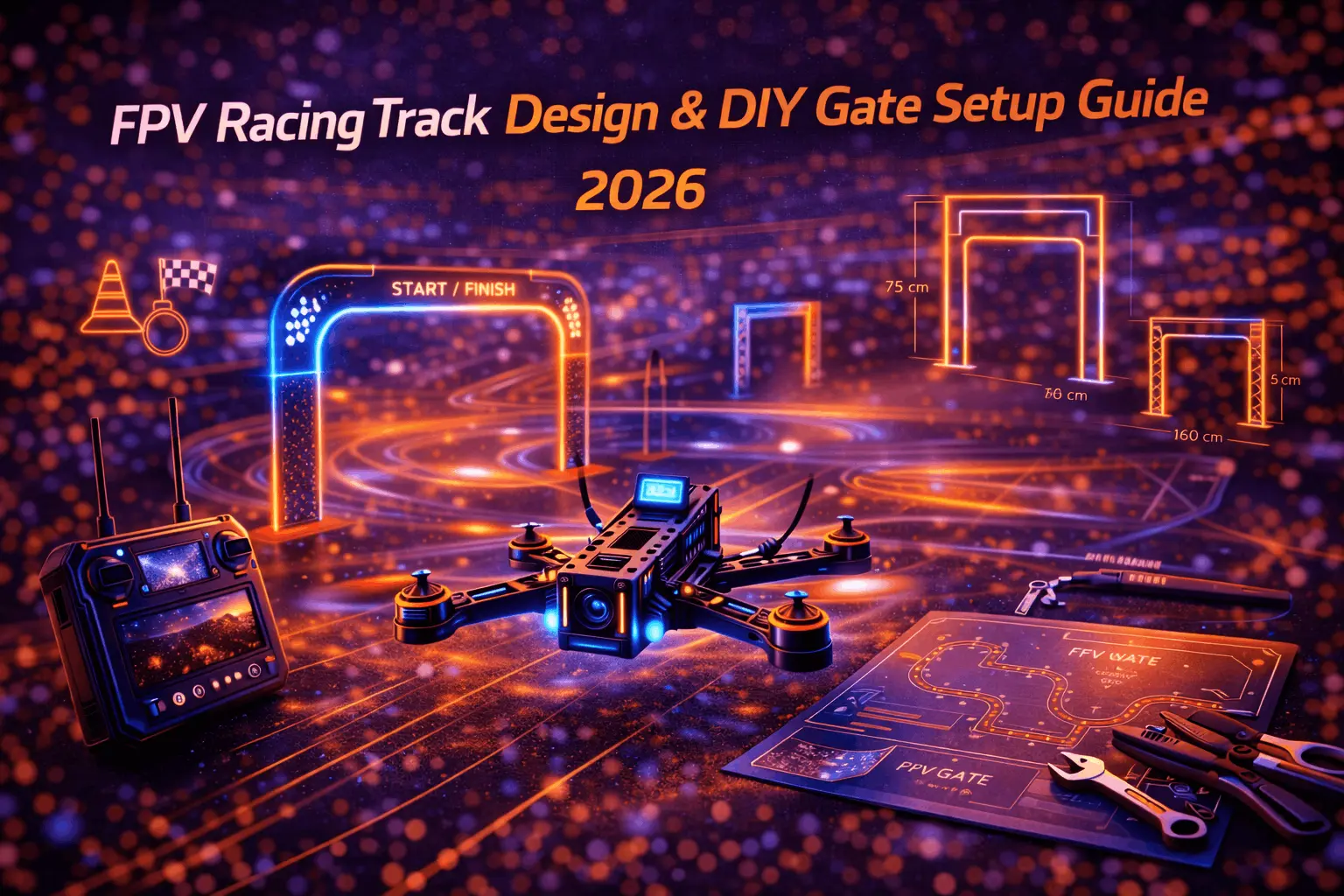
You don’t need a professional venue to get faster. A backyard, an empty parking lot, or a strip of flat field becomes a legitimate training ground with a few gates and some thought about layout. I built my first practice track for under $50 using PVC pipe and pool noodles, and it did more for my lap consistency than months of random park flying.
Here’s the thing most newer pilots miss: the difference between pilots who plateau and pilots who keep improving is structured practice on a repeatable course. Freestyle ripping teaches throttle control and orientation, sure. But racing demands gate accuracy at speed—and that’s a specific skill built through thousands of reps on a known track.
This guide covers DIY gate construction, layout principles, timing options, and everything you need to host your own race events. Budget range: $30 for a bare-bones backyard setup to $1,000+ for a full MultiGP-ready course.
Why Track Practice Accelerates Your Flying
Gate racing is a precision discipline. You’re threading a 700g machine through a 5-foot opening at 80+ mph while managing battery voltage, wind gusts, and the mental pressure of a ticking clock. Open-air cruising doesn’t train any of that.
A fixed track gives you a benchmark. You fly the same gates in the same order, and your DVR tells you exactly where you’re gaining or losing time. After a few sessions, you start noticing patterns—maybe you always overshoot that second gate after the long straight, or you bleed speed on left-hand turns. That’s the kind of specific feedback that drives real improvement.
Simulators are phenomenal for stick time and learning racing lines, and I’d still recommend logging hours there regularly. But real gates add what sims can’t replicate: genuine depth perception challenges, wind drift, sun glare, and the very real pucker factor of knowing a bad line means a trip to the soldering bench. The combination of sim practice and real track sessions is what produces the fastest progression.
There’s also the competition prep angle. If you’ve never flown a split-S gate or a tight chicane under pressure, race day is not where you want to encounter them for the first time. Home track practice removes surprises and lets you walk into events with actual confidence instead of nervous hope.
Track Components: What You Actually Need
Gates
This is the core of any track. Everything else is optional—but you need something to fly through.
MultiGP Standard Dimensions: The official gate opening is 5’×5’ (1.524m × 1.524m). For championship-level events, MultiGP uses larger 7’×6’ gates to reduce crashes at high speeds. For home practice, stick with 5×5—it matches what you’ll see at any local chapter event.
Commercial gates run $15-80 each depending on type. Air gates (inflatable) are the most visible and portable but cost more. Vinyl mesh panels on PVC frames are what most MultiGP chapters use—durable, professional-looking, and they pack flat. LED-lit gates ($50-150) are great for dusk sessions but need a power source.
DIY gates are where most pilots should start. You can build a solid PVC gate for $10-15 in materials, and pool noodle arches cost about $5 each. I’ll cover both builds in detail below.
Size recommendations by skill level: Beginners benefit from 6’×6’ openings (less intimidating, fewer crashes). Standard 5’×5’ for intermediate and up. For tight technical practice, 3’×3’ gates will punish sloppy lines and sharpen your precision fast.
Flags and Course Markers
Flags define the flight path between gates, mark boundaries, and give your brain visual anchoring points during fast runs. They’re cheap and make a huge difference in track readability from the goggles.
Sports corner flags ($5-15 each), traffic cones ($1-3), pool noodles staked in the ground ($2-3), or even brightly-colored ribbon tied to stakes all work. The key is high contrast against your flying environment—orange and yellow pop against green grass, white works on dirt.
Timing Systems
You don’t need a timing system to start. A buddy with a stopwatch or reviewing your DVR footage after a session both work for tracking improvement. But once you want precision, a few options stand out.
ImmersionRC LapRF Personal (~$75-100) is the gold standard for personal lap timing. It sits in the start/finish gate, reads your 5.8GHz VTX signal as you pass through, and reports lap times via Bluetooth to a free iOS/Android app. Works with analog, digital, any polarization. Integrated 18650 battery gives about 8 hours of runtime. For solo practice, nothing beats it for the price.
RotorHazard (open source) is the go-to for multi-pilot event timing. It’s a Raspberry Pi-based system using multiple RX modules—DIY cost runs $150-250 depending on components, but you get a full race management system with web interface, real-time scoring, and support for 8+ simultaneous pilots. This is what many MultiGP chapters run.
Budget approach: Start timing with your DVR. Fly a lap, mark the start frame, mark the end frame, calculate the time. It’s tedious but free. Graduate to the LapRF when you’re committed to structured training.
DIY Gate Construction
PVC Pipe Gate — The Standard ($10-15 per gate)
This is what 90% of home tracks use. Cheap, durable, easy to build, and it survives crashes without flinching.
Materials per gate:
- 4× lengths of 1/2” or 3/4” PVC pipe (buy 10ft sticks and have the store cut them, or bring a hacksaw)
- 4× 90-degree PVC elbows
- 4× T-connectors (for ground feet)
- 8× short pipe stubs (~8-12” each, for the foot extensions)
- Bright spray paint (orange or yellow work best)
- Optional: pool noodles for the top bar
Assembly:
Cut your PVC to 5-foot lengths for the sides and top/bottom (or whatever gate size you want). Dry-fit the square frame using 90-degree elbows at each corner. At the two bottom corners, use T-connectors instead of elbows—insert short pipe stubs pointing outward as ground feet. These prevent the gate from tipping in wind or after light impacts.
Do not glue the joints. Friction-fit allows you to break the gate down flat for transport. If joints are too loose, wrap electrical tape around the pipe end before inserting—creates a tighter fit without permanence. For a permanent install, a single self-tapping screw through each joint locks everything solid.
Paint the frame a high-visibility color. Sliding a pool noodle over the top bar is a game-changer for visibility through FPV goggles—that bright foam cylinder is the first thing your eye catches on approach. It also absorbs prop strikes, which saves both the gate and your blades.
In windy conditions, weigh down the feet with sandbags or small dumbbells. A PVC gate in a gust becomes a sail otherwise.
Pool Noodle Arch — Ultra Budget ($5 per gate)
If you just want something to fly through tomorrow with zero fuss, this is it.
Buy two pool noodles from a dollar store. Thread a length of flexible wire, garden stake, or thin fiberglass rod through the hollow centers for rigidity. Bend into an arch shape and stake both ends into the ground. Done.
These are incredibly crash-friendly—a quad hits foam and bounces off. The trade-off is they’re less visible than framed gates and won’t hold a precise square opening. But for backyard skill work, they’re unbeatable for the price.
Hula Hoop Gate — Minimal Effort ($5-10)
A large hula hoop zip-tied to a vertical PVC stake driven into the ground. Five minutes of assembly. The opening is small (under 3 feet typically) which makes it a solid precision trainer, but it’s limited to a single vertical orientation.
Good as a supplementary obstacle rather than a primary gate.
Track Layout Design
Core Principles
A good track has rhythm. It alternates between speed sections where you can open up the throttle and technical sections that demand precision. Constant tight turns are exhausting and don’t teach much beyond slow maneuvering. All straights with no challenge is just flying fast in a line.
The sweet spot: a mix where pilots find a flow state. Fast enough to feel exciting, technical enough to demand focus.
Essential layout elements:
- At least one long straight (15-25m) for speed building and throttle management
- A chicane section (quick left-right gate sequence, 3-6m spacing) for technical skill
- Sweeping corners that reward smooth, banked turns over choppy corrections
- Varied gate spacing throughout—tight sections feel completely different from wide ones
Multiple racing lines through the same course make competition more interesting because they create passing opportunities. If there’s only one possible line, faster quads just stack up behind slower ones.
Space Requirements
Minimum functional: 50’×50’ (15×15m). You’ll fit 3-4 gates in a tight pattern. It’s cramped, but cramped forces technical flying—which is actually great practice for precision skills and indoor cinewhoop-style tight maneuvering.
Comfortable practice: 100’×100’ (30×30m). Room for 5-8 gates with a proper mix of straights and technical sections. This is the sweet spot for a home track.
Competition standard: 200’×200’ (60×60m) minimum. MultiGP tracks often run 200’×100’ or larger, with 8-12+ obstacles including towers, dive gates, hurdles, and split-S elements.
Work with whatever space you have. Vertical elements (gates mounted high, dive gates angled downward) use minimal ground footprint and add massive variety.
Scaling Difficulty
Beginner layout: 6’×6’ gates, 30+ feet spacing between gates, 3-4 gates total, gentle turns (45-90°), long recovery straights. The goal is building confidence and basic gate threading.
Intermediate layout: Standard 5’×5’ gates, 15-25 feet spacing, 6-8 gates, mixed tight and wide sections, some direction changes. Start timing laps here.
Advanced layout: 5’×5’ or smaller gates, varied spacing (some as tight as 10 feet), 8-12+ gates, technical combinations like chicane-to-power-loop, elevation changes. Add split-S gates and dive elements if terrain allows.
Sample Track Layouts
Layout 1: Beginner Square (4 Gates, 50’×50’)
Four gates at cardinal points forming a square. Fly clockwise, then counterclockwise. Simple, but it teaches consistent turns and gate approaches. Add flags at midpoints between gates to define the flight path. Once you’re comfortable, tighten the square or offset gates to add variety.
Layout 2: Figure-8 (6 Gates, 75’×50’)
Two overlapping oval patterns creating a figure-8 with a crossover point. The crossover teaches split-S transitions and altitude management. More engaging than a simple loop, and the direction reversal on every lap keeps your brain sharp. This layout packs a lot of variety into a moderate footprint.
Layout 3: Technical Mix (8 Gates, 100’×100’+)
A proper mini-course. Include: one long straight with a gate at each end, a tight three-gate chicane section (gates spaced 3-5m apart), two sweeping corner gates, and one elevated or angled gate if your setup allows. Vary gate spacing throughout—short gaps for technical work (3-6m), longer gaps for speed sections (12-25m). Place flags between focus elements to define the path.
Layout rotation tip: Change your layout every 2-3 weeks. Running the same pattern too long builds track-specific muscle memory instead of transferable racing skill. Keep the fundamentals (chicane, straight, sweeping turn) but rearrange their order and direction.
Hosting Your First Race Event
Once you’ve got a track running, inviting other pilots is the natural next step. Local racing is where FPV community really comes alive, and you don’t need a massive operation to start.
Minimum Requirements
A track with 6+ gates, any timing method (even manual), shade or seating for pilots between heats, a clearly marked spectator boundary, water, and a first aid kit. That’s genuinely it. Don’t overthink the first one.
Race Formats
Time trial is the simplest: each pilot flies solo, best time wins. Perfect for 2-6 pilots and requires zero frequency coordination since only one quad is in the air at a time.
Head-to-head puts two pilots on course simultaneously. More exciting to watch and fly, but requires separate video channels to avoid interference. Pre-assign channels and verify with a test flight before racing.
MultiGP bracket format runs qualifying rounds (individual time trials) into elimination brackets (head-to-head). This is the standard for organized events with 8+ pilots and produces clear, competitive results.
Frequency Management
This is the single biggest logistical challenge of multi-pilot racing. With analog video, pilots must be on non-overlapping channels—print a channel chart and assign bands before anyone powers up. The classic “RaceBand” channels (R1-R8) provide the cleanest separation for up to 8 simultaneous pilots.
Digital systems like DJI O4 or HDZero handle channel management differently but still need coordination. HDZero pilots can share the timing system seamlessly since it still uses 5.8GHz for the VTX signal.
Growing Your Event
Start small. Invite 3-4 local pilots. Run a casual session with informal timing. Post results and photos on social media. Run it again next month. Consistency builds attendance more than anything else.
Once you’re running regular events with 8+ pilots, consider registering as a MultiGP chapter—it’s free, gives your pilots access to official rankings, and connects you to the broader FPV racing community. Many of the biggest chapters started as a few friends in a parking lot.
Budget Breakdown
Bare Minimum: $30-60
Four DIY pool noodle or PVC gates, a few traffic cones, spray paint. Enough for a functional backyard practice track. No timing system—use your DVR or a phone stopwatch. This is where you should start if you’re on the fence.
Solid Practice Setup: $200-400
Six proper PVC gates with mesh panels or painted frames, flag markers, an ImmersionRC LapRF for lap timing, and basic course accessories. Good for committed solo practice and casual sessions with friends.
Event-Ready: $600-1,000+
Eight to ten quality gates (commercial mesh panels recommended for visibility), full multi-pilot timing system (RotorHazard build or LapRF 8-Way), course banners, PA system for announcements. Suitable for hosting official MultiGP chapter events.
Where to buy gates and timing gear:
Check Gates & Timing on Amazon
Check Racing Accessories on Amazon
Frequently Asked Questions
What’s the absolute minimum to start practicing at home?
About $20-30. Three pool noodle arches in your backyard give you gate accuracy training. It won’t simulate competition conditions, but it builds the fundamental skill of threading your quad through an opening at speed—which is exactly what racing demands. Don’t let budget prevent you from starting.
Can I set up a track in a public park?
Maybe. Check local drone regulations and park rules first. Many parks restrict drone flying or temporary structures. Some areas have dedicated flying fields where tracks are welcome. Private land with owner permission is always the simplest option. If using public space: get written permission, never leave gates unattended, clean up completely, and consider liability coverage if hosting events.
Are commercial gates worth the money over DIY?
For solo practice, honestly no. A $12 PVC gate flies identically to an $80 commercial one. Where commercial gates earn their price is event hosting—they look more professional, set up faster, and the high-vis mesh panels read better through goggles at speed. Many organizers run DIY gates for practice and buy commercial sets for race day. Smart approach.
How do I make a track challenging but not frustrating?
Include one section that rewards speed (long straight or sweeping arc), one section that demands precision (tight chicane), and connecting sections with natural flow. Avoid layouts that are all tight turns (exhausting) or all wide open (boring). Fly your own track repeatedly—if you’re frustrated rather than challenged, redesign. Watch other pilots on your layout and note where everyone struggles. Change the layout every few weeks to keep it fresh.
Should I register with MultiGP?
For home practice, there’s no need. For hosting events, absolutely—chapter registration is free and gives your pilots access to official rankings and Universal Time Trial leaderboards. The standardized track designs (like the UTT courses) also give you proven layouts to start with instead of designing from scratch.
Get Building
The perfect track is the one you actually build. A $30 setup you fly every weekend will do more for your racing than any theoretical course you never get around to constructing. Grab some PVC, paint it orange, stake it in the ground, and go put in laps.
The pilots progressing fastest in this hobby aren’t running the fanciest equipment—they’re the ones with a consistent practice routine on a known track. If you’re serious about getting into FPV racing, building a home track is the single highest-ROI investment you can make after your drone and goggles.
This guide contains affiliate links. Purchases through our links earn us a commission at no extra cost to you, supporting our testing and content creation.