Introduction
I still remember the first time I flew a cinewhoop through an open house listing. The realtor watched the footage afterward and said, “That looks like something from a Netflix show.” That was three years and maybe two hundred indoor flights ago, and cinewhoops have only gotten better since.
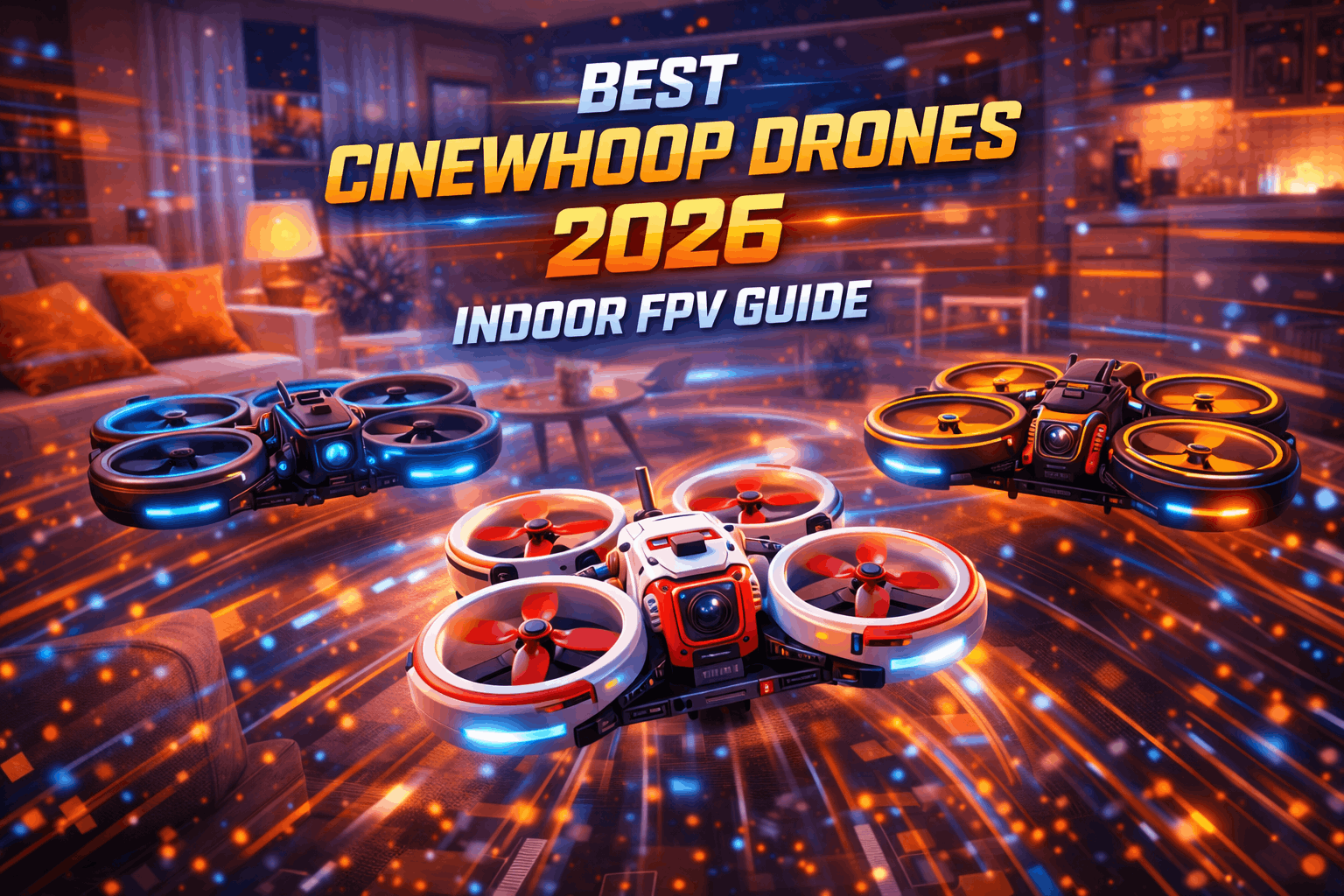
A cinewhoop is an FPV drone with ducted propellers—full guards surrounding each motor—designed specifically for smooth cinematic footage in tight spaces. The name combines “cine” (cinematography) with “whoop” (the ducted prop design). Where a freestyle quad is tuned for snappy aggressive response, a cinewhoop is deliberately “mushy.” That’s the point. The gentle, dampened flight characteristics translate directly to buttery video that clients love.
These aren’t toys pretending to be tools anymore. In 2026, cinewhoops carry integrated DJI O4 systems shooting 4K at 120fps, fly on refined factory tunes that took years to develop, and produce footage that genuinely competes with gimbal rigs costing five times more. Real estate tours, wedding coverage, commercial ads, warehouse inspections, event videography—cinewhoops handle all of it because prop guards let you fly inches from walls, ceilings, and people without anyone flinching.
This guide covers the three cinewhoop platforms worth buying in 2026, based on hundreds of hours across paid gigs and personal projects. I’ll be direct about what each does well and where each falls short, because the right cinewhoop depends entirely on how you plan to use it.
Affiliate disclosure: This guide contains affiliate links to GetFPV and Amazon. Purchases through these links support our content at no extra cost to you.
Understanding Cinewhoop Design
Before diving into specific models, it’s worth understanding what makes cinewhoops fundamentally different from other FPV platforms—because the design choices affect everything about how you fly and what footage you produce.
Cinewhoops vs. Racing and Freestyle Quads
The distinction goes deeper than “it has prop guards.” A racing quad optimizes every gram and every tuning parameter for maximum speed and aggressive response. Stick inputs translate instantly to movement. Top speeds exceed 100mph. The entire aircraft is built to be fast, fragile, and cheap to repair after inevitable crashes.
A cinewhoop inverts those priorities completely. Stick inputs are dampened—deliberately. Movement feels gradual and floaty. Top speeds rarely hit 40–50mph, and you’d never want to fly that fast with one because the footage would be unwatchable. The prop guards add 30–50g of dead weight that does nothing for flight performance. The camera system adds another 50–100g. The heavier battery needed to compensate adds more. A cinewhoop at 280–400g is often double the weight of a comparable racing quad, and it flies nothing like one.
The first time I flew a cinewhoop after months on a 5-inch freestyle rig, I genuinely thought something was broken. The controls felt mushy, the throttle response was delayed, and the aircraft seemed to resist every input. It took about twenty minutes to realize the “problem” was the point. That dampened, resistant feel is what produces buttery smooth footage. Every design compromise that frustrates a racing pilot serves the cinematographer.
This also means the flight characteristics differ by environment. Cinewhoops handle confined indoor spaces gracefully because their gentle response gives you time to react in tight quarters. Racing quads in the same space feel like driving a sports car through a parking garage—technically possible but terrifying and inadvisable.
Weight and Regulations
Most cinewhoops fall between 250g and 400g all-up weight, which puts them above the sub-250g threshold that simplifies drone regulations in many jurisdictions. The Pavo Pico at under 71g is a notable exception—it flies under virtually every weight-based restriction.
For professional use, know your local rules before charging clients. Indoor flying on private property is generally unregulated, but the moment you fly outdoors or in certain commercial contexts, registration and certification requirements may apply. Our drone laws guide covers the current regulatory landscape.
Best Cinewhoop Models for 2026
Quick Comparison
| Model | Size | Weight | Camera | Flight Time | Price | Best For |
|---|---|---|---|---|---|---|
| GEPRC CineLog 35 V3 O4 Pro | 142mm | 280g | DJI O4 4K/120fps | 7–8.5 min | ~$510 | Professional video work |
| BetaFPV Pavo Pico II | 80.8mm | 54–71g | Swappable VTX | 4–6.5 min | $150–191 | Travel & portability |
| DJI Avata 2 | 170mm | 377g | Integrated 4K | 20–23 min | $849–999 | Beginners & long flights |
GEPRC CineLog 35 V3 O4 Pro — The Professional Choice
The CineLog 35 is the cinewhoop I grab when there’s a client on the other end of the footage. It’s not the cheapest, not the most portable, and definitely not the longest-flying. But the video quality from the integrated DJI O4 system is genuinely stunning—4K at 120fps with clean color science that needs minimal grading in post.
At 142mm wheelbase and 280g dry weight, it’s compact enough for small apartments but stable enough for smooth tracking shots through warehouses. GEPRC’s factory tune is one of the best I’ve flown out of the box. Throttle response is linear and predictable, directional changes are gradual without being sluggish, and the aircraft feels planted rather than twitchy. Pilots coming from racing quads need a session or two to stop overcontrolling, but the adjustment is quick.
Build quality matches the price tag. Carbon fiber frame with reinforced stress points, clean wiring, proper motor sizing that provides power without being overkill. I’ve bounced this thing off more walls than I’d like to admit during real estate shoots, and the prop guards take it without cracking or warping. One shoot in a Victorian-era house with narrow hallways and low archways—I clipped maybe six doorframes. Landed, checked the aircraft, kept shooting. That’s the kind of durability you need when clients are watching.
The real-world limitation is flight time. Seven to eight minutes on a 4S 850–1100mAh battery sounds short, and it is compared to the Avata 2. But for cinewhoop work, you’re rarely running continuous eight-minute takes. Most shots are 30–90 seconds. I carry eight batteries per session and rarely run out. The bigger annoyance is battery cost—quality 4S packs add up fast. Budget $200+ for a proper battery rotation.
Camera angle adjustability deserves mention because it affects every shot you take. The mount accommodates a range from low-angle ground-level perspectives to steeper overhead views, and swapping between them takes thirty seconds with a hex wrench. I typically run 25–30 degrees for real estate work—steep enough for dynamic forward movement, shallow enough to capture ceiling details in luxury properties. For event work where I’m tracking subjects, I’ll drop to 15–20 degrees for a more natural eye-level perspective.
One thing that surprised me: the O4’s low-light performance is genuinely usable in dimly lit interiors. I’ve shot in restaurants with ambient candlelight and the footage was clean enough for client delivery with minor exposure adjustment in post. The O3 would have been noisy garbage in the same conditions. If you’re working events or hospitality venues, this alone justifies the O4 upgrade.
At roughly $510 for the aircraft (goggles and radio separate), the CineLog 35 is an investment. But if you’re doing paid work where clients expect professional results, it’s the right tool. The footage speaks for itself.
Best for: Professional videography, real estate, commercial work, experienced pilots wanting top-tier video quality.
Skip if: You need 20+ minute flights, want a complete plug-and-play system, or are brand new to FPV.
BetaFPV Pavo Pico II — The Travel Cinewhoop
The Pavo Pico II breaks the rules of what a cinewhoop should be. At 80.8mm wheelbase and 54–71 grams, this thing fits in a jacket pocket. I’m not exaggerating—I’ve flown it out of my coat at events where pulling out a full cinewhoop kit would have been impractical.
The swappable VTX system is genuinely clever engineering. You choose between DJI O3, O4, Avatar, or Vista modules depending on what goggles you own and what quality level you need. That flexibility is unusual at any price point, let alone $150–191.
Video quality exceeds what you’d expect from something this small. It’s not CineLog 35 territory—the sensor is tiny and low-light performance suffers—but for social media content, B-roll, and situations where having any cinewhoop beats having no cinewhoop, the footage is clean and usable. I shot a friend’s birthday party with the Pavo Pico because my main rig was at home. The clips looked great on Instagram. Would I deliver that footage to a paying client? Probably not for their hero reel, but as supplementary angles, absolutely.
Flight time is the honest limitation. Four to six minutes means carrying a bag of tiny batteries—I bring ten minimum. The aircraft uses specific small-format cells that aren’t interchangeable with standard FPV packs. And wind is a real factor; this thing weighs less than most action cameras, so outdoor flights need calm conditions.
Durability is adequate for gentle flying but this isn’t a tank. Hard impacts can crack the frame or damage components. Fly it like the delicate precision instrument it is, not like a freestyle beater.
Where the Pavo Pico really shines is as a complementary platform, not a replacement. I keep one in my travel bag permanently. When I was shooting a wedding last year and the venue had a narrow wine cellar the CineLog couldn’t navigate comfortably, I pulled out the Pavo Pico and captured a tracking shot through the shelves that became the couple’s favorite clip from the entire day. That’s the value proposition—it goes where nothing else can, and it’s always with you because carrying it costs nothing in weight or space.
The control feel takes adjustment if you’re used to larger aircraft. The Pavo Pico responds faster to inputs than you’d expect, partly because it’s so light. First-timers tend to overcorrect. Dial your rates down 20–30% from what you’d run on a 3-inch cinewhoop and the handling becomes much more manageable. In tight spaces, the tiny prop guards give real protection—I’ve bumped walls in hotel hallways without any damage.
Best for: Traveling creators, backup cinewhoop, social media content, tight spaces where even a 3-inch cinewhoop can’t fit.
Skip if: You need professional delivery quality, long flight times, or a rugged platform for daily commercial use.
DJI Avata 2 — The Beginner’s Bridge
The DJI Avata 2 isn’t really designed for the FPV community. It’s designed for content creators who want cinematic indoor footage without learning to fly a manual FPV quad. And at that specific job, it’s remarkably good.
The numbers tell the story: 20–23 minute flight times (that’s not a typo—it genuinely flies three times longer than the CineLog 35), integrated 4K camera with solid image processing, obstacle avoidance sensors, and a motion controller that lets someone with zero FPV experience capture usable footage within an hour of unboxing.
I’ll be honest: as an experienced FPV pilot, the Avata 2 frustrates me. The speed limits feel restrictive, the motion controller lacks the precision of a proper radio transmitter, and the locked DJI ecosystem means nothing is cross-compatible with my other builds. But I’ve watched beginners pick this thing up and produce footage that would have taken me months to learn on a manual cinewhoop. The stabilization, the automated flight modes, the obstacle avoidance—it all works together to flatten the learning curve dramatically.
Video quality from the integrated camera is genuinely excellent. Color science is pleasant, stabilization handles minor shake well, and 4K output satisfies clients who don’t need cinema-grade flexibility in post. For real estate work specifically, the 20-minute flights mean covering an entire large property on a single battery. That efficiency is hard to argue with.
The trade-offs are real though. At 377g, it’s the heaviest option here—noticeably less nimble in tight rooms compared to the CineLog 35. Repairability is limited with proprietary everything. And you’re committing to DJI’s ecosystem for goggles, batteries, and accessories with no flexibility to use those components elsewhere.
At $849–999 for the complete Fly More package, the total cost is clear upfront. No separate goggles or radio to budget for. Whether that’s good value depends on whether you want a complete turnkey solution or prefer building a flexible system from components.
One thing I will say in the Avata 2’s defense: it’s democratized cinematic FPV in a way nothing else has. I’ve recommended it to three realtor friends who had zero interest in learning traditional FPV. All three are now shooting their own listing tours and saving $200–400 per property on videographer fees. The footage isn’t as refined as what I produce with the CineLog, but their clients can’t tell the difference in most cases. That accessibility matters, even if it doesn’t excite the FPV community.
The obstacle avoidance also deserves credit for indoor work. It’s not perfect—it misses thin objects like lamp cords and can struggle in very dark corners—but it’s caught enough near-misses with furniture and doorframes to justify itself. For experienced pilots it’s something you disable. For beginners, it’s training wheels that prevent expensive lessons.
Best for: Beginners, content creators without FPV background, anyone prioritizing flight time and ease of use.
Skip if: You’re an experienced FPV pilot wanting full manual control, need the most compact platform, or prefer open ecosystems.
Choosing the Right Cinewhoop
The decision tree is simpler than most guides make it:
Doing paid professional work? CineLog 35. The video quality gap over the alternatives is visible to clients, and the refined flight characteristics produce consistently professional results. The $510 investment pays for itself after one or two gigs.
Need maximum portability? Pavo Pico II. Nothing else comes close to fitting a capable cinewhoop in your pocket. Accept the flight time and quality trade-offs because the portability advantage is transformative for travel creators.
Brand new to FPV? Avata 2. The learning curve is measured in hours, not weeks. The flight times give you room to practice without constant battery swaps. Graduate to a CineLog 35 when you outgrow the training wheels.
Shooting real estate specifically? Both the CineLog 35 and Avata 2 work well. CineLog gives better video and maneuverability in small rooms. Avata 2’s longer flights cover large properties efficiently. Read our dedicated FPV real estate guideb for deeper recommendations.
Event coverage and weddings? This is where the choice gets nuanced. Events have people moving unpredictably, variable lighting, and usually limited time for retakes. I prefer the CineLog 35 because the video quality holds up in challenging light and the manual control lets me react to unexpected moments. But I’ve seen excellent event work from Avata 2 pilots who use the obstacle avoidance as a safety net in crowded spaces. If you’re shooting events solo without a spotter, the Avata 2’s safety features have real value.
Content creation and social media? Honestly, any of the three works depending on your style. The Pavo Pico produces surprisingly good content for platforms that compress everything anyway. Instagram Reels and TikTok don’t need 4K/120fps—they need interesting angles and smooth movement, which the Pavo Pico delivers at a fraction of the cost.
Workflow Considerations
Something most cinewhoop guides ignore: the workflow around the aircraft matters as much as the aircraft itself.
With the CineLog 35 running DJI O4, your footage lives on a microSD card in the air unit. After each flight, you swap batteries and keep shooting. At the end of a session, you pull the card and ingest into your editing software. The O4 records in a format that plays nicely with DaVinci Resolve, Premiere, and Final Cut. Color grading flexibility is good. The workflow is familiar to anyone who’s worked with action cameras.
The Avata 2 records internally with DJI’s processing pipeline, which produces pleasant-looking footage that needs less grading but offers less flexibility if you want to push it in post. The stabilization is baked in at the recording level, which is great for consistency but removes the option to use third-party stabilization tools like Gyroflow.
The Pavo Pico’s workflow depends entirely on which VTX module you’ve installed. O4 footage follows the O4 workflow. Avatar footage follows its own path. This flexibility is both the Pavo Pico’s strength and its complexity—you need to understand whichever ecosystem you’ve chosen.
Battery management is the unglamorous reality of cinewhoop work. For a typical two-hour real estate session with the CineLog 35, I bring eight batteries, a parallel charging board, and a field charger. Between setups in different rooms, I’m swapping batteries every 6–7 minutes and rotating charged packs. With the Avata 2, two batteries cover the same session with room to spare. That logistical simplicity is genuinely valuable for working professionals even if the video quality premium goes to the CineLog.
Budget Reality Check
Don’t just budget for the aircraft. Total system cost catches people off guard:
A CineLog 35 setup runs roughly $1,000–1,200 total: aircraft ($510), DJI goggles ($300–500), batteries and charger ($150–200), and accessories. A Pavo Pico setup is $400–600 all-in. The Avata 2 Fly More combo at $849–999 includes everything except spare batteries.
For pilots on a tight budget under $500, the Pavo Pico plus compatible goggles is your entry point. Our budget FPV setup guide covers how to stretch that budget further. Just know that sub-$500 means real compromises in flight time or video quality—there’s no magic workaround.
Camera Systems and Video Quality
Integrated Digital FPV Systems
The shift to integrated digital systems is the single biggest reason cinewhoops became professional tools. The DJI O4 system in the CineLog 35 handles both FPV transmission and 4K recording from one unit—no separate FPV camera and GoPro needed. What you see in your goggles closely matches the recorded output, which eliminates the guesswork about framing that plagued older setups.
The O4 represents the current peak: improved low-light performance over the O3, higher bitrate recording, lower latency, and better range. For new builds, the O4 premium is worth it. If you’re budget-conscious, the O3 remains very capable—I shot professional real estate content with O3 for over a year before upgrading.
Walksnail Avatar and HDZero offer alternatives outside the DJI ecosystem. Video quality trails DJI for recording purposes, but if you’re philosophically committed to open systems or already invested in those goggles, both produce usable footage. Our digital vs analog comparison covers the ecosystem decision in depth.
Action Camera Mounting
Some pilots still mount a separate GoPro for recording while using a basic FPV camera for flying. The advantage is camera independence—upgrade your GoPro without touching the drone, and access GoPro’s Hypersmooth stabilization. The trade-off is 50–100g of extra weight (using a “naked” GoPro with housing stripped), more complex mounting, and separate battery management.
For most pilots in 2026, integrated O3/O4 makes more sense than the GoPro route. The weight savings improve flight characteristics, the simplified setup means fewer failure points, and O4 video quality has closed most of the gap with GoPro. The GoPro approach still makes sense if you need slow-motion beyond 120fps or specific GoPro features like Hypersmooth 6.0.
Getting Smooth Footage
Smooth cinewhoop footage comes from three layers working together. First, proper aircraft tuning: the PID settings must eliminate oscillations and create linear stick response. Factory tunes on the CineLog 35 and Avata 2 are genuinely good—most pilots won’t need to touch Betaflight unless chasing perfection.
Second, pilot technique matters more than equipment. Gentle progressive stick inputs, constant speed through shots, and planning movements before executing them. The biggest mistake I see from racing pilots transitioning to cinewhoop work is fighting the aircraft—trying to force snappy inputs that the dampened tune resists. Work with the mushiness, not against it. Fly slower than instinct tells you. The best cinewhoop shots I’ve captured were at walking pace.
Third, post-production stabilization using ReelSteady or Gyroflow polishes what’s already good. These tools are impressive but they can’t fix fundamentally shaky flying—they smooth the last 10%, not the first 90%.
Cinematic Shot Vocabulary
Once your flying is smooth, the creative side opens up. Cinewhoops enable a specific vocabulary of shots that other camera platforms can’t replicate. Learning when to use each one is what separates impressive demo reels from actual storytelling.
The forward push is your bread and butter—a slow, steady advance into a scene. Through a doorway, down a hallway, into a room. It creates reveal and draws the viewer in. I use this for probably 60% of my real estate shots. The key is maintaining constant speed; any acceleration or deceleration reads as amateur.
Pull-back reveals work in reverse—start close on a detail and pull back to show context. Great for showcasing architectural features or establishing spatial relationships. Start tight on a fireplace mantle, pull back to reveal the full living room. This shot requires planning your exit path because you’re flying backward.
Orbits circle around a subject at constant distance and altitude. These are harder than they look—maintaining true circular motion while keeping the subject centered in frame requires coordinated stick inputs that take practice. I practice orbits around a pole in my backyard before any shoot that might need them.
Tracking shots follow a moving subject (a person walking through a space, a car in a parking structure). The cinewhoop’s smooth flight makes these feel cinematic rather than shaky. Match your subject’s speed exactly and maintain consistent distance. Too close feels aggressive; too far loses intimacy.
Vertical reveals—ascending or descending to change perspective—work beautifully in spaces with dramatic height like atriums, stairwells, or warehouses. Smooth throttle management is critical here. Any wobble in altitude reads immediately in the footage.
Speed matters more than most beginners realize. The most compelling cinewhoop footage I’ve shot was at walking pace or slower. Fast flight looks exciting in goggles but produces footage that’s hard to watch. Think of your cinewhoop as a floating camera dolly, not a race vehicle. Our cinematic FPV filming guide goes deeper into composition and storytelling techniques.
Flying Cinewhoops Indoors
Indoor flying is where cinewhoops earn their keep, but confined spaces demand respect even with prop guards.
My pre-flight routine for any indoor shoot: walk the entire space first. Note ceiling height, hanging fixtures, mirrors (they cause disorientation in goggles), HVAC vents that push air currents, and identify at least two emergency landing spots. Plan your flight path considering where the aircraft goes if you lose orientation—because in a tight hallway, there’s nowhere to recover.
Start every session slow. I mean embarrassingly slow. Get a feel for how the aircraft behaves in that specific space before pushing proximity or speed. Ceiling height matters more than you’d think—a room with 8-foot ceilings flies completely differently than a warehouse with 20-foot clearance. Air currents from heating systems affect the Pavo Pico noticeably and even push the CineLog around in some spaces.
Prop guards are not invincibility shields. They prevent direct propeller contact with surfaces and people, which is crucial. But a 280g aircraft at speed still has momentum. I’ve knocked a vase off a shelf with a CineLog that was “protected” by guards—the guards saved the props, but the impact force moved the vase. Maintain buffer distances from anything fragile or valuable, and communicate clearly with anyone present about staying predictable.
For pilots wanting to develop indoor skills before risking real environments, FPV simulators with indoor maps are genuinely useful practice. The muscle memory for smooth inputs translates directly to real flights.
Common Indoor Mistakes I’ve Learned the Hard Way
Ceiling fans are invisible death traps. They’re above your natural line of sight during walkthrough, and in goggles, a stationary ceiling fan blade is nearly invisible against a white ceiling. I clipped one during a real estate shoot—blade caught the prop guard, whipped the aircraft sideways into a wall. No damage to the house, thankfully, but the CineLog needed new props and the realtor looked at me like I’d lost my mind. Now I check every ceiling fan before every flight, even in spaces I’ve shot before.
Mirrors and glass walls cause disorientation that’s genuinely dangerous. Flying past a large mirror in goggles can make you briefly think you’re heading into open space when you’re actually flying toward a wall. I mark mirror locations mentally during my walkthrough and plan flight paths that approach mirrors at angles rather than head-on.
Pets are unpredictable hazards. I’ve had a cat launch itself at a CineLog mid-flight (prop guards saved the cat, the cat did not save the CineLog). Dogs bark and chase. Ask the owner to secure pets before you fly—it’s a safety and professionalism issue.
The last piece of indoor wisdom: always know where your insurance stands before flying in someone else’s property. Even with prop guards and careful technique, accidents happen. Professional liability coverage isn’t optional if you’re charging for this work. Check our drone insurance guide for coverage options and what to look for in a policy.
Building vs. Buying a Cinewhoop
Unless you genuinely enjoy the build process and have solid soldering skills, buy a ready-to-fly cinewhoop. Building rarely saves money once you price all components, and the factory tune on something like the CineLog 35 represents thousands of hours of optimization you’d need to replicate through Betaflight configuration and testing.
That said, building teaches you how the aircraft works, which makes troubleshooting and repairs dramatically easier. If you’re running cinewhoops commercially and can’t afford downtime waiting for manufacturer support, building skills have real value. For a first cinewhoop though, buy proven hardware and focus on developing your flying and filming skills. That’s where the learning curve actually matters.
For the component details—motors in the 1404–1507 range for 3-inch builds, flight controllers with good filtering, appropriate VTX selection—our build guide covers the fundamentals that apply to any FPV platform.
Whichever route you take, establish a maintenance routine from day one. Cinewhoops accumulate wear faster than you’d expect because they’re intentionally flown near obstacles. I check prop guards for cracks after every session, inspect motor bearings weekly during heavy use, and keep the camera lens clean (a fingerprint smudge ruins footage in ways you won’t notice until you’re reviewing in post). Five minutes of maintenance prevents expensive mid-shoot failures.
Essential Accessories
A few items that genuinely matter for cinewhoop sessions:
Batteries: Budget for 6–8 minimum per platform. For the CineLog 35, quality 4S packs in the 850–1100mAh range. For battery fundamentals and charging best practices, our LiPo guide covers everything.
Spare props: Buy 10–20 sets. They’re $5–10 per set and break more often than you’d expect even with guards. The guards protect from wall contact; they don’t prevent prop-to-guard strikes during hard impacts.
ND filters: Essential for outdoor shooting to control exposure and achieve cinematic motion blur. ND filter sets for FPV covering ND8, ND16, and ND32 handle most conditions. Less critical for indoor work where lighting is typically lower, but if you’re shooting a venue with large windows letting in direct sunlight, having ND options saves your exposure.
Transport: A proper case matters when you’re carrying expensive camera equipment. Our FPV backpack guide covers the best options for different setups. At minimum, store LiPo batteries in fire-resistant bags during transport—this is non-negotiable safety, not optional.
FAQ — Best Cinewhoop Drones 2026
What is a cinewhoop and how does it differ from a regular FPV drone?
A cinewhoop is an FPV drone with full propeller ducts (guards) designed for smooth cinematic footage rather than racing or freestyle. The key differences: prop guards enable safe indoor flying near walls and people, flight tuning prioritizes smooth camera motion over aggressive response, and integrated camera systems (typically DJI O3/O4) handle both FPV feed and 4K recording. They’re heavier (250–400g) and slower than racing quads—deliberately. The gentle, dampened flight is what produces professional-looking video.
Which cinewhoop is best for professional video work?
The GEPRC CineLog 35 V3 O4 Pro. The DJI O4 system delivers 4K/120fps with excellent color science, the factory tune produces consistently smooth footage, and the build quality survives daily commercial use. At ~$510, the investment pays for itself quickly in paid work. The DJI Avata 2 is a viable alternative if 20+ minute flights and beginner-friendly operation outweigh the video quality and flexibility advantages of the CineLog.
Can beginners fly cinewhoops or do I need racing experience?
Beginners can absolutely start with cinewhoops. The DJI Avata 2 specifically is designed for zero-experience pilots with motion controller, obstacle avoidance, and automated flight modes. Even manual cinewhoops are more forgiving than racing quads because the gentle flight characteristics tolerate sloppy inputs better. Racing experience isn’t required and may actually require unlearning aggressive habits. Budget 10–20 hours of practice (including simulator time) to produce consistently smooth footage.
How long do cinewhoops fly per battery?
It varies significantly: CineLog 35 gets 7–8.5 minutes on 4S 850–1100mAh packs, Pavo Pico II manages 4–6.5 minutes on its tiny cells, and DJI Avata 2 achieves a remarkable 20–23 minutes. For anything other than the Avata, plan on carrying 6–8 batteries minimum per shooting session. Most actual shots are 30–90 seconds, so shorter flight times are less painful than the raw numbers suggest.
What’s the best portable cinewhoop for travel?
The BetaFPV Pavo Pico II, hands down. At 80.8mm and under 71g, the complete setup fits in a jacket pocket. Nothing else in the cinewhoop category comes close to that portability. The trade-offs—short flights, reduced video quality, wind sensitivity—are worth accepting when the alternative is leaving your cinewhoop at home.
Do I need special goggles for cinewhoops?
Goggles must match the video system in your cinewhoop. DJI O3/O4 aircraft require DJI goggles (Goggles 2, 3, or N3). Avatar systems need Avatar-compatible goggles. HDZero needs HDZero goggles. There’s no cross-compatibility between brands. If you already own FPV goggles, choose a cinewhoop with a matching video system. If buying from scratch, factor $300–600 for goggles into your total budget.
Can I use a cinewhoop for real estate videography?
Yes—cinewhoops have become standard tools for real estate video. Prop guards enable safe indoor flights through living rooms, kitchens, and hallways. The smooth flight characteristics produce the polished walkthrough footage clients expect. The CineLog 35 offers better maneuverability in small rooms; the Avata 2’s longer flights cover large properties efficiently. Check our dedicated real estate FPV guide for the full workflow including shot planning and client delivery.
How much does a complete cinewhoop setup cost?
Budget realistically for the full system: Pavo Pico setup runs $400–600 total (aircraft + goggles + batteries). CineLog 35 setup runs $1,000–1,200 (aircraft + goggles + radio + batteries + charger). DJI Avata 2 Fly More is $849–999 all-inclusive. Don’t forget recurring costs: replacement props ($5–10/set), additional batteries ($25–50 each), and memory cards. Total accessory investment often matches or exceeds the aircraft cost over the first year.