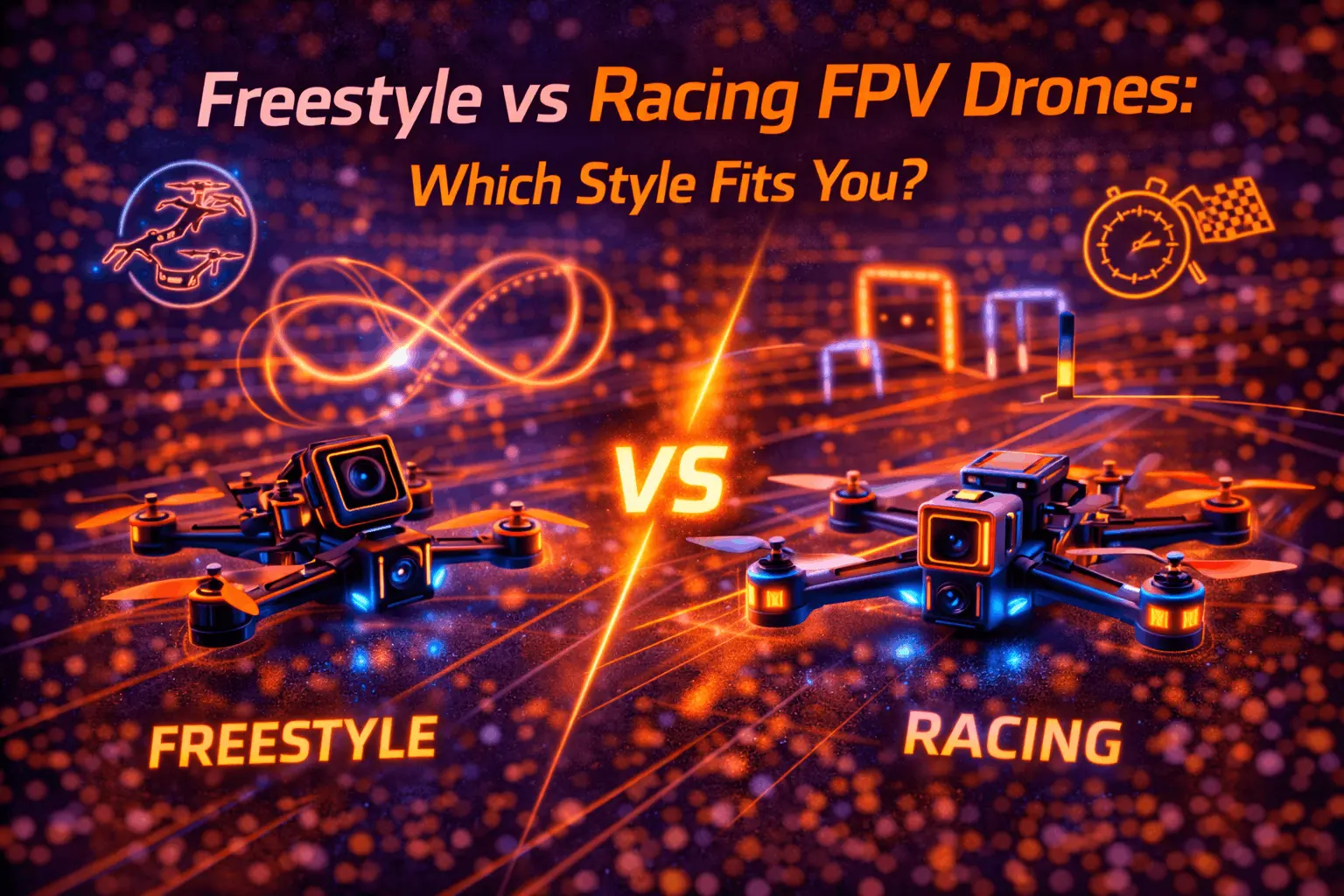
Freestyle and racing represent two fundamentally different approaches to FPV. One rewards creative expression and flow. The other demands raw speed and lap-time consistency. Both use similar hardware at their core, but the builds, the skills, and the mindsets behind them pull in very different directions.
A freestyle pilot scouts a location, imagines flight lines, and strings tricks into sequences that feel uniquely theirs. A racing pilot memorizes a gate sequence and shaves milliseconds off laps, competing directly against the clock and other pilots. Both demand real mastery — they just reward different things.
This isn’t a hierarchy. Many pilots fly both, switching based on mood, location, or whether a MultiGP event happens to be that weekend. Skills transfer between the two, and your goggles, radio, and charger serve both without question. The real differences come down to frame design, weight philosophy, video system priorities, and what you optimize for when you’re building and tuning.
Here’s an honest breakdown of both paths so you can decide where to start — or why you might want both.
What Freestyle and Racing Actually Look Like
Freestyle FPV
Freestyle is creative expression through flight. There are no rules, no competition metrics, no external scoring system. The only measure that matters is whether you nailed the line you saw in your head.
Freestyle pilots chase flow states — that zone where stick inputs become instinctive and flying turns into improvisation. Each pilot develops a personal style over time. Some favor aggressive power loops and inverted snaps. Others prefer buttery-smooth proximity flying or cinematic orbits. There’s no “correct” approach, and that’s the whole point.
Core tricks and techniques:
- Power loops — vertical rotations driven by throttle and pitch
- Split-S — half-roll into a dive, then pull up
- Matty flips — inverted mid-air flips
- Proximity flying — intentionally threading through tight gaps
- Flowing lines — smooth curves connecting multiple maneuvers
- Orbits — circular paths around objects
- Inverted flight — controlled upside-down cruising
You string these together in the moment. You see a gap in a building, imagine a line through it, and execute — or crash trying. That’s what makes it addictive.
Where freestyle happens: abandoned structures (“bandos”), mountain ridgelines, forests, urban environments (with permission), and honestly anywhere interesting enough to inspire a creative line. Even an open field works for drilling tricks.
FPV Racing
Racing is competitive speed optimization with objective, measurable results. A course is defined with gates, flags, and obstacles in a fixed sequence. Your only job: navigate that course faster than everyone else. The clock doesn’t care about style.
That measurability is what hooks racing pilots. You know exactly how fast you flew. You know where a competitor gained half a second on you. That feedback loop drives improvement in a way that freestyle’s subjective “did that feel good?” can’t replicate for competitive personalities.
What racing looks like in practice:
- MultiGP events — structured league with 500+ chapters and over 30,000 registered pilots worldwide
- Gate clipping — precise entry through defined gates at speed
- Line optimization — finding the fastest path through course geometry
- Bracket racing — head-to-head elimination tournaments
- Professional DRL — Drone Racing League at the elite level
Courses are predetermined. You memorize the gate sequence, find the optimal racing line, and then repeat it with maximum consistency. Variation comes from competitors, wind, and your ability to manage pressure.
Where racing happens: organized MultiGP events (local chapters exist in most areas), purpose-built outdoor tracks with gates, indoor converted warehouses and arenas, and professional DRL venues.
The Spectrum Between
Most experienced pilots don’t sit cleanly in one camp. A pilot might race on Saturdays and freestyle on Tuesday evenings. “Fast freestyle” — tricks performed at higher speed than traditional freestyle — lives right between the two disciplines. Some racers fly with genuine style, winning heats while maintaining smooth, clean lines.
A freestyle quad can complete a race. A racing quad can attempt tricks. Neither is perfect for both purposes, but both can do both — with trade-offs we’ll cover next.
Build Differences That Actually Matter
Frames
Freestyle frames prioritize durability above all else. You’re crashing into walls, scraping through gaps, bouncing off concrete. Proximity is the point — and the frame needs to survive it.
Typical freestyle frame characteristics: True-X geometry for balanced handling, 5–6mm carbon arms, 100–140g frame weight, and wider bodies to accommodate a GoPro mount. Proven options include the iFlight Nazgul Evoque, Source One, and TBS Source Five — designs that absorb impacts without snapping arms on every session.
Racing frames optimize for speed through weight reduction and aerodynamic efficiency. Every gram affects acceleration and top speed, and races are decided by milliseconds. You’ll see Stretch-X geometry (slightly longer forward arms for better forward-flight stability), thinner 4–5mm arms, frame weights of 60–90g, and compact profiles that minimize drag. The iFlight Nazgul Evoque in its racing configuration, GEPRC Racer, and Armattan frames are popular choices.
Why these differences exist: freestyle crashes are high-energy impacts — frame slamming into a wall at speed. Thick arms absorb that. Racing crashes tend to be lower-energy slides and tumbles on open ground. Thinner arms handle that fine while saving crucial grams.
For a deeper dive into frame selection, check our Best 5-Inch FPV Frame guide.
Motors
Freestyle motors balance torque and smooth power delivery. You need precise control at variable speeds — smooth throttle response matters more than peak RPM when you’re threading a gap at 30% throttle, then punching out into a power loop. On 6S batteries, 1750–1900KV is the sweet spot. Higher torque at lower KV gives you that controllable, confidence-inspiring feel.
Racing motors chase maximum power-to-weight ratio. Higher KV options (1900–2150KV on 6S) generate more RPM and thrust, translating directly to faster acceleration and higher top speed. Racing heats are short — you’re not worried about efficiency. You want peak output for 2–3 minute laps.
Racing motors are often lighter too, shaving grams from the stator and bell wherever possible. That weight reduction compounds with a lighter frame, smaller battery, and no camera to create a quad that accelerates noticeably harder.
For specific motor recommendations, our Best FPV Motors 2026 guide covers both disciplines.
Props
Freestyle props typically run 5.1” with moderate pitch (5.1×3 to 5.1×4). These give balanced thrust without excessive noise — important if you’re flying near populated areas. Peanut-tip designs reduce noise further. Props last longer in freestyle because you’re not running full throttle continuously.
Racing props are aggressive — 5×4 or higher pitch. Maximum thrust is the priority, and noise is irrelevant at organized race events. Props are an expendable consumable. Budget for replacing them constantly — racing breaks props regularly, and racers often carry dozens of spares per event.
See our Best FPV Propellers 2026 for detailed recommendations.
Electronics and Video Systems
Both disciplines share the same fundamental architecture: F7 flight controllers, 4-in-1 ESCs (45–55A rated), and quality receivers (ExpressLRS has become the standard for both). The differences show up in battery sizing, weight targets, and video system choices.
Freestyle electronics tend toward:
- Larger batteries — 1300–1500mAh 6S for longer flight times exploring spots
- GPS modules — sometimes added for GPS Rescue if a battery dies far out
- GoPro or action camera — adds ~150g but enables content creation
- HD digital video — DJI O3/O4 or Walksnail for image quality that feeds YouTube and social media
- All-up weight of 700–800g with GoPro is normal and acceptable
Racing electronics tend toward:
- Smaller batteries — 850–1100mAh 6S (racing heats last 2–5 minutes)
- No GPS — dead weight with no racing benefit
- No action camera — every gram counts
- Low-latency video system — this is where racing gets specific
- All-up weight target of 400–450g
Video System: The Biggest Discipline Split
This is where freestyle and racing diverge most sharply, because each discipline prioritizes opposite ends of the image quality vs. latency spectrum.
Freestyle pilots want beautiful footage. HD digital systems like DJI O3/O4 and Walksnail deliver stunning image quality that looks great on camera and in the goggles. The higher latency (~25–30ms for DJI O3, ~22ms for Walksnail) is perfectly acceptable for flowing flight patterns where you’re not reacting to split-second gate entries.
Racing pilots want the lowest possible latency for real-time responsiveness. Here’s how the systems stack up based on verified manufacturer specs:
- HDZero — 3ms glass-to-glass sub-frame latency with HDZero Goggles 2. Fixed latency regardless of signal strength. This is the racing gold standard for consistency.
- Analog — ~10–20ms glass-to-glass. Still used competitively, proven reliable, cheapest option.
- DJI O4 Pro (Racing Mode) — 15ms with DJI Goggles 3. A significant improvement over O3, making DJI competitive for racing for the first time.
- DJI O3 — ~28–30ms minimum with Goggles 2/3. Flyable for casual racing, not ideal for serious competition.
- Walksnail Avatar (Race Mode at 540p) — ~18–22ms. Variable latency, but stabilized in race mode. Decent for recreational racing.
For a complete breakdown of digital FPV systems, see our Walksnail Avatar vs DJI O4 vs HDZero comparison and Analog vs Digital FPV guide.
Weight: Why It Matters More Than You Think
Freestyle quad (with GoPro):
- Frame + electronics: ~350–400g
- Battery (1300mAh 6S): ~220g
- GoPro: ~150g
- Total: ~700–800g
Racing quad (no camera):
- Frame + electronics: ~250–300g
- Battery (850mAh 6S): ~140g
- Total: ~400–450g
That ~300g difference translates to measurably faster acceleration, higher top speed, and quicker direction changes. In racing, where lap times are decided by tenths of seconds, weight optimization is non-negotiable.
For battery specifics, our FPV Drone Batteries guide covers both use cases in detail.
How the Flying Actually Feels Different
Freestyle Flying
Freestyle is artistic interpretation of a space. You approach a location with creative intent: “How can I fly this spot in a way that looks and feels interesting?” Then you compose sequences on the fly, combining tricks, proximity passes, and smooth connecting lines.
Speed serves the art. You might crawl through a narrow gap at 15% throttle, then punch out into a power loop, then smooth into a cinematic orbit — all in one sequence. A polished, stylish flight at variable throttle is infinitely better than max-throttle panic. Control and style beat raw speed every time.
The mental state is creative engagement. You’re improvising within learned patterns, reading the environment in real time. Flow states are common when freestyle is clicking — where impossible-seeming lines become instinctive.
Racing Flying
Racing is pure optimization. The course is defined. Your job is single-minded: complete it faster than anyone else. The optimal line through gate #3 is a physics problem, not a creative choice. Fastest wins. Period.
Speed is constant and maximal. Throttle stays high except where gates force deceleration. Every corner entry is calculated for the highest possible apex speed. Acceleration out of turns matters enormously — recovering speed faster after corners is where races are won.
The mental state is focused and competitive. You’re aware of competitors, your placement, the time gap. Pressure management becomes a genuine skill — the ability to execute your optimal line when it actually counts, with other quads around you.
Skills That Transfer (and Don’t)
What transfers directly: Throttle management, rate mode comfort, spatial awareness in 3D, orientation recovery, equipment knowledge (Betaflight configuration, PID tuning, troubleshooting). A freestyle pilot learning to race already has solid foundational control. A racer trying freestyle has precision and discipline.
Freestyle-specific skills: Trick vocabulary and chaining, flow composition, line reading through environments, proximity distance judgment, inverted flight comfort, personal style development.
Racing-specific skills: Line optimization through gate sequences, consistent lap execution, race strategy and positioning, pressure management under competition, gate timing precision.
Which is harder? Neither, honestly. They challenge completely different capabilities. Freestyle has a lower entry barrier (anyone can attempt a trick) but an infinite ceiling (personal style mastery never ends). Racing basics are accessible (gate navigation is learnable), but winning races consistently at competitive levels is extremely hard. Progression feels different too — freestyle shows visible growth weekly (new tricks), while racing progress is measured in tenths of seconds on lap times.
Can One Quad Do Both?
Yes, with trade-offs. You can fly the same quad at a MultiGP event Saturday and film freestyle content Sunday. It won’t be ideal for either, but it works — especially at the casual level.
The compromise build: Medium-durability frame (5mm arms, ~100g), moderate motor KV (1800–1900KV on 6S), versatile props (5.1×3.5), medium battery (1100–1300mAh), and a removable GoPro mount. This quad is a bit heavy for competitive racing and potentially fragile for aggressive bando proximity. For casual enjoyment of both? Perfectly fine. Many local pilots do exactly this.
When specialization becomes necessary:
- Competitive racing — if you’re chasing podiums at MultiGP events, a lightweight racing-specific build provides measurable lap-time advantages that a freestyle quad simply can’t match.
- Aggressive proximity freestyle — if you’re threading through tight bando gaps and bouncing off walls regularly, you need thick arms and durable construction that a racing frame doesn’t offer.
The natural progression most pilots follow: Start with one versatile quad → discover which style resonates more → build a specialized second quad → continue flying both as interests evolve.
What transfers between setups regardless: Your radio transmitter, FPV goggles, charger, tools, and fundamental piloting skills. The shared ecosystem investment ($500–900 for radio, goggles, and charger) serves both disciplines equally, making a second specialized quad much cheaper than your first full setup.
Community and Culture
Freestyle Community
Freestyle culture centers on individual expression and sharing. YouTube, Instagram, and TikTok feature freestyle content heavily. Successful freestyle pilots become content creators, building audiences around their personal style and the spots they fly.
Participation is self-directed: fly whenever you want, share clips if you feel like it, explore new locations, develop your own recognizable style. No formal schedule, no rankings, no external pressure. Local flying groups share spot recommendations and organize casual sessions, but nothing is mandatory.
Racing Community
Racing culture emphasizes competition and organized progression. MultiGP provides the structure: local chapters, regular events, regional competitions, and a clear path to national championships and global qualifiers. Published rankings, pilot tiers, and formal advancement paths give racing a structured competitive ecosystem.
Participation follows an organized schedule: join a local chapter, attend regular race events, compete in qualifying heats, climb rankings, and potentially advance to regional and national competition. Team affiliations and sponsorships become possible at higher levels. For more on getting into competitive racing, see our FPV Racing League Guide and FPV Racing Getting Started guide.
Shared Ground
Both communities occupy the same forums, local groups, and social media spaces. Pilots from both disciplines interact regularly and respect each other’s skills. Retailers and manufacturers serve both without rigid division — most components work for either discipline with different optimization.
The FPV community is fundamentally welcoming to both approaches. Many of the best pilots fly both styles and see them as complementary rather than competing.
Which Should You Choose?
Freestyle fits you if:
- Creative expression and personal style matter to you
- You prefer self-directed progression without external competition pressure
- Content creation (YouTube, social media) interests you
- You enjoy flexible schedules — fly when the mood strikes
- You value developing something uniquely yours over objective metrics
- No MultiGP chapter exists nearby (or organized events don’t fit your schedule)
Racing fits you if:
- Competition drives you and objective measurement of improvement motivates you
- You thrive under pressure and against other pilots
- Organized community events energize rather than stress you
- Clear goals and structured feedback loops help you improve faster
- You’re interested in potential competitive advancement, team affiliations, or sponsorships
- A local MultiGP chapter is accessible and running events regularly
Most experienced pilots do both
Different moods call for different flying. Some days you want creative expression in a quiet bando. Other days you want the adrenaline of head-to-head racing with friends. Skills genuinely complement each other — racing precision improves freestyle control, and freestyle creativity helps racers commit to aggressive lines.
If budget and space allow, owning both quads gives you the full range of FPV enjoyment:
- Freestyle quad for personal expression: ~$400–500 (plus ~$300–400 for GoPro if desired)
- Racing quad for competitive events: ~$300–400
- Same radio, goggles, and charger serve both
- Total for both quads: ~$700–900 on top of your shared ecosystem
Our FPV Racing Setup Cost Breakdown and Budget FPV Drone Setup Under $500 guides detail exact pricing.
Bottom line: start with whichever genuinely excites you. Motivation matters more than the “correct” starting point. If you’re unsure, try both risk-free in a simulator first — Velocidrone and Liftoff both offer racing and freestyle environments. Visit a local flying group where both communities overlap. You’re not choosing one path forever.
The best discipline is whichever gets you flying most frequently. More stick time means faster skill development, regardless of what style you’re flying.
FAQ
Can I use the same drone for freestyle and racing?
Yes, with compromises. A versatile 5-inch build handles both casually — you’ll fly slightly slower race times and less extreme proximity, but both work. Many local pilots run one quad for everything. For serious competition or aggressive bando flying, dedicated builds make a real difference. If budget limits you to one, lean toward a freestyle-oriented build — durable frames handle casual racing fine, while racing frames break quickly in proximity work.
Which is harder to learn?
They challenge different abilities. Freestyle has a lower barrier to entry (anyone can attempt tricks immediately) but an infinite skill ceiling. Racing basics are accessible, but competitive consistency is genuinely hard to achieve. Progression feels different: freestyle shows visible growth as you learn new tricks weekly, while racing improvement is measured in tenths of seconds. Choose whichever interests you — motivation trumps any abstract difficulty ranking.
Do I need a GoPro for freestyle?
Not required. Plenty of pilots fly freestyle purely for personal enjoyment without recording. Digital FPV systems like DJI O4 and Walksnail have decent onboard recording that’s acceptable for social media. That said, serious content creators still prefer GoPro quality — it’s noticeably better for YouTube. Many pilots fly without GoPro for practice sessions and mount it for “hero” sessions at interesting spots or when attempting new tricks.
What video system is best for racing?
HDZero with HDZero Goggles 2 delivers the lowest and most consistent latency (3ms glass-to-glass sub-frame) — it’s the racing standard for a reason. Analog remains competitive and cheap. DJI O4 Pro with Goggles 3 in Racing Mode (15ms) has made DJI a viable racing option for the first time. For casual racing, any modern system works — latency differences matter most at competitive levels. Most local races are won with whatever system the pilot already owns.
How much does a racing quad cost vs. a freestyle quad?
Racing quad (no camera, lightweight): ~$300–400. Freestyle quad (durable, no GoPro): ~$400–500. Freestyle quad with GoPro: ~$700–900. Both require the same ecosystem investment (radio $80–120, goggles $300–600, charger $50–100, batteries $50–100 each) — that shared gear totals $500–900 regardless of discipline. Adding a second specialized quad is much cheaper than your initial setup.
Can freestyle tricks help in racing?
Some transfers exist: split-S for direction recovery, tight maneuvering confidence, recovery from disorientation, aggressive commitment to lines. Most trick vocabulary (power loops, matty flips) is racing-irrelevant though. The bigger benefit flows both ways — pilots who fly both disciplines develop stronger overall skills than single-discipline specialists. Racing builds precision that sharpens freestyle control. Freestyle builds creative confidence that helps racers fly aggressive lines with conviction.
Should I start with freestyle or racing?
Common recommendation: start freestyle. It’s more forgiving (bad trick = try again, no audience), self-paced, and develops fundamental control without schedule pressure. Counter-argument: racing provides clear goals, structured feedback, and community support that some personalities thrive on. Practical answer: start with whichever excites you more. Simulator time lets you try both risk-free. Visit local groups that include both communities. Neither path is wrong — both develop legitimate FPV skills.