Introduction
Your frame is literally what holds everything together. Get it wrong and you'll fight vibration issues, break arms constantly, struggle with component fitment, or carry unnecessary weight that kills your flight performance. I've built on roughly 30 different frames over the years—from $25 AliExpress gambles to $180 premium carbon builds. Here's what I've learned: price matters, but not always how you'd expect. A $70 frame from an established brand often outperforms a $130 frame from an unknown manufacturer. This guide cuts through the marketing to help you pick the right 5-inch frame for your flying style and actual budget.
The 5-inch format dominates FPV for good reason. Prop efficiency peaks around this size; 5-inch props deliver optimal thrust-to-weight for both racing and freestyle. You can carry action cameras, fit modern electronics easily, and battery options abound (4S through 6S, 1300-1800mAh typical). Most quality FPV parts default to 5-inch compatibility. It's the Goldilocks zone: agile enough for tricks, powerful enough for racing, stable enough for cinematic flying.
Note: This guide contains affiliate links. If you purchase through our links, we may earn a commission at no extra cost to you. This helps support our testing and content creation.
Why 5-Inch Is Still the Sweet Spot
The 5-inch frame has remained the FPV standard for nearly a decade because physics favors it. Five-inch props at 160-190 km/h provide a speed range most pilots want—fast enough for competitive racing, agile enough for freestyle tricks, but not so fast you can't control smooth movements for filming. Smaller formats (3-inch whoops) sacrifice power and payload. Larger formats (7-inch, 10-inch) prioritize efficiency over agility, extending flight time but limiting maneuverability.
Component availability matters. Manufacturers design stacks (flight controller + ESC), motors, and electronic systems around the 5-inch standard. Finding quality 20x20mm or 30.5x30.5mm stacks is trivial. Finding components for exotic frame sizes? Frustrating. Most competition racing (MultiGP) happens on 5-inch quads, as covered in our racing leagues guide. Most freestyle content you see online? 5-inch. When you inevitably crash hard enough to break something, replacement parts for a 5-inch build are available everywhere—next-day shipping, reasonable pricing.
The regulatory advantage shouldn't be overlooked either. Some 5-inch builds can stay under 250 grams (regulatory threshold in many countries), though achieving this requires careful component selection. Most 5-inch builds land in the 400-650g range, which is reasonable for liability and regulatory purposes if needed.
Frame Anatomy: What Actually Matters
Before discussing specific frames, understand frame specifications and what they mean for real flying. If you're building your first FPV racing drone, understanding these fundamentals is critical.
Carbon Fiber Thickness: Frame arms typically range from 4-6mm thickness. Thicker isn't always better—the relationship between carbon quality and thickness matters enormously. Premium carbon (T700, T800 aerospace-grade) at 4mm can be stronger than cheap carbon at 6mm because higher-modulus carbon fiber has superior strength-to-weight ratio. Most quality frames settle on 5mm as the sweet spot: adequate durability without excessive weight. Racing frames lean toward 4-5mm. Freestyle frames typically use 5-6mm.
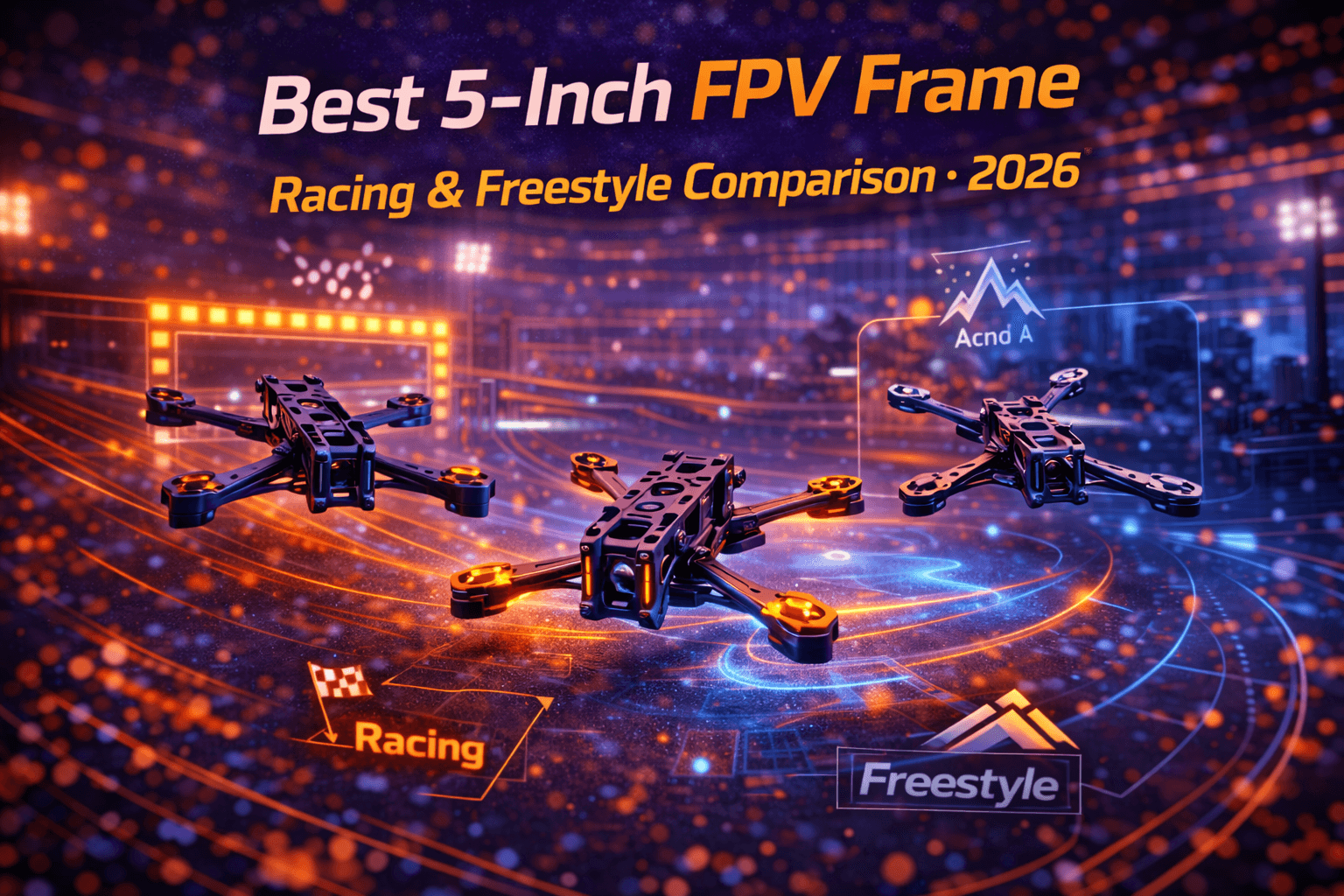
Geometry Types: The motor layout significantly affects handling characteristics. True-X frames (motors at symmetric 90-degree angles) provide balanced control on all axes—optimal for racing where predictable pitch and roll response matters equally. Stretched-X frames extend the front-to-back distance, reducing prop wash during forward flight and favoring pitch precision at the expense of roll responsiveness—preferred by some racers flying forward-heavy tracks. Squashed-X (or Compressed X) does the opposite: side arms closer together, better roll response, smoother for freestyle flowing lines.
Deadcat geometry positions front motors forward and outward while rear motors remain central, keeping propellers completely out of camera view. Ideal for cinematic flying with action cameras. The tradeoff? Asymmetric handling feels "weird" until you adapt, and you sacrifice some responsiveness for camera clarity. For more on cinewhoops, see our best cinewhoop drones guide.
Stack Mounting: Most frames support 30.5x30.5mm (standard size) or 20x20mm (compact) flight controller mounting. Some offer both with variable standoff options. Check your FC/ESC dimensions before purchasing. A 30.5x30.5mm stack won't fit a 20x20mm frame, and forcing it ends badly.
Camera Mounting: Two standard widths exist: 19mm (micro, most common) and 14mm (nano, older standard). Most modern FPV cameras are 19mm width. Action camera mounting (GoPro, DJI O3/O4) requires specific frame support. If you're building around DJI O4 Pro, verify frame compatibility—not all frames accommodate the larger air unit without modification.
Arm Design: Replaceable arms versus unibody construction represent different philosophies. Replaceable arms cost $8-15 per set, so breaking one arm in a crash means replacing just that component. Unibody frames are lighter and theoretically stronger, but catastrophic failure means replacing the entire frame. For beginners, replaceable arms make economic sense. Advanced pilots often prefer unibody for weight savings and structural integrity.
Weight Considerations: Frame-only weight ranges from 80g (racing minimalist designs) to 150g+ (durable freestyle builds). Every gram matters in racing; a 20g difference between frames translates to measurable acceleration and agility differences. For freestyle, a slightly heavier frame (5-10g) providing extra durability might be better than shaving grams that won't meaningfully improve trick performance.
Best 5-Inch Frames by Purpose and Budget
Best Budget Frame: TBS Source One V5 ($35-45)
The Source One represents the best value in FPV frames, period. This open-source design licensed by Team BlackSheep is manufactured by multiple vendors globally, ensuring competitive pricing and parts availability. You can build with the Source One V5 for the same price as three-four other entry frames.
The Source One weighs 123.5g with true-X geometry optimized for freestyle. Six millimeter carbon arms provide solid durability. Mounting flexibility helps: support for both 30.5x30.5mm and 20x20mm stacks means you'll find an FC that fits. The wide stance (226mm wheelbase) makes flying smooth and forgiving—excellent for learning.
Where does it shine? Parts availability. Because this frame is open-source, countless 3D-printed accessories exist online. Replace broken camera mounts, TPU protection parts, battery straps—endless community-designed options. That abundance of accessories allows cost-effective repairs and customization.
The Source One isn't the lightest frame. It's not the most aggressively engineered. But it's reliable, proven by thousands of competitive pilots, and genuinely affordable. Perfect for first builds, learning pilots, or anyone on a tight budget. Many intermediate pilots still use Source One builds despite owning premium frames. It's a great option for budget FPV setups under $500.
Best For: Beginner builds, budget-conscious builders, freestyle flyers without premium aspirations, learning pilots who will crash frequently
| Specification | Value |
|---|---|
| Price | $35-45 |
| Weight | 123.5g |
| Geometry | True-X |
| Arm Thickness | 6mm |
| Material | Carbon fiber |
| Stack Options | 30.5x30.5mm, 20x20mm |
Find TBS Source One frames on GetFPV
Best Mid-Range: iFlight Nazgul Evoque F5 V3 (~$100)
The Nazgul Evoque has earned legendary status in FPV for good reason. This is the frame you see in professional freestyle content, racing videos, and serious hobby builds everywhere. iFlight iterates constantly; the V3 represents the current generation with excellent refinements. For complete builds using this frame, check our best FPV racing drones guide.
The frame weighs 150g without accessories—competitive weight despite robust construction. Six millimeter arms provide crash durability without excessive heft. Geometry comes in two flavors: Squashed-X (symmetric handling, better freestyle) and Deadcat (props completely out of view for cinematic flying). iFlight includes comprehensive TPU protection parts: arm guards, front/rear bumpers, battery pads, camera mounts.
The Nazgul Evoque V3 upgraded stack mounting to support both 20x20mm and 30.5x30.5mm electronics, expanding component compatibility significantly. DJI O4 Air Unit Pro support comes built-in with included heatsinks and optimized camera mounting. Out-of-box tuning is excellent; the Evoque flies smoothly without exotic PID adjustments.
Real-world durability is solid. The frame survives hard crashes with minimal arm damage. Replacement parts (arms, camera plates, TPU accessories) are readily available and affordable. Community support is extensive—thousands of build logs, tuning guides, and troubleshooting resources.
The Evoque isn't budget-priced, but it delivers premium performance at a mid-range cost. It's the frame that wins FPV racing championships, gets used by content creators, and proves reliable through hundreds of flight hours. If you're building one serious quad and want reliable performance without premium pricing, the Nazgul Evoque is the answer.
Best For: Serious freestyle pilots, competitive racers, content creators, all-around performance priority
| Specification | Value |
|---|---|
| Price | $99-110 |
| Weight | 150g (frame only) |
| Geometry | Squashed-X or Deadcat |
| Arm Thickness | 6mm |
| Material | Carbon fiber |
| Stack Options | 20x20mm, 30.5x30.5mm |
| DJI O4 Support | Yes |
Browse iFlight Nazgul Evoque frames on GetFPV
Best for DJI O4 Pro: GEPRC Vapor X5 ($70-80)
GEPRC engineered the Vapor X5 specifically for DJI O4 Air Unit Pro owners. This isn't afterthought compatibility—it's thoughtful design from someone understanding O4 mounting and thermal requirements.
The frame weighs 206g (X5 version) or 214g (6-inch X5) with excellent weight distribution. Five millimeter wide carbon arms provide rigidity without excessive heft. True-X geometry delivers balanced handling. GEPRC includes vibration-damping silicone and redesigned aluminum camera mounts that perfectly interface with DJI O4 Pro VTX.
What makes the Vapor X5 special? Quick-release arm design simplifies repairs. Comprehensive mounting flexibility: 20x20mm or 30.5x30.5mm stacks, 20x20mm or 25x25mm VTX mounting. This flexibility means almost any quality electronics combination will fit cleanly. The frame supports analog, Walksnail, or HDZero setups if you ever switch from DJI.
Real durability is competitive. Five millimeter arms withstand hard crashes without bending. The integrated camera cage protects lenses from prop strikes. Replacement parts (arms, TPU accessories) are available at reasonable prices.
Best For: DJI O4 Pro users, freestyle and racing versatility, quick repair priority
| Specification | Value |
|---|---|
| Price | $70-80 |
| Weight | 206g (5-inch) |
| Geometry | True-X |
| Arm Thickness | 5mm |
| Material | Carbon fiber |
| Stack Options | 20x20mm, 30.5x30.5mm |
| DJI O4 Support | Optimized |
Find GEPRC Vapor frames on GetFPV
Best Premium: ImpulseRC Apex EVO ($150-180)
The Apex EVO represents the pinnacle of frame engineering. This premium option justifies its cost through exceptional durability, refined geometry, and industry-leading vibration characteristics.
The frame weighs 115g—remarkably light for its strength. Four millimeter premium T800 carbon fiber arms deliver aerospace-grade rigidity without excessive weight. True-X geometry with optimized motor angles provides balanced handling. ImpulseRC includes titanium hardware, reducing weight while improving corrosion resistance.
What sets the Apex EVO apart? Engineering precision. Every standoff height, arm angle, and mounting point is mathematically optimized. The result: incredibly smooth flight characteristics, minimal propwash, exceptional handling responsiveness. Competitive racers and professional pilots choose the Apex EVO for measurable performance advantages.
Durability is legendary. The premium carbon and engineering quality mean arms rarely break even in hard crashes. When replacement is necessary, arms cost $15-20 but last significantly longer than budget alternatives.
Best For: Competitive racers, professional pilots, pilots who crash hard frequently, those wanting absolute best
| Specification | Value |
|---|---|
| Price | $150-180 |
| Weight | 115g |
| Geometry | True-X (optimized) |
| Arm Thickness | 4mm (T800 carbon) |
| Material | Premium carbon fiber |
| Stack Options | 30.5x30.5mm |
Browse premium racing frames on GetFPV
Best Racing-Specific: FlyFishRC Volador VX5 (~$90)
The Volador VX5 optimizes specifically for competitive racing. True-X geometry with stretched arm angles favors forward pitch control. Four millimeter arms reduce weight without sacrificing racing durability.
The frame weighs 98g bare—among the lightest quality racing frames available. Every gram removed translates to faster acceleration and improved cornering. Replacement arms cost $12-15, reasonable considering their durability.
FlyFishRC designed the VX5 around racing requirements: minimal drag, maximum strength-to-weight, optimized camera angles for racing perspective. If your priority is lap times over freestyle tricks, the VX5 delivers.
Best For: Competitive racers, lap time priority, weight-conscious builds
| Specification | Value |
|---|---|
| Price | $85-95 |
| Weight | 98g |
| Geometry | Stretched True-X |
| Arm Thickness | 4mm |
| Material | Carbon fiber |
| Stack Options | 30.5x30.5mm |
Frame Maintenance and Repair
Frames break. Understanding repair and replacement extends equipment life dramatically. For comprehensive guidance, see our FPV maintenance guide and crash recovery guide.
Replacement Arms: Most frames with replaceable arms cost $8-15 per arm set. Keep spares on hand if you fly aggressively. Learn to replace arms—it takes 15-30 minutes with basic tools.
Hardware Kits: M3 and M2 screws strip or get lost. Keep spare hardware kits ($5-10) available.
TPU Protection: 3D-printed camera mounts, arm guards, and battery straps absorb impacts. Replace worn TPU parts before they fail completely.
Find replacement frame parts on GetFPV
FAQ
Q: What frame geometry should I choose?
A: True-X for balanced handling (racing and freestyle). Squashed-X for freestyle (better roll response). Stretched-X for racing (better pitch control). Deadcat for cinematic (props out of camera view). If unsure, start with True-X—most versatile option.
Q: How much should I spend on my first frame?
A: $35-60 for learning builds. You'll crash frequently. TBS Source One V5 ($35-45) is perfect. Once comfortable flying (50+ hours), upgrade to $80-110 mid-range (Nazgul Evoque, GEPRC Vapor). Premium frames ($150+) make sense for experienced pilots who fly hard.
Q: Do frames come with all mounting hardware?
A: Most quality frames include all necessary hardware (motor screws, standoffs, stack hardware). Budget frames sometimes skimp on hardware quality or quantity. Always verify what's included. You might want spare M3 and M2 hardware on hand for field repairs, but this is cheap ($5-10 for variety packs).
Q: Can I use a racing frame for freestyle?
A: Yes, with tradeoffs. Racing frames are lighter (good for some tricks) but less crash-resistant (bad for learning new tricks). Freestyle frames on racing tracks will be slower (heavier, less efficient). Many pilots use "all-around" frames like the Nazgul Evoque V3 that work reasonably well for both. Serious competitors invest in specialized frames.
Q: Which frame supports the most component options?
A: The TBS Source One V5 and most recent GEPRC/iFlight frames support 30.5x30.5mm AND 20x20mm stack mounting, plus multiple VTX spacing options. This flexibility helps if you're reusing electronics across builds or want future-proofing.
Q: How do I know if a frame fits my electronics?
A: Measure your FC and ESC (especially height and width), then verify the frame supports those dimensions. Most frames list:
- Stack mounting hole size (30.5x30.5mm, 20x20mm)
- Max stack height (typically 18-22mm)
- VTX mounting options
- Camera width compatibility (19mm, 20mm, 14mm)
Mismatch any of these and you'll need adapters or component changes.
Q: Are premium frames worth the extra cost?
A: It depends. Premium frames (Apex EVO, ItsFPV ERA) deliver exceptional durability and superior vibration characteristics. If you fly hard, crash frequently, and value reliability, they justify the cost. If you're a casual flyer or beginner, a $70-100 quality mid-range frame provides better value.
Q: What about frames under $35?
A: Generic AliExpress clones under $30 are risky. Carbon fiber quality is unpredictable, replacement parts are hard to find, and you might save $20 only to spend it on repairs. The TBS Source One V5 at $35-45 is genuinely the lowest price where I'd confidently recommend a frame.
Final Thoughts
Your frame choice should reflect your flying style, budget, and crash expectations, not marketing hype or what famous YouTubers fly. The TBS Source One V5 works perfectly for beginners. The Nazgul Evoque F5 V3 serves serious pilots at mid-range pricing. The Apex EVO rewards durability-focused enthusiasts. The GEPRC Vapor X5 delivers excellent value for DJI O4 Pro builders.
Avoid analysis paralysis. A good frame at any price point beats perfect frame research with zero flights. Buy something proven, start flying, and upgrade when your priorities clarify. Worst case: you're out $50-100 and learned valuable lessons. Best case: you found your forever frame.
Practice in FPV simulators before investing in expensive frames—it's cheaper to crash virtually than to replace carbon fiber arms.
If you're ready to build, browse complete 5-inch frame selection on GetFPV for the latest options and competitive pricing.