Introduction
FPV drone tours have revolutionized real estate marketing, transforming static listings into immersive experiences. But not every FPV drone works for real estate, and the technical requirements differ fundamentally from freestyle flying.
This guide covers why FPV matters for real estate, what equipment actually works, realistic business considerations, and specific recommendations. You'll understand whether FPV real estate is viable for you.
Note: This guide contains affiliate links. If you purchase through our links, we may earn a commission at no extra cost to you. This helps support our testing and content creation.
Why FPV for Real Estate
What FPV Offers Real Estate Marketing
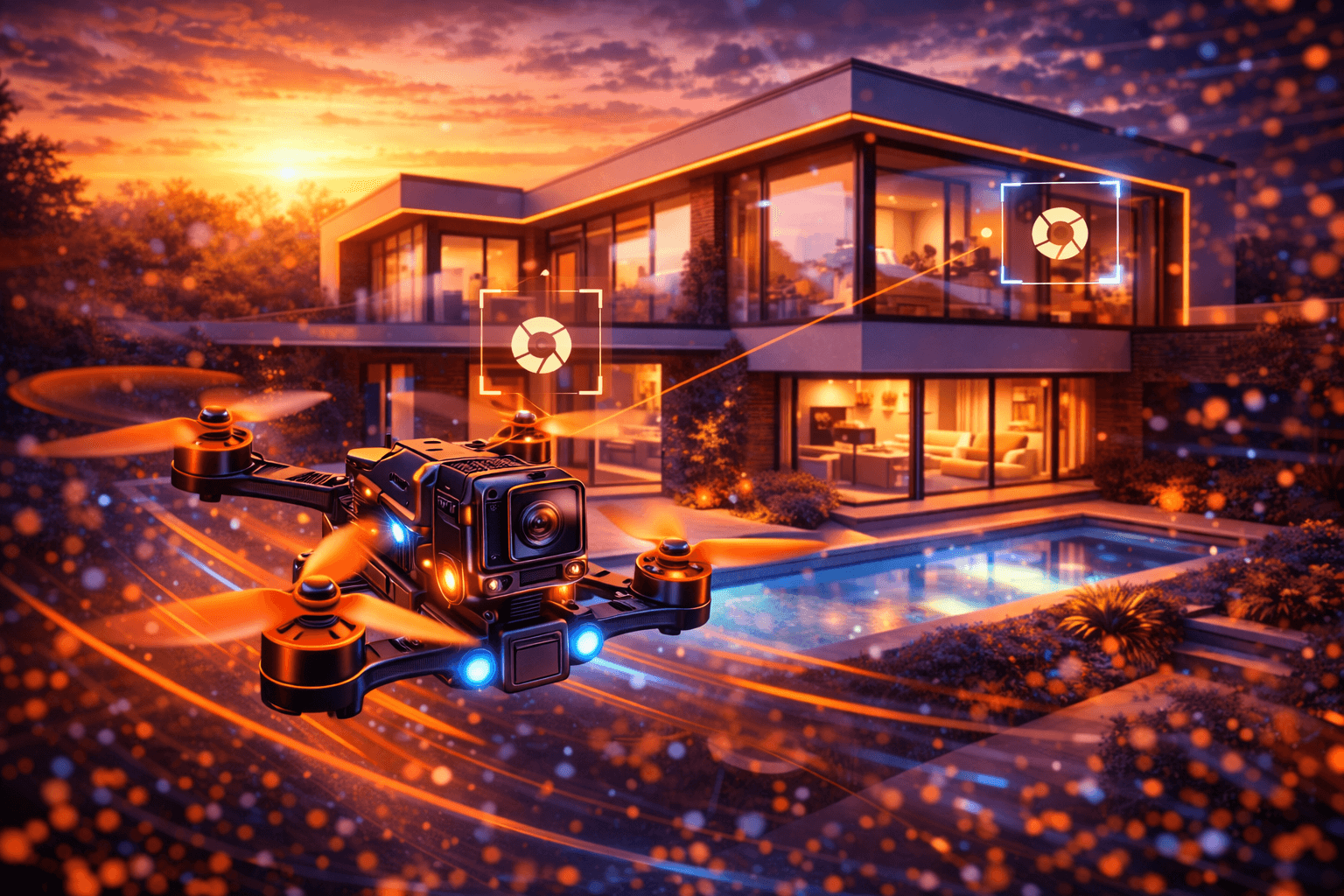
Immersive property tours: Unlike traditional aerial photography showing exterior only, FPV flies smoothly through interiors and seamlessly transitions indoors/outdoors. Buyers experience the property flow, not just aerial views.
Unique perspectives: Smooth camera movement through rooms creates dimension impossible to achieve standing still. You show buyers what movement through the home feels like.
Emotional connection: Dynamic, smooth footage creates engagement traditional drone footage can't match. Buyers visualize living in the space.
Competitive advantage for agents: Most competitors offer standard aerial photography. FPV tours differentiate listings, justify premium pricing, and generate buzz.
Higher-value property justification: FPV cinematography pairs with luxury properties. Real estate agents selling multi-million dollar homes pay premium for premium marketing.
FPV vs Traditional Drones
DJI drones (Air, Mavic, Mini) excel at exterior aerial shots but can't fly indoors. They're limited to hovering over properties from above—boring for cinematic real estate.
FPV drones navigate indoors, create smooth motion, transition seamlessly from inside to outside. Completely different creative possibilities.
Handheld gimbals can move through homes but require walking, slow movement, limited elevation changes. FPV offers speed, fluidity, and three-dimensional movement impossible on foot.
Market Demand Reality
Real estate agents want results. FPV property tours command premium pricing ($450-$950 starting rates for interior/exterior tours). Agents justify premium rates with superior buyer engagement.
Client education needed—most agents haven't seen professional FPV real estate work. Show them examples first.
Essential Requirements for Real Estate FPV
Safety and Control
Non-negotiable priority: You're flying indoors around expensive homes, sometimes people, and valuable furnishings. Crashes damage homes, injure people, and end careers.
Requirements:
- Prop guards mandatory (protect walls, furniture, people)
- GPS and failsafe reliability (don't lose the drone)
- Stable hovering (precision control)
- Predictable handling (confidence-inspiring)
- Ample clearance awareness (know when you're too close)
Image Quality
Client deliverable standards:
- 4K minimum (5K better for post-stabilization cropping)
- Professional stabilization (ReelSteady or equivalent)
- Good low-light performance (many interiors dark)
- Proper color science (accurate skin tones, architectural colors)
- Dynamic range preservation (windows + interior detail)
Clients compare your footage to $10M property marketing videos. Quality perception matters significantly.
Flight Time and Efficiency
Business reality: Shooting 3000 sq ft homes needs multiple takes. You'll fly through each room several times refining shots.
Requirements:
- 5-8 minute flight times minimum
- Multiple batteries for single session
- Quick battery changes (time = money)
- Efficiency directly affects profitability
One exhausted battery = lost selling time.
Indoor Maneuverability
Practical flying needs:
- Tight turn radius (narrow hallways)
- Low-speed stability (smooth interior passes)
- Precise control (doorway threading)
- Ceiling proximity confidence (close flying safety)
Real estate spaces are constrained. Professional racing quads are wrong for this application. Dedicated cinewhoops are purpose-built for smooth indoor cinematography.
Professional Appearance
Client perception matters: You're charging $300-800 per property. Showing up with beat-up freestyle quad sends the wrong message. Professional appearance justifies premium pricing.
Top Drone Recommendations for Real Estate
Best Overall: Flywoo Explorer LR 4" with DJI O3
Why it wins: Purpose-built cinewhoop with professional FPV footage quality, indoor/outdoor capability, and professional appearance.
Specifications:
- 4-inch wheelbase (compact but powerful)
- DJI O3 digital system (HD video preview, long range)
- Stripped-down GoPro option (44g for agility)
- Smooth, controllable flying
- Prop guards (safety for interiors)
- Professional appearance
Why for real estate:
- Indoors and outdoors seamlessly
- Smooth, controlled movement
- Professional video quality
- Client-presentable appearance
- Built specifically for cinematography
Cost: $489 drone + GoPro (typically $350-450) = $840-$950 complete
Business case: First five jobs at $400 average recover equipment cost. ROI clear and quick.
Find Flywoo Explorer and cinewhoops on Amazon
Budget-Conscious Option: DJI Avata 2
Why it works: Accessible entry point for FPV real estate without massive investment.
Specifications:
- Compact design for interiors
- Reasonable learning curve
- Acceptable video quality
- Lower price point
- Some pre-built market
Limitations:
- Less specialized than purpose-built cinewhoop
- Smaller ecosystem of accessories
- Not optimal for cinematography
- Stiffer learning curve than consumer drones
Cost: ~$1,200-1,600 new, $1,000-1,200 used with basic accessories
Realistic assessment: Works for interior tours but less optimal than cinewhoops. Better for budget-conscious beginners building portfolio. Editing your footage matters just as much as flying it — see our best FPV video editing software guide. Read our DJI Avata 2 review for detailed analysis.
Premium Professional: GepRC CineLog 30
Why premium matters: Higher-end cinewhoop for operators prioritizing client perception and footage quality.
Specifications:
- 3-inch frame (compact, agile)
- Advanced stabilization system
- Professional camera mount
- Smooth, refined flying characteristics
- Premium build quality
- Expensive but justified by results
When justified:
- High-value property work
- Premium market positioning
- Long-term business operation
- Client expectations for luxury marketing
Cost: $600-800 frame + accessories = $1,200-1,600 complete
Realistic assessment: Premium option for established operators. Overkill for learning curve. Our GepRC CineLog 25 review covers similar builds.
Browse GepRC cinewhoops on Amazon
Traditional Alternative: DJI Air 3
Important caveat: Not an FPV drone. Can't fly indoors. Included for context.
Why agents still request it:
- Familiar platform
- Excellent outdoor shots
- 46-minute flight time
- Professional appearance
Real estate limitations:
- No indoor capability
- Limited dynamic movement
- Static hovering shots vs cinematic flow
- Different use case entirely
If considering: DJI Air 3 excels at exterior showcase shots. Pair with FPV for complete solution (both indoor movement + outdoor stability). Don't use alone for real estate.
Complete Setup Beyond the Drone
Camera Equipment
GoPro Hero 12 or Hero 13 (standard):
- 4K quality
- Proven real estate footage
- Reliable platform
- Industry-standard
- Cost: $350-450
ND filters (essential):
- Proper shutter speed in outdoor light
- Cinematic motion blur
- Set of 3-4: $50-100
Browse ND filter sets on Amazon
Extra batteries:
- Carry 4-6 GoPro batteries
- Backup mount bracket
- Cost: $30-50
FPV System
Goggles (essential):
- Precise flying control
- Real-time framing
- Professional confidence
- Cost: $300-600
For real estate work, consider our recommendations in the best FPV goggles guide, with emphasis on digital systems for real-time HD preview.
Radio controller:
- DJI RC Motion 3 (recommended for DJI systems)
- RadioMaster Pocket (universal compatibility)
- Cost: $150-300
Our FPV controllers guide covers options for different systems.
Batteries and Power
LiPo batteries:
- 4S or 6S depending on quad
- Minimum 6-8 batteries per session
- Cost: $25-40 each
Charger:
- Multi-battery parallel charging
- Field-portable option
- Cost: $100-200
Proper battery care and storage extends equipment life and ensures safety.
Software and Editing
ReelSteady GO ($100):
- Professional stabilization
- Industry standard
- Worth every penny
DaVinci Resolve (free):
- Professional editing
- Color grading
- Audio mixing
Adobe Creative Cloud ($60/month):
- Premiere Pro
- After Effects
- Professional workflow
Transport and Protection
Professional backpack:
- Organized compartments
- Battery isolation
- Professional appearance
- Cost: $100-200
Check our guide on best FPV backpacks for transport solutions.
Total equipment investment: $2,500-3,500 for professional setup
Business Considerations
Pricing Strategy
Market rates (USA, 2026):
- Standard homes (1500-2500 sq ft): $300-600
- Large homes (2500-4000 sq ft): $600-900
- Luxury properties (4000+ sq ft): $900-1,500+
- Rush delivery: +50%
- Additional revisions: $100-200
Pricing factors:
- Property size and complexity
- Editing time required
- Market competition
- Your experience level
- Client budget
Revenue Potential
Part-time operation (5-8 properties/month):
- Average $450 per property
- Gross: $2,250-3,600/month
- Expenses: $500-800/month
- Net: $1,750-2,800/month
Full-time operation (15-20 properties/month):
- Average $500 per property
- Gross: $7,500-10,000/month
- Expenses: $1,500-2,500/month
- Net: $6,000-7,500/month
Reality check: Takes 3-6 months building clientele before consistent income. Location heavily influences demand.
Client Acquisition
Real estate agent networking:
- Attend open houses
- Join local real estate associations
- Offer free sample shoot for influential agents
- Build referral relationships
Digital marketing:
- Professional website with portfolio
- Instagram with sample work
- YouTube with full tours
- Google My Business listing
Traditional outreach:
- Cold email with examples
- Door-to-door agent visits
- Broker open presentations
- Real estate conference attendance
Legal Requirements
FAA Part 107 License (mandatory):
- Required for ANY commercial flying
- Even indoors, even on private property
- If you're paid, you need it
Process:
- Study 2-3 weeks
- Pass FAA knowledge test
- Cost: $175
- Renewable every 2 years
Enforcement reality: Inconsistent but increasing. Professional clients increasingly demand proof. Operating without it risks $20,000 fines. Learn more in our FPV drone laws guide and Part 107 certification guide.
Insurance (Mandatory)
Liability coverage:
- Flying near homes, people, property
- One accident without insurance = bankruptcy
- Cost: $500-2,000/year
What's covered:
- Third-party injury
- Property damage
- Legal defense
- Client requirements typically
Errors & omissions:
- Increasingly expected by agents
- Protects against delivery failures
- Often bundled with liability
Reality check: One uninsured crash costs more than years of insurance premiums. Read our complete FPV drone insurance guide. Ready to go pro? Our FPV drone business guide covers the full business setup for detailed coverage options.
Documentation and Professionalism
Proof of license: Keep on phone or wallet
Insurance certificate: Provide to agents upfront
Contracts: Simple agreement covering deliverables, revisions, payment terms
Business legitimacy: LLC or sole proprietorship with business license
Learning Curve and Training
FPV Skill Development Timeline
Complete beginner to professional-quality:
- Months 1-2: Simulator practice (20+ hours)
- Months 2-3: Outdoor line-of-sight flying (25+ hours)
- Months 3-4: Basic FPV in open spaces (15+ hours)
- Months 4-6: Indoor flying and proximity confidence (20+ hours)
- Months 6+: Smooth cinematography development (continuous)
Realistic timeline: 6+ months focused practice before first paid job.
Practice Strategy
Simulator first:
- Zero-risk learning
- Build muscle memory
- Practice indoors virtually
- Tools: Liftoff, DRL Simulator
Check our FPV simulators guide for recommendations.
Own home practice:
- Low-stakes indoor flying
- Understand quad behavior
- Build confidence gradually
Friend/family properties:
- Low-pressure practice
- Build portfolio examples
- Refine technique
- Get testimonials
First paying jobs:
- Better offer free/discounted first jobs
- Build case studies and portfolio
- Get referrals from satisfied clients
- Establish reputation for quality
Common Challenges and Solutions
Technical Challenges
Low-light interiors:
- Proper camera settings (ISO, shutter speed)
- Post-production brightness adjustment
- Plan shoots for optimal natural light
WiFi interference:
- Frequency hopping
- Avoid 2.4GHz conflicts
- Outdoor prelim test before indoor
Tight spaces:
- Practice extensively
- Confidence building gradual
- Know your quad's dimensions
Business Challenges
Client education:
- Show video examples first
- Explain unique value vs traditional drones
- Set expectations clearly
- Deliver beyond expectations
Price resistance:
- Educate on value (better marketing = faster sales)
- Compare to other marketing spend
- Justify premium with results
- Confidence in pricing
Irregular work:
- Diversify services (add traditional drone, photos)
- Build agent relationships for steady flow
- Marketing consistency essential
- Network continuously
Equipment investment:
- Start lean, scale up
- Finance if necessary
- Break-even calculation shows ROI quick
- Money recovered through first 5-10 jobs
FAQ
Q: Can I really make money doing FPV real estate tours?
A: Yes, but it requires professional execution. Success factors: quality portfolio, agent relationships, competitive pricing, reliable delivery. Expect 3-6 months building clientele before consistent income. Works better as add-on to existing media business. Realistic income: $2,000-8,000/month part-time once established, location-dependent.
Q: Do I need Part 107 license for real estate FPV?
A: Yes, legally required for any commercial flying, even indoors. FAA considers flight-for-compensation as commercial regardless of location. Enforcement inconsistent but increasing. Professional clients increasingly demand proof. $175 test, 2-week study. Worth it for legitimacy and legal protection.
Q: What's minimum equipment investment to start professionally?
A: Realistically $2,500-3,500: quality cinewhoop ($840-950), goggles ($300-600), batteries/charger ($300-400), software ($100), support gear ($200-300). Cheaper possible but looks unprofessional. Finance if needed—first 5-10 jobs recover investment.
Q: How long does shooting a typical home take?
A: On-site: 1.5-2 hours (setup, shooting, pack-up). Post-production: 2-4 hours (stabilization, editing, color, music). Total: 4-6 hours per property. Larger homes take longer. Charge accordingly—don't undervalue time investment.
Q: Can I use 5-inch freestyle quad for real estate?
A: Technically possible but unprofessional. Racing quads are: too aggressive, too loud, too dangerous indoors, wrong tune for smooth footage, intimidating to clients. Invest in proper cinewhoop. Real estate is business, not practice. Clients pay for professionalism.
Q: How do I price competitively?
A: Research local market: $300-600 for standard homes, $700-1,000 for larger properties. Consider property size, complexity, editing, revisions. Don't race to bottom—quality commands premium. Bundle with traditional services for more value. Start slightly below market to build portfolio, raise prices as demand grows.
Q: What if I crash and damage the client's home?
A: Why insurance is mandatory. Quality cinewhoop with prop guards minimizes risk, but accidents happen. Insurance covers repair costs and legal defense. Without insurance, personal liability could bankrupt you. One uninsured crash ends your business. $500/year insurance prevents $50,000 disasters.
Q: Should I offer FPV as standalone or combined with other services?
A: Combined services win more business. Agents prefer one vendor for all media (FPV tours + traditional aerial + photos + video). Diversification smooths income (weather grounds traditional drones; FPV works indoors). Standalone possible but harder. Build full media portfolio for maximum viability.
Final Business Assessment
You're a Good Fit If:
- Already have 6+ months FPV flying experience
- Understand basic business operations
- Can invest $2,500-3,500
- Have time for consistent marketing
- Professional demeanor and communication
- Willing to handle regulations properly
Reconsider If:
- Brand new to FPV (learn first)
- No business experience
- Limited budget for investment
- Impatient for income
- Unwilling to get Part 107
- Uncomfortable with client interaction
Success Factors:
Professional quality delivery: Non-negotiable. Clients compare to premium marketing videos.
Consistent marketing: Business doesn't appear—you create it through relationships and visibility.
Competitive pricing strategy: Research market, price accordingly, deliver value.
Excellent client service: Reliability, communication, exceeding expectations.
Continuous improvement: Flying, editing, business skills all develop over time.
Business discipline: Track costs, time, profitability. Run it like a real business, not a hobby.
Realistic Expectations:
- 3-6 months before first consistent income
- Part-time viable after 3-6 months
- Full-time requires volume (8+ properties/week)
- Location heavily influences demand
- Equipment investment required upfront
- Learning never stops
- Patience and persistence needed
The honest assessment: FPV real estate is a legitimate business opportunity with proven market demand. Success requires professional execution, business discipline, and patience. Start as side project while building clientele. Scale to full-time once booking consistent.
If you're ready to start building your professional FPV real estate setup, explore complete cinewhoop packages and accessories on Amazon. Having reliable, professional equipment is essential for building a successful real estate FPV business.