Introduction
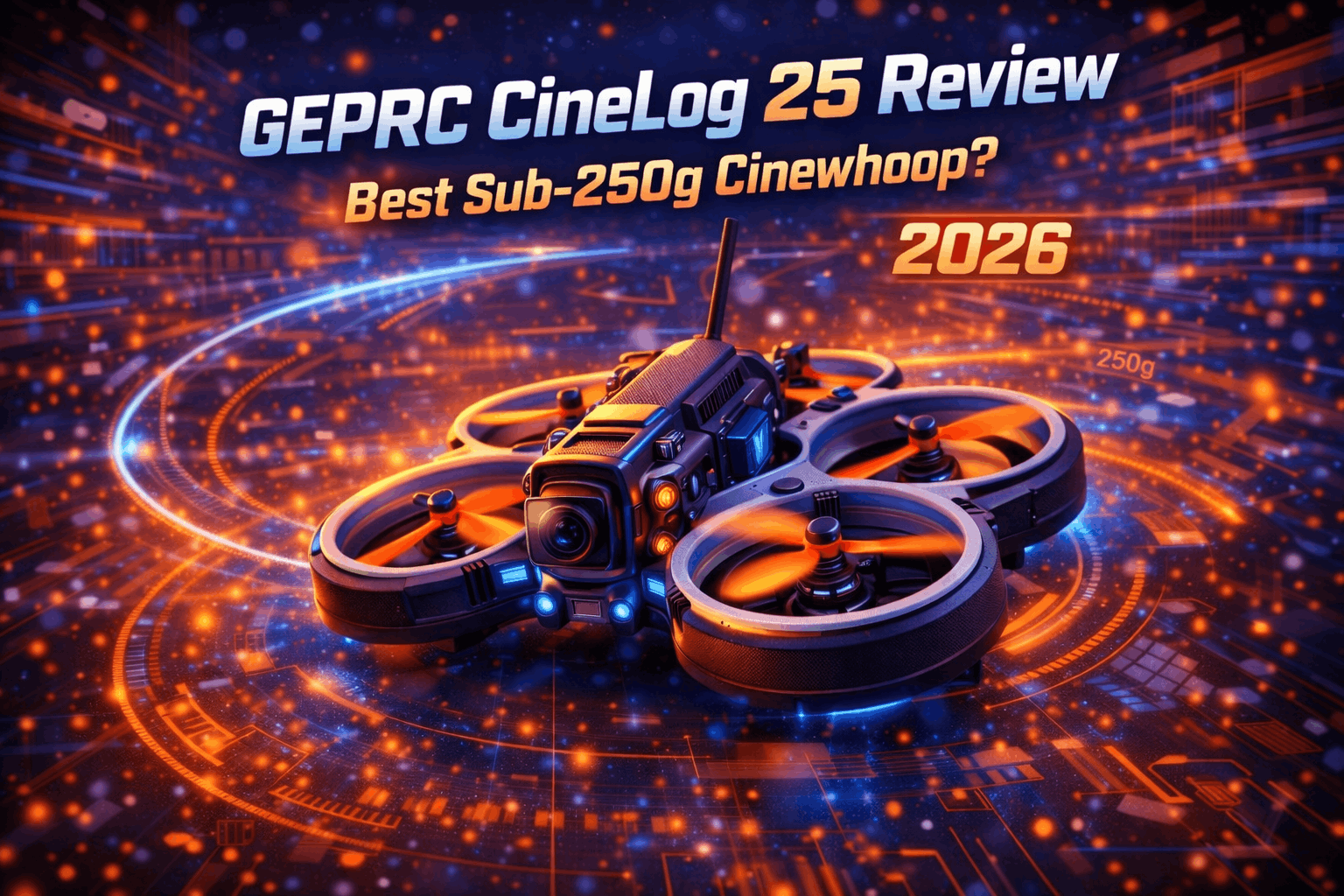
Sub-250g drones used to mean compromise: shaky footage, underpowered motors, and frames that felt more like toys than tools. The GepRC CineLog 25 helped flip that script. It packs legitimate cinematic capability into a pusher-frame cinewhoop that can, in the right configuration, sneak in under the magic 250g threshold while still carrying a naked GoPro. For FPV content creators who need to fly close to people, indoors, and in sensitive locations, that combination isn’t a spec-sheet detail — it’s the difference between “sorry, we can’t” and “yes, we can shoot that.”
I’ve been using my CineLog 25 as a dedicated indoor cinewhoop for about four months now, alongside my CineLog 35 and Pavo Pico. It fills a very specific gap: bigger and more capable than the Pico, lighter and less intimidating than the 35, and close enough to 250g that I’ve used it at locations where larger quads would’ve been refused. This review covers what it actually delivers after dozens of real-world shoots, not just a bench test.
Note: This guide contains affiliate links. If you purchase through our links, we may earn a commission at no extra cost to you. This helps support our testing and content creation.
The Sub-250g Advantage
The “249g” label on a product page isn’t marketing fluff — it has practical consequences. In many regions, sub-250g drones sit in a friendlier regulatory category. You may not need to register the aircraft, and you often have more flexibility about where you can legally fly, especially for recreational work. For commercial operators, lighter platforms can simplify risk assessments and insurance, particularly when you’re flying indoors or close to people.
From a safety standpoint, a 230–250g cinewhoop is in a different league than a 600g 5-inch freestyle quad. A prop-guarded CineLog 25 bumping into a wall or light fixture is an inconvenience; a 5-inch quad doing the same thing can be a catastrophe. That matters when you’re negotiating access to hotels, offices, restaurants, or private homes. I’ve had three location managers approve the CineLog 25 on sight after holding it in their hand — the reaction is consistently “oh, that’s it?” which is exactly what you want.
Portability is another quiet win. The CineLog 25, a small LiPo, and a naked GoPro all fit in a compact shoulder bag. I toss my CineLog 25 kit into my regular camera bag alongside my gimbal gear — it adds almost no weight and gives me a completely different perspective option for any shoot.
There is a catch: staying under 250g in real builds is tight. My CineLog 25 with O3, ELRS, a 4S 660mAh pack, and GoPro Bones weighed 263g on my kitchen scale. I got it down to 248g once by switching to a 520mAh battery and removing the foam bumpers — technically legal, but I lost a minute of flight time and some crash protection. In practice, I fly it at ~260g and accept that I’m slightly over the threshold. Even at that weight, it’s still firmly in “small, safe, non-intimidating” territory.
Design and Build Quality
The CineLog 25’s design is unapologetically task-focused. It’s a 2.5-inch pusher-style cinewhoop: props sit below the frame, ducts and foam guards wrap the periphery, and the electronics are sandwiched in a tight, low-profile stack. The 109mm wheelbase gives just enough room for GR1404 4500KV motors and 63mm props without making the frame bulky.
The frame uses ultra-light carbon plate with plastic ducts and EVA foam around the edges. On paper, 2–2.5mm carbon sounds thin, but this is a cinewhoop, not a basher. In practice, the combination of flexible ducts and foam does an excellent job of absorbing knocks. I’ve tagged doorframes, furniture edges, and one very expensive-looking chandelier (the client didn’t notice, thankfully) — the CineLog 25 shrugged off every one. Hard, full-throttle impacts onto concrete can crack ducts, but replacements are cheap and swap in minutes.
Weight distribution is one of its strongest design choices. GepRC places the VTX at the bottom with the flight stack above and battery on top, creating a low center of gravity. This makes the CineLog 25 feel planted in forward flight and keeps throttle changes predictable — a critical quality for smooth cinematic footage.
The camera damping system genuinely works. Soft rubber grommets isolate both the FPV camera and the action cam mounting plate. I experimented with different durometer grommets and found the stock medium-soft set works best for my GoPro Bones weight. Harder grommets transmitted more prop vibration; softer ones let the camera bounce during direction changes. The stock choice is well-considered.
Motor choice is sensible: GR1404 4500KV on 4S give decent thrust-to-weight without sacrificing efficiency. The ducts shape airflow around the props, and combined with the EVA foam edge, the CineLog 25 is noticeably quieter than open-prop 2.5-inch platforms. I measured roughly 58–62 dB at 1 meter hover, which is quiet enough that my wife in the next room doesn’t complain — a metric I take seriously.
Camera protection is solid. The FPV camera sits recessed behind TPU, and the action camera mount sits within the duct footprint. You can still smack a GoPro into a doorframe if you misjudge — I did exactly that on my third shoot — but casual taps generally hit foam first.
Check GepRC CineLog 25 pricing on GetFPV | Check on Amazon
Flight Performance
In the air, the CineLog 25 feels like what it was built to be: a stable camera platform for tight spaces, not a freestyle rig pretending to be a cinewhoop.
On 4S 660–850mAh packs with digital video and a naked GoPro, throttle response is predictable and linear. You have enough punch to correct lines and pop over obstacles, but not so much that a millimeter of stick movement turns into a meter of altitude. This is exactly what I want when I’m threading a hallway with a client’s furniture on both sides.
Acceleration is “confident” rather than “violent.” From a hover, a quick half-stick blip brings you up to ceiling height in a couple of seconds, not in an instant. That’s ideal indoors, where overshooting by 30cm means hitting a ceiling fan. I’ve had one close call with a ceiling fan in a kitchen — the conservative throttle response gave me time to back off before contact. On a snappier quad, I wouldn’t have had that margin.
The stock Betaflight tune is deliberately soft: roll and pitch rates are conservative, and expo is tuned for smooth arcs rather than snappy flips. I flew it stock for the first three weeks, then made only two changes: bumped yaw rate by about 10% (the stock yaw felt sluggish for orbiting shots) and lowered D-term slightly to reduce a faint high-frequency buzz I noticed on cold days. The factory tune is genuinely good for 90% of cinewhoop work.
Prop wash handling is decent for a pusher cinewhoop. Sharp 180-degree turns and rapid descents can provoke a bit of mushy wobble — that’s the nature of ducted 2.5-inch props pushing disturbed air. The low center of gravity and camera damping do a respectable job of hiding the worst of it in footage, especially if you’re stabilizing with Gyroflow afterward.
Indoor performance is where the CineLog 25 shines. The combination of prop guards, compact footprint, and gentle throttle curve gives you confidence to thread doorways, weave between chairs, and hug walls. For real estate fly-throughs, restaurant tours, and event venues, this predictable, “sticky” handling is exactly what you want. I’ve shot maybe 20 indoor walkthroughs on the CineLog 25 and my hit rate on usable takes is higher than on any other quad I own.
Outdoors, weight becomes a limitation. In calm conditions, the CineLog 25 handles gentle tracking shots and orbits perfectly. In 10–15 km/h wind, you’ll feel it working — leaning into gusts, occasionally getting pushed off line. I generally don’t take it outdoors if trees are visibly swaying, because the footage shows the corrections.
Battery life depends heavily on configuration. On a 4S 660mAh with only digital FPV (no external camera), gentle cruising hits 5–6 minutes. Add a naked GoPro, and realistic flight time drops to 3.5–4.5 minutes. Push harder and you’ll see closer to 3 minutes. For paid work, I carry 8 batteries and plan 4-minute sessions — it’s tight but manageable.
Camera and Footage Quality
Stock Digital System
With DJI O3, the onboard recording is good enough for social media content and casual projects. 4K recording directly in the drone means you can fly without a separate camera for many situations. Dynamic range is respectable but not GoPro-level — interior-to-exterior transitions can clip highlights, especially in high-contrast real estate scenarios.
I’ve delivered O3-only footage to two clients for social media content and both were satisfied. For anything going on a professional reel or into a 4K timeline with serious color grading, I still mount the GoPro Bones.
Naked GoPro / GoPro Bones
This is where the CineLog 25 earns its reputation. The frame and TPU mounts accept naked GoPro cameras cleanly, and the damping system keeps jello at bay provided your props are balanced.
Footage quality with GoPro Bones is excellent. True 4K60 with wide FOV, stabilized in post with Gyroflow. In smooth, deliberate lines, footage looks surprisingly close to what I get from my larger CineLog 35 — the main difference is the 35 handles wind and aggressive maneuvers better. For controlled indoor work, the 25’s footage is nearly indistinguishable.
Low light is where differences become obvious. O3 onboard recording in dim stairwells or evening interiors gets noisy and warpy at the edges. GoPro Bones holds shadow detail better. For paid real estate jobs, the extra hassle of a separate action camera is worth it.
Stabilization workflow matters. The CineLog 25’s soft tune pairs well with post-stabilization — you’re not fighting sudden angular accelerations that can trip up the algorithm. I run Gyroflow on all my CineLog 25 footage and the results are consistently smooth.
Setup and Configuration
Out of the box, the CineLog 25 ships bind-and-fly with your choice of receiver. Factory Betaflight configuration is solid — rates and filters are tuned for smooth cinematic response.
My typical first-setup workflow: bind the ELRS receiver, verify stick response in Betaflight’s Receiver tab, check motor direction in the Motors tab (props off — GepRC usually ships these correct, but never assume), map an arm switch, and check OSD layout for voltage and link quality.
Most pilots can fly the CineLog 25 on stock PIDs. If you’re carrying a heavier camera, tiny D-term tweaks and slightly lower rates can smooth things further, but the factory tune is already aimed squarely at the cinewhoop use case. I was flying real client shoots on stock settings within the first week — that says something about GepRC’s tuning.
Who This Is For
Buy the CineLog 25 if: You need a lightweight cinewhoop for indoor shoots, real estate work, or event coverage. You want something close to 250g that clients and location managers aren’t afraid of. You already have DJI goggles and want a 2.5-inch platform that carries a naked GoPro cleanly.
Skip the CineLog 25 if: You mainly fly outdoors in wind — a CineLog 35 or 3.5-inch platform handles that better. You want a freestyle quad — this isn’t one. You need 250g compliance with zero compromise — realistic filming setups often creep slightly over.
For my workflow, the CineLog 25 handles about 40% of my indoor cinewhoop work — the tighter spaces where the CineLog 35 feels too big and the Pavo Pico doesn’t have enough camera quality. It’s a specialist, and a good one.
Compared to Alternatives
Within its class, the CineLog 25 competes with several strong 2.5–3-inch cinewhoops:
CineLog 30 / 35: Moving up to 3-inch or 3.5-inch brings much better authority outdoors and more comfortable full-size GoPro carrying. You gain power and flight time but lose the “obviously safe” sub-250 feel. For tight indoor work, the 25 remains more maneuverable. I use my 35 for larger spaces and outdoor work, the 25 for tight apartments and offices.
BetaFPV Pavo Series (Pavo25/Pavo30): The Pavo line focuses on lightweight frames and clean digital integration. Compared to a Pavo25, the CineLog 25 generally offers more refined camera damping and a slightly more robust frame, at the cost of a few extra grams.
DIY sub-250g builds: You can build a custom 2.5-inch rig that hits sub-250g more comfortably, but you’ll invest many more hours tuning vibrations, sourcing mounts, and solving fitment puzzles. The CineLog 25’s value is that GepRC has already done that integration work. I’ve built one custom 2.5-inch cinewhoop — it took two weekends and still doesn’t fly as smooth as my CineLog out of the box.
Pros & Cons
Pros:
- Mature, well-tuned 2.5-inch pusher design optimized for cinematic flying
- Capable of near-250g configurations with careful component choices
- Excellent camera damping that genuinely minimizes jello with naked GoPros
- Low center of gravity and prop guards inspire confidence indoors
- Factory Betaflight tune is flyable for client work out of the box
- Wide ecosystem of aftermarket mounts and spares
- Quiet enough for indoor use without disturbing people nearby (~58–62 dB at 1m)
Cons:
- Real-world filming setups often creep above 250g (my typical build: ~263g)
- Limited top speed and wind authority compared to 3–3.5-inch cinewhoops
- Ducts and foam are consumables — I’ve replaced foam twice in 4 months
- Not suitable as a freestyle or long-range platform
- 3.5–4.5 min flight time with GoPro requires carrying 8+ batteries for a real session
FAQ: GepRC CineLog 25
Can it really stay under 250g with a GoPro?
Technically yes, but barely. My lightest configuration with O3, ELRS, GoPro Bones, and a 520mAh 4S battery hit 248g — but I lost a minute of flight time and had to remove the foam bumpers. My practical filming setup sits at ~263g. If strict 250g compliance matters for your region, budget time for weight optimization.
Is it powerful enough for outdoor filming?
In calm conditions, absolutely. It tracks people, bikes, and slow vehicles just fine. In wind above 10–15 km/h, you’ll see the quad working to hold position and the footage shows corrections. For outdoor work in variable conditions, I reach for the CineLog 35 instead.
O3 recording vs GoPro — which do I need?
For social media and casual content, O3 recording is genuinely good enough — I’ve delivered O3-only footage to two clients who were happy. For professional real estate, advertising, or anything going into a serious color grading pipeline, GoPro Bones still delivers noticeably better results in shadows and dynamic range.
How long does it actually fly?
With GoPro Bones and a 660mAh 4S: 3.5–4.5 minutes of smooth cruising. Without external camera on the same battery: 5–6 minutes. I carry 8 batteries for a real session and plan 4-minute flights.
Is it a good first FPV drone?
It can work, especially if your goal is cinematic indoor footage. The guarded props and soft tune are forgiving. But I’d recommend spending 10+ hours in a simulator first, and maybe starting on something cheaper like a Tinyhawk before risking a GoPro on a learning platform.
CineLog 25 vs Pavo Pico for indoor work?
Different tools. The Pavo Pico is smaller, lighter, and more portable — I keep it in my everyday backpack. The CineLog 25 carries a proper GoPro and delivers notably better footage quality. For serious indoor production work, CineLog 25. For casual shots and always-available pocket cinewhoop, Pavo Pico.
Final Verdict
The GepRC CineLog 25 remains one of the best sub-250g cinewhoops for real-world content creation. It’s not the newest platform in 2026, but its combination of well-thought-out frame design, effective camera damping, mature tuning, and strong digital FPV integration make it feel like a proven tool rather than a novelty.
After four months of regular use, what I appreciate most is the consistency. Every flight feels the same. The tune is predictable. The footage quality with GoPro Bones is reliably excellent. The build survives my (frequent) wall contacts without drama. For a tool I depend on for paid work, that reliability matters more than any spec-sheet advantage.
If your work lives primarily indoors, or in sheltered outdoor environments, and you value low intimidation, safety, and portability over raw performance, the CineLog 25 is easy to recommend. It’s a specialist — brilliant at close-quarters, human-friendly FPV cinema — and that’s exactly what it should be.