Buy a ready-to-fly quad or build from scratch? Every new FPV pilot hits this fork in the road, and the internet is full of bad advice on both sides.
Here’s the short version: BNF gets you flying fast. Building teaches you how everything works. Neither is objectively better — they serve different pilots with different priorities. And despite what forums tell you, building isn’t necessarily cheaper.
I’ve gone both routes. My first quad was BNF, and I was ripping packs within an hour of unboxing. My first build took two weeks and three trips to the soldering station before it flew straight. Both taught me something valuable. This guide breaks down the real costs, time investment, and trade-offs so you can pick the path that actually fits your situation.
Note: This guide contains affiliate links. If you purchase through our links, we may earn a commission at no extra cost to you. This helps support our testing and content creation.
Understanding Your Options
What Is BNF (Bind-N-Fly)?
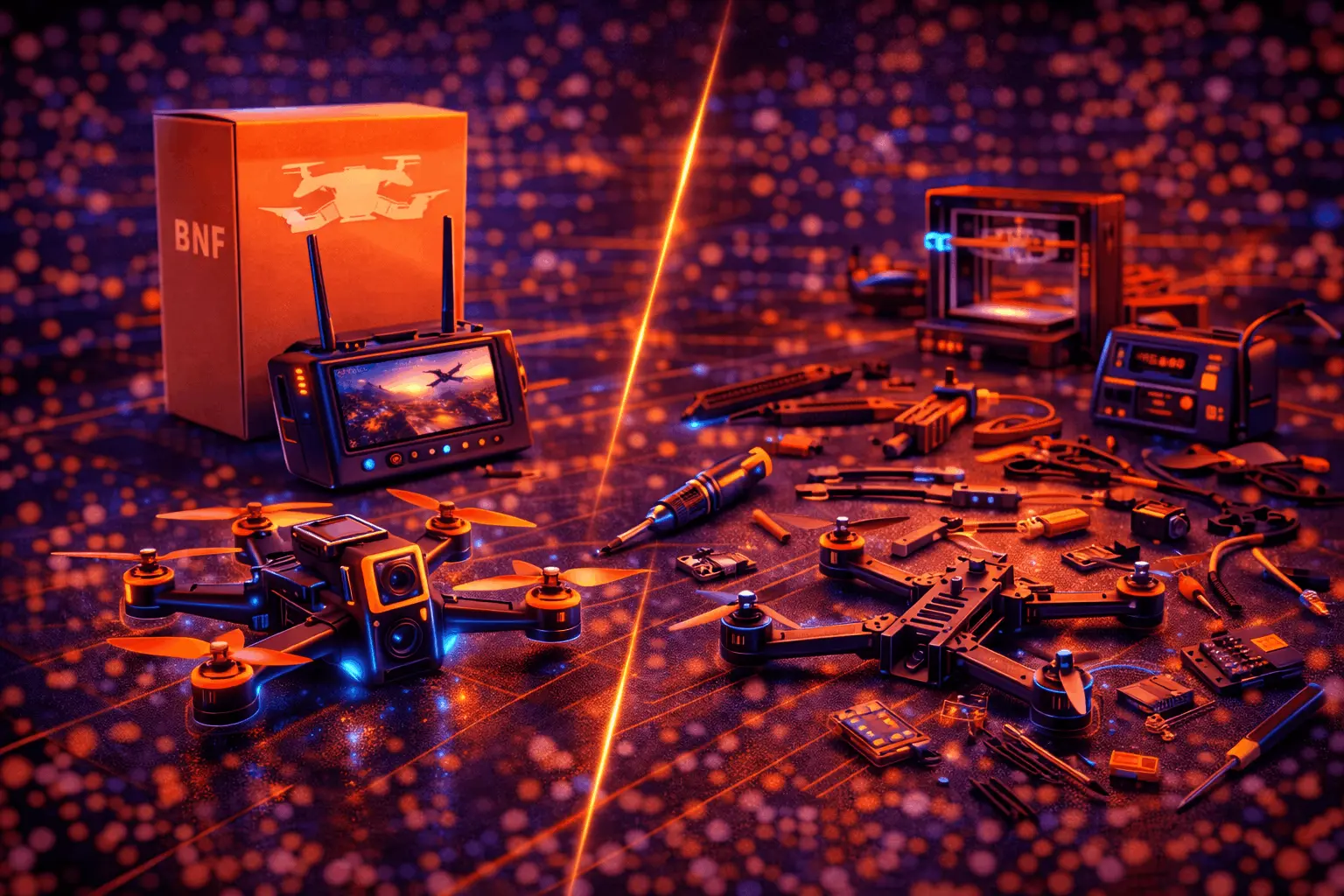
A BNF drone arrives fully assembled and factory-tested. Frame, motors, flight controller, ESC, FPV camera, and video transmitter — all installed, soldered, and configured. You unbox it, charge a battery, bind your radio, and fly.
A typical BNF includes the complete assembled quad with propellers. What it does not include: your radio transmitter, FPV goggles, LiPo batteries, and a charger. You still need these peripherals regardless of which path you choose.
What Does Building Mean?
Building means selecting each component individually — frame, motors, ESC, flight controller, camera, VTX, receiver — sourcing them from different retailers, and assembling everything yourself. You solder every connection, configure Betaflight, bind the receiver, and test before flying.
You’ll need tools: a decent soldering iron (TS101 or Sequre S60 are the go-to options), solder and flux, hex drivers, wire strippers, and a multimeter. Plus patience. Your first build won’t go perfectly, and that’s fine.
The payoff? You control every decision. Prefer a lightweight frame for freestyle? Done. Want premium motors but a budget camera? Your call. Building gives you total flexibility over the final machine.
The Middle Ground
These aren’t the only two options. Plenty of pilots take a hybrid approach:
Kit builds bundle pre-selected components you assemble yourself — less research, same hands-on experience. Modified BNF means buying a finished quad and swapping specific parts over time (new motors, better camera, different VTX). And the most common progression for long-term pilots: start BNF, learn your preferences through flying, then build a custom quad once you know exactly what you want.
Cost Comparison: The Honest Numbers
BNF Pricing (2026)
For a 5-inch freestyle quad — the most popular all-around size:
| Category | Price Range | Examples |
|---|---|---|
| Analog BNF | $250–$400 | GEPRC Mark5 Analog, iFlight Nazgul Evoque F5 V2 Analog |
| Digital BNF (DJI O4) | $500–$630 | GEPRC Mark5 O4 Pro ( |
| Premium Digital BNF | $600–$700+ | iFlight Nazgul Evoque F5 V3 w/ GPS, DeepSpace Seeker5 DC |
What you’re paying beyond components: assembly labor, factory testing, quality control, and warranty support. That labor premium is real, but it’s not as large as people think — manufacturers buy components at scale, which offsets some assembly cost.
Building Costs (2026)
Analog 5-inch freestyle build:
| Component | Price Range | Notes |
|---|---|---|
| Frame | $40–$80 | Source One V5, Mark5 frame kit, TBS Source One |
| Flight controller | $40–$60 | F722-based FC with ICM42688P gyro |
| 4-in-1 ESC | $40–$60 | 45A–55A BLHeli_32 |
| Motors ×4 | $60–$100 | 2207 1800KV (6S) or 2450KV (4S) |
| FPV camera | $25–$50 | Caddx Ratel 2, Foxeer Razer |
| Analog VTX | $25–$50 | 800mW–1.6W output |
| Receiver | $15–$30 | ELRS receiver — best value in 2026 |
| Props (5+ sets) | $10–$15 | Gemfan 51466 or HQ Ethix S5 |
| Hardware/wires | $15–$25 | XT60, capacitor, zip ties, heat shrink |
| Component total | $270–$470 | ~$350 typical analog build |
Adding digital video:
- DJI O4 Pro Air Unit: +$200–$260
- Walksnail Avatar HD: +$120–$180
- HDZero: +$130–$190
- Digital build total: $470–$730
Tools (one-time investment):
| Tool | Price | Why You Need It |
|---|---|---|
| Soldering iron (TS101/Sequre) | $50–$80 | Temperature-controlled, fine tip essential |
| Solder + flux | $15–$25 | 63/37 leaded solder, flux pen |
| Hex driver set | $15–$30 | M2, M2.5, M3 — you’ll use these constantly |
| Wire strippers | $10–$15 | 20–28 AWG sizes |
| Multimeter | $20–$40 | Continuity testing saves hours of debugging |
| Helping hands/vise | $10–$20 | Third hand for holding boards |
| Misc (heat shrink, tweezers) | $10–$20 | Consumables |
| Tool total | $130–$230 | One-time cost, lasts years |
First Quad: Real Cost Comparison
| Path | Drone Cost | Tools | Total |
|---|---|---|---|
| Analog BNF | ~$300 | $0 | ~$300 |
| Analog build | ~$350 | ~$170 | ~$520 |
| Digital BNF (O4) | ~$530 | $0 | ~$530 |
| Digital build (O4) | ~$550 | ~$170 | ~$720 |
The myth that building is cheaper? It’s wrong for your first quad. When you factor in tools, building costs $150–$200 more. The “building saves money” crowd already owns a soldering iron and doesn’t count their hours of research time.
When Building Does Save Money
Building becomes cost-effective from quad #2 onward — tools are already purchased, you know which components matter, and you avoid paying the assembly premium. By your third build, you’re genuinely saving $50–$100 per quad versus BNF equivalents. Over a few years with multiple machines, the math swings decisively toward building.
Bottom line: choose based on what experience you want, not cost savings. If you’re building one quad to try FPV, BNF is the smarter financial play. If you’re committed long-term, building pays off eventually.
Time Investment
BNF: Flying Today
Unbox, charge a battery (about an hour of passive waiting), bind your receiver to your transmitter (10 minutes if you follow the manual), verify radio settings, do a quick preflight check. Total active time: under an hour. Most BNF pilots are flying the same afternoon they receive their quad.
All your mental energy goes straight to stick time. No debugging motor direction, no fighting Betaflight configuration, no cold solder joints to rework. You’re learning to fly while builders are still waiting for parts to ship.
Building: Weeks, Not Hours
Realistic first-build timeline:
| Phase | Duration | Reality Check |
|---|---|---|
| Research and parts selection | 3–10 hours | Decision paralysis is real. “Which FC?” spirals into weeks. |
| Waiting for shipping | 3–14 days | Multiple retailers = multiple shipping windows |
| Assembly and soldering | 4–8 hours | First solder joints take 3× longer than they should |
| Betaflight configuration | 1–3 hours | Overwhelming the first time, routine by the third |
| Troubleshooting | 0–10+ hours | Motors spinning wrong way, receiver not binding, mystery smoke |
| Total | 10–30+ hours across 2–4 weeks | Everything going smoothly: 2 weeks. Murphy’s Law: 4–6 weeks. |
Experienced builder timeline: 3–5 hours from parts on table to maiden flight. The gap between first and second build is enormous.
The Real Question
BNF is obviously faster. The actual question is: what do you want to spend your limited hobby time doing?
If you have 6 hours a week for FPV and you want all of them in the air — BNF is the obvious choice. If you enjoy the building process itself (and plenty of people genuinely do), the time investment isn’t wasted — it’s part of the hobby.
Don’t let anyone guilt-trip you about “not being a real pilot” because you fly BNF. The quad doesn’t know who soldered it. A pilot ripping 10 packs a week on a BNF develops skills faster than someone who spends half their hobby time building and troubleshooting.
Skill Development: What Each Path Teaches
What Building Gives You
Building front-loads the technical learning. You come out understanding how the electrical system works: how motors, ESC, and flight controller communicate; how receiver protocols function; why certain components pair well together. You learn soldering through necessity, and that skill pays dividends every single crash.
The biggest advantage? Repair self-sufficiency. When you’ve built a quad from bare components, post-crash repair isn’t intimidating. You know where every wire goes. You can diagnose a dead motor, swap a damaged ESC, or reflash firmware without sending the quad back to the manufacturer. That midnight crash? You’re back in the air by morning.
Building also develops systematic troubleshooting habits. When your quad won’t arm, you learn to work through the chain: power → FC → receiver → motors → configuration. That diagnostic process becomes second nature and transfers to every quad you’ll ever touch.
What BNF Gives You
BNF lets you pour 100% of your early mental bandwidth into flying. No split attention between assembly frustration and stick skill development. You progress faster through flight modes, learn throttle management sooner, and attempt freestyle tricks earlier.
You also get a reference machine — a properly built, factory-tested quad that flies correctly. When you eventually open it up for repairs or modifications, you can study professional assembly quality: clean wiring runs, proper solder joints, tidy component placement. That’s a learning template you can replicate later.
The Inevitable Truth
You will need repair skills regardless. FPV crashes are a when, not an if. Whether you fly freestyle, race gates, or cruise cinematic lines — eventually an arm breaks, a motor dies, or a wire shakes loose. BNF doesn’t exempt you from learning soldering; it just delays it.
The pragmatic approach: commit to learning three core skills within your first year, no matter which path you start on:
- Soldering — motor swaps, wire repairs, receiver installation
- Betaflight basics — receiver setup, PID adjustments, failsafe configuration
- Multimeter diagnostics — continuity checks, voltage testing, finding shorts
These three skills handle 80% of common FPV problems. You can pick them up from YouTube tutorials and practice on your own gear when issues come up.
Customization and Component Choice
BNF Limitations
When you buy BNF, you’re accepting the manufacturer’s component decisions. These are usually solid choices — brands like iFlight, GEPRC, and Diatone know how to spec a freestyle quad. But they’re optimized for mass appeal, not your specific preferences.
Easy to change on a BNF: props (5-second swap), software settings in Betaflight, camera angle, battery choice. Hard to change: motors (requires desoldering every connection), frame geometry (essentially a full rebuild), FC/ESC stack (major surgery), video system (depends on mounting).
After a few months of flying, you’ll develop opinions. Maybe you want lighter weight for snappier freestyle. Maybe you prefer more motor authority for aggressive recoveries. A BNF quad doesn’t adapt to those evolving preferences — it’s a fixed package.
Building Freedom
When you build, every component reflects your priorities. Want an ultralight freestyle ripper under 400g AUW? Choose a minimal frame and titanium-shaft motors. Prefer a tank that survives bando sessions? Go 6mm arms and reinforced standoffs. Need long flight times for cinematic work? Optimize for efficiency with lower-KV motors and efficient props.
The flip side: too much choice paralyzes beginners. If you don’t yet know the difference between 2207 and 2306 motors, or why ESC amperage ratings matter, the freedom to choose everything becomes overwhelming. That’s why the “BNF first, build second” progression works so well — you develop preferences through flying before you need to make component decisions.
Repair and Maintenance Reality
BNF After Crashes
Simple repairs like prop swaps are trivial. But the first time you crack an arm or kill a motor, you face a choice: learn to solder or pay someone else. Arm replacements and motor swaps both require desoldering and resoldering — there’s no plug-and-play shortcut for most BNF quads.
Manufacturer warranties typically cover 30–90 days and explicitly exclude crash damage. Since crashes are the primary cause of repairs in FPV, warranty protection has limited practical value. Don’t choose BNF expecting the manufacturer to fix your crashes.
Builders After Crashes
You built it. You know where every solder joint is. Diagnosing a dead motor takes minutes, not hours. You keep spare motors, spare arms, and extra ESCs on hand because you ordered extras during the original build. The midnight crash at your favorite flying spot doesn’t mean waiting a week for a repair shop — you fix it at home and fly the next morning.
Over two years of active flying, you’ll deal with dozens of crashes. Each repair reinforces your skills. Builders develop a compounding knowledge advantage: by year two, diagnosing problems feels automatic.
Smart Approach for Either Path
Budget for repairs from day one. Set aside $50–$100 for spare motors, arms, and props. Accept that soldering is in your future regardless. If you start BNF, don’t wait for catastrophic failure to pick up the iron — practice basic joints on scrap wire after a couple months of flying. Proactive learning beats emergency cramming.
Which Path Fits You?
Go BNF If You…
- Have limited hobby time and want every available hour in the air
- Aren’t sure FPV is for you and want lower financial risk to test the waters
- Genuinely don’t enjoy building — forcing yourself to build when you’d rather fly just creates resentment
- Want a proven, tested machine without debugging assembly mistakes
- Are buying gear for a kid — check out our teaching kids FPV guide for age-appropriate recommendations
Solid BNF starting points: the GEPRC Mark5 (analog or O4 Pro) offers excellent value. The iFlight Nazgul Evoque F5 V3 with DJI O4 is a proven performer. For beginners on a budget, the BetaFPV Cetus Pro kit gets you flying for under $300 with everything included.
Go Build If You…
- Enjoy tinkering as much as (or more than) flying — the build process is half the fun
- Already own tools or a workshop setup
- Want deep technical understanding from day one
- Plan to build multiple quads over the coming years — the cost savings compound
- Have specific performance requirements that no BNF matches
- Have a mentor or local community that can guide your first build — check your local MultiGP chapter for support
Our complete build guide walks through every step. You’ll also want to read the soldering guide and Betaflight configuration guide before starting.
Genuinely Unsure? Start BNF.
This is solid, no-regret advice. BNF gets you flying immediately, and you can always build quad #2 once you understand what you actually want from a machine. You lose nothing by sequencing flight experience before building experience. Many of the best pilots I know started on a BNF and built their second or third quad after flying for 6 months.
Frequently Asked Questions
Is building really cheaper than BNF?
Not for your first quad. Tools add $130–$230 to your first build. Component costs are roughly equivalent to BNF pricing because manufacturers buy at scale. Building becomes cheaper from quad #2 onward, and the savings grow with each subsequent build. Choose building for control and learning, not cost savings.
I’ve never soldered — can I build a first quad?
Yes. Soldering is a learnable skill, not innate talent. Your first joints will be ugly but functional. Watch FPV-specific soldering tutorials, practice on scrap wire, and use a temperature-controlled iron with quality 63/37 solder. Start with the large motor pads before attempting smaller FC connections. Budget extra time for your first build — the learning curve is steepest at the beginning.
Will I need repair skills if I buy BNF?
Absolutely. Crashes are inevitable, and motor swaps, arm replacements, and wire repairs all require soldering. The only difference is timing: builders learn before flying, BNF pilots learn when something breaks. Plan to develop basic soldering and Betaflight skills within your first year regardless of which path you choose.
How long does a first build actually take?
Realistically 2–4 weeks from ordering parts to maiden flight. Active hands-on time is about 6–10 hours for assembly plus configuration. Most of the calendar time is waiting for parts to arrive and researching how to do each step. Everything going smoothly: 2 weeks. With unexpected problems: 4–6 weeks. Experienced builders finish a complete build in an afternoon.
Which BNF drones are worth buying in 2026?
For 5-inch freestyle with digital video, the GEPRC Vapor D5 with DJI O4 Pro ($500) offers arguably the best value right now. The iFlight Nazgul Evoque F5 V3 with O4 ($600+) is a proven performer with a switchable DC/X frame. The GEPRC Mark5 O4 Pro (~$520–$560) remains popular for its lightweight design. For analog, the Nazgul Evoque F5 V2 Analog and Mark5 Analog (under $400) are solid options. Stick to established brands — iFlight, GEPRC, Diatone, BetaFPV — and check recent YouTube reviews for each specific model.
Can I upgrade a BNF over time?
Somewhat. Props, receiver, battery choice, and camera angle are easy changes. Camera and VTX swaps require soldering but are manageable. Motors and frame changes essentially rebuild the quad. Most pilots find it more efficient to fly BNF stock, then build a second custom quad tailored to their preferences, rather than heavily modifying the original BNF.
Making Your Decision
Step 1: Be honest about your priorities. If you want to fly above all else, BNF is the right call. If building and understanding machines brings you genuine satisfaction, build.
Step 2: Assess your situation. Limited time? BNF. Already own tools and enjoy workshop projects? Build. Tight budget for a single quad? BNF. Planning multiple builds over years? Building pays off.
Step 3: Don’t overthink it. Both paths lead to the same place — an FPV pilot who crashes, repairs, flies again, and loves every minute of it. The best drone is the one that gets you in the air. Welcome to FPV.
Shop BNF Drones and Build Components
Ready to buy BNF:
Ready to build: